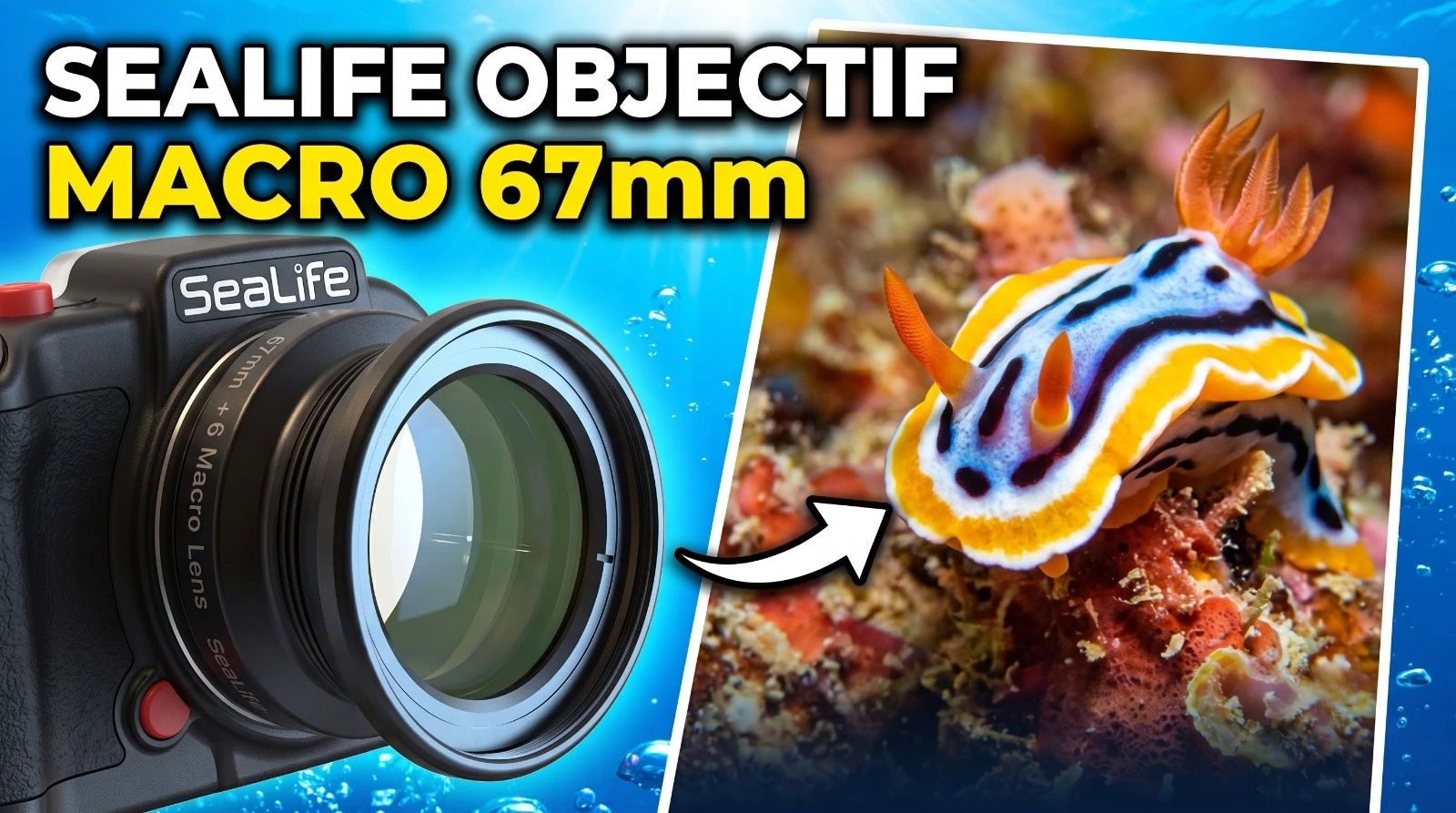
The SeaLife 67mm +6 macro lens lets you focus as close as 5 cm underwater with a smartphone in a SportDiver housing. The real limitation is the autofocus you cannot control. A clear-eyed look at what works and what doesn''t.
Macro photography underwater is one of the most demanding disciplines there is. Not because the equipment is complex - because everything happens 5 centimeters from a living subject, in a medium that moves constantly, with a photographer who breathes and drifts.
The SeaLife 67mm +6 macro lens opens that possibility for a smartphone in a SportDiver housing. Understanding what it gives you - and what it doesn't fix - is what makes the difference between a useful purchase and a frustrating one.
A +6 diopter close-up lens placed in front of an existing optic modifies the minimum focus distance. Without the lens, the SportDiver cannot achieve true macro working distances - the focus near limit is too far from the subject for serious macro work. With the +6 lens, that minimum drops to 5 cm from the lens element.
At 5 cm, a 3 cm nudibranch fills a significant portion of the frame. A pygmy seahorse on a gorgonian branch becomes properly visible. An egg mass on coral can be photographed with enough detail to identify the species.
The lens mounts via the SportDiver lens adapter (sold separately if you don't already have it) to the 67mm port. It's also compatible with any other housing accepting 67mm threads - including the DiveVolk with an appropriate adapter.
Macro on a smartphone through a SeaLife housing has one structural limit: autofocus.
SeaLife's proprietary app does not allow manual focus point selection. At 5 cm working distance, depth of field is measured in millimeters. The autofocus chooses which millimeters it decides to put in focus.
On a completely static subject against a neutral background, the autofocus can succeed. On a moving nudibranch in a field of gorgonians, on a pygmy seahorse whose eye sits behind a coral branch, on a shrimp at the entrance to its burrow - the autofocus will often pick the wrong millimeter. Not always. Often enough to matter.
This is a limitation of the proprietary app and the SportDiver system, not of the 67mm lens itself.
On cooperative subjects - fixed egg masses, slow-moving nudibranches, sponges, algae - the SportDiver plus 67mm macro lens produces correct results. For an underwater photographer who wants to explore macro occasionally without investing in a dedicated compact with a proper macro port, it's an accessible entry.
If macro is your primary practice, a setup that keeps the phone's native app accessible (the iPhone with DiveVolk, for example) will let you lock focus manually. The frustration of missed focus at 5 cm working distance disappears when you control where the camera focuses.
At AquaExposure, we teach macro with active focus control. It's a skill you build - and to build it, you need to be the one choosing the focus point.
Yes. It threads onto any 67mm port. It works with the SportDiver lens adapter, but also with the DiveVolk and other housings that accept the 67mm thread format. If your housing has a 67mm port, this lens is compatible.
No - and this is the main limitation of the combination. SeaLife's proprietary app does not allow manual focus point selection. At 5 cm working distance, depth of field is only a few millimeters. The autofocus decides where those millimeters land.
5 cm from the lens element. This is enough for nudibranches, pygmy seahorses on gorgonians, egg masses, and small crustaceans. Without the lens, the SportDiver's minimum focus distance makes true macro impossible.
Technically yes, but the constraints are more demanding than for still photography. At 5 cm working distance, any movement - housing or subject - takes the frame out of focus. For first use, still photography at macro distances is far more instructive than video.