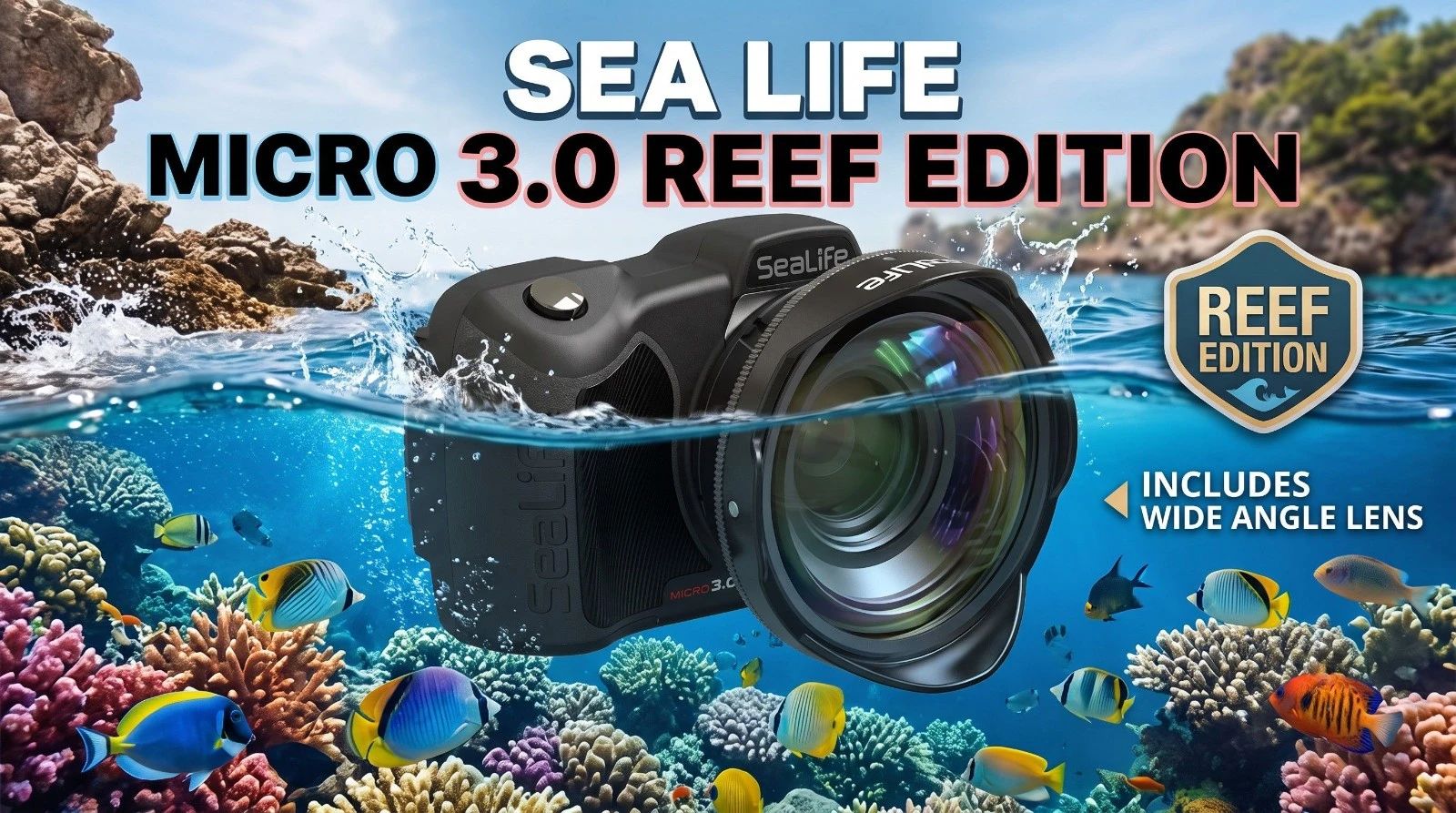
The Micro 3.0 Reef Edition is permanently sealed to 60 meters with no O-ring to maintain. Wide-angle dome lens included, 16MP, 4K, RAW support. At 1129 euros, who is this camera actually for?
There are two types of underwater photographers. Those who want total control over every parameter. And those who want a reliable, correct image with minimal preparation. The SeaLife Micro 3.0 Reef Edition is built for the second group - deliberately, not patronizingly.
The Micro 3.0 is not a housing for your smartphone. It's a standalone waterproof compact camera sealed to 60 meters from the factory. You don't open it to insert a phone. You take it out of the bag and put it in the water.
The sensor is 16 megapixels. It shoots JPEG and RAW. Field of view is 100 degrees underwater before the dome. Video goes up to 4K at 30 frames per second. Battery life exceeds 3 hours. Internal storage is 64 gigabytes.
The Reef Edition adds the wide-angle dome lens in the box. With the dome, field of view increases by 40% and minimum focus distance drops to 12.7 cm (5 inches). In practice: you can go wide on a reef or wreck, then move to a subject 12 cm from the lens without changing anything.
Price: 1,129 euros.
The SportDiver is a housing for your smartphone. The Micro is a camera. The implications are concrete.
The Micro doesn't need a proprietary app to shoot. It has its own buttons, its own file system, its own battery. You're not dependent on your phone to take a picture underwater.
It captures RAW. The SportDiver does not.
It's sealed to 60 meters permanently - no seal to check, no risk of forgetting to grease the O-ring before a dive. The SportDiver is rated to 40 meters, with a seal exposed to manipulation every time you open it.
The Micro has its own limitations. Autofocus is automatic and cannot be manually locked on a precise point the way you can with a phone's native app via the DiveVolk. Carrying it is slightly bulkier than a smartphone housing. And the Micro's screen, while functional, doesn't match the display quality of a recent iPhone.
The Micro 3.0 Reef Edition suits divers who want something simple and reliable, who dive to 60 meters, and who prefer not to depend on their smartphone underwater.
It also works well for travelers: no phone at risk, a dedicated camera with 64GB of internal storage, minimal pre-dive preparation. A compact for someone who photographs regularly underwater but doesn't want the complexity of a mirrorless system with housing.
For beginners learning settings and technique, at AquaExposure we recommend a housing that keeps the phone's native app accessible - the iPhone with DiveVolk, for example. Training is built around native professional modes and RAW that aren't available on the Micro. It's not about quality - it's about pedagogy.
Yes. The Micro 3.0 captures both JPEG and RAW files. This is a significant advantage over the SportDiver system, which requires SeaLife's proprietary app and cannot access native RAW from a smartphone.
For many use cases, yes. The 16MP sensor with RAW capture, permanent 60m depth rating, and included wide-angle dome make it a complete system without additional accessories. The main limitation is the automatic autofocus - you cannot manually lock focus on a precise point.
The Reef Edition includes the wide-angle dome lens. Without it, the field of view is already 100 degrees underwater. With the dome, it increases by 40% and minimum focus distance drops to 12.7 cm (5 inches). If you photograph reefs, wrecks, or wide subjects, the Reef Edition is the logical choice.
No. The camera is factory-sealed to 60 meters - no accessible O-ring, no greasing, no pre-dive checks. If it develops a fault, service is handled through SeaLife's warranty and repair network.