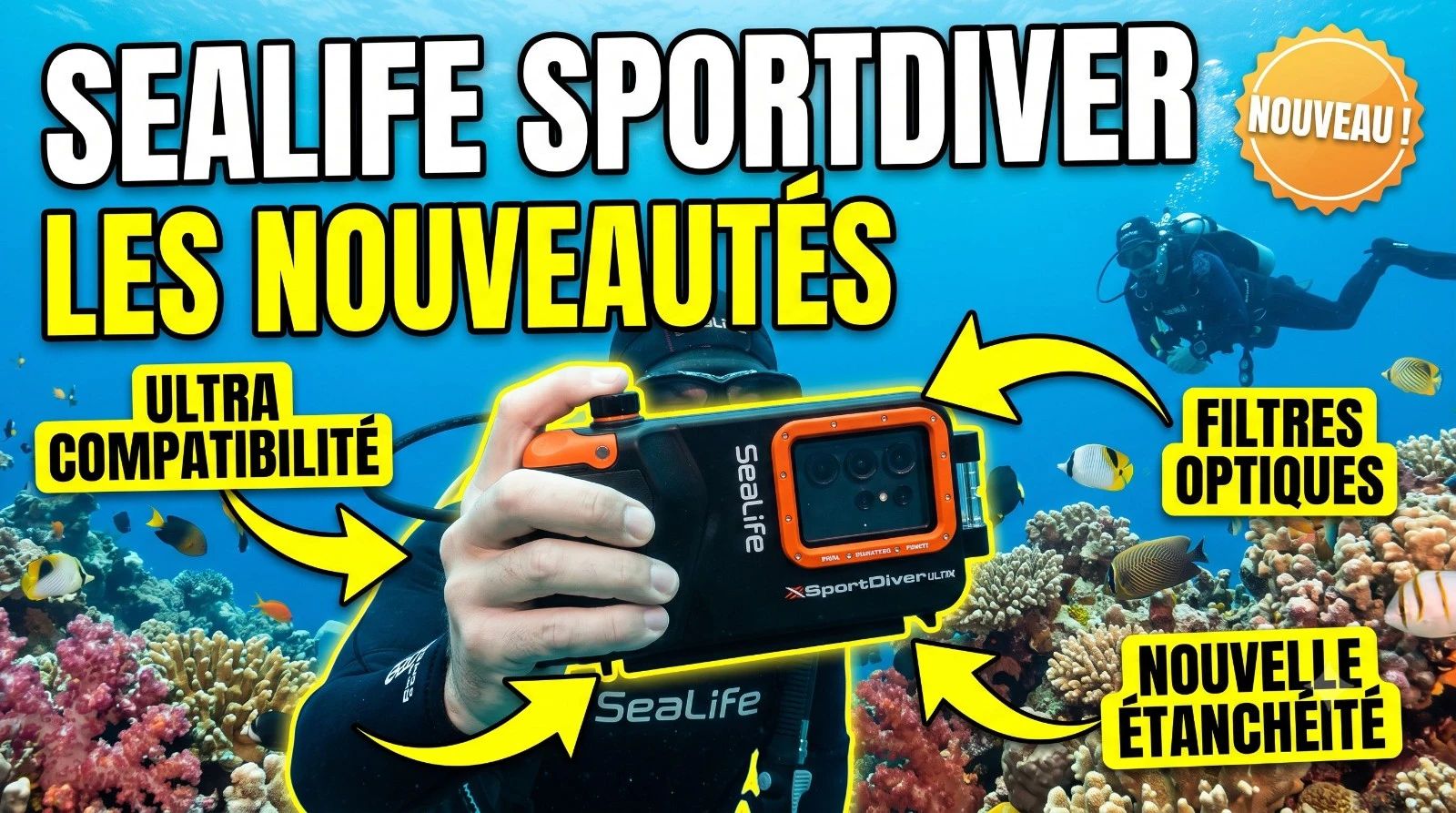
SeaLife SportDiver 2026: The Updates Are Real, the Limits Too
SeaLife relaunches the SportDiver in July 2026 with 7 new products via SCUBAPRO. An honest review of improvements and field limitations - and why AquaExposure still recommends DiveVolk for training.
Is the SeaLife SportDiver 2026 compatible with all iPhones?
The SportDiver 2026 is compatible with iPhones from model 8 up to the iPhone 15 Pro Max. As with all previous generations, compatibility with very recent models depends on a SeaLife update. Check before purchasing if you have an iPhone 16 or newer.
Can you take RAW photos with the SeaLife SportDiver?
No. The SeaLife SportDiver uses the proprietary SeaLife app for triggering, which limits access to the smartphone's native formats. For RAW and full shooting control, solutions like DiveVolk or AxisGo are better suited because they leave the phone's native camera app accessible.
What is the maximum depth of the SeaLife SportDiver 2026?
The SportDiver 2026 is certified to 40 meters. The SportDiver S version goes down to 30 meters. These depths cover the majority of recreational dives.
What is the difference between SeaLife SportDiver and DiveVolk?
The SeaLife SportDiver is a standalone housing with its own sensors and dedicated app. The DiveVolk (and its equivalent AxisGo) is a waterproof membrane housing that lets the smartphone run with its native apps, meaning access to RAW, professional mode, and full autofocus control. At AquaExposure, we use DiveVolk for training because it does not limit the smartphone's capabilities.
Does the SeaLife SportDiver moisture alarm trigger frequently for no reason?
This is one of the most common field feedback points. When the housing is closed on a hot boat or in direct sunlight, the trapped air heats up and relative humidity rises, which can trigger the alarm even if the seal is perfectly intact. The new 2026 version includes an improvement to this system, but the physical principle remains the same. An alert in the water must always be taken seriously.
To learn how to get the most out of your gear underwater, discover the AquaExposure training.
SeaLife SportDiver 2026: The Updates Are Real, the Limits Too
In July 2026, SeaLife is shifting into high gear. Seven new products launched simultaneously, distribution taken over by SCUBAPRO, and a revised SportDiver featuring a brand-new electronic module. For a market where announcements are multiplying, this is a remarkable entry.
At AquaExposure, we have been training divers in underwater photography for several years. We know these housings from the inside, not just on paper. So yes, there are real steps forward in this relaunch. And there are also field limitations that we must name clearly.
The 7 New Products of July 1st, 2026
SeaLife is releasing seven products simultaneously. Here is what is in this catalog, product by product.
1. SportDiver Housing (revised) - 299 euros This is the centerpiece of the relaunch. The SportDiver housing returns with a redesigned electronic module that remains waterproof even when the door is open. In practice, a splash when inserting your phone on the boat no longer puts the circuit at risk. The dual alarm system is refined, featuring an early moisture alarm and a manometric pressure alarm. The certified depth remains at 40 meters.
2. Micro 3.0 Reef Edition - 1,129 euros The Micro 3.0 is SeaLife's all-in-one sealed compact camera, with no separate housing, no O-ring to maintain, permanently waterproof down to 60 meters. This Reef Edition directly integrates the wide-angle dome lens, which increases the field of view by 40% and allows you to get as close as 12.7 cm to the subject. This is a different positioning from the SportDiver: no smartphone, but a dedicated camera ready to dive without setup.
3. SportDiver Pro 2500 Set The updated SportDiver set paired with a Sea Dragon 2500 lumen photo-video light, certified to 40 meters. The Sea Dragon 2500 restores the warm colors absorbed by water starting from 5 meters, the most direct fill lighting for smartphone photography at depth.
4. SportDiver Ultra Duo 5000 Set - 1,229 euros SeaLife's high-end configuration. The SportDiver Ultra (the large-size model, for the most recent smartphones) combined with two Sea Dragon 2500 lights, totaling 5,000 lumens. For those who want a complete turnkey setup without looking elsewhere for lighting.
5. 67mm Macro Lens +6 A close-up lens compatible with the SportDiver lens adapter and any housing with a 67mm port. It allows focusing as close as 5 cm from the subject with high optical precision. For nudibranchs, pygmy seahorses, egg clutches, this is the type of subject this lens is made for. Pay attention to the point mentioned below regarding autofocus control.
6. Sea Dragon Mini 1200 A new compact dive light, 1,200 lumens. Miniature format, designed for divers who want lightweight fill lighting without cluttering the setup.
7. Sea Dragon Mini 1600 The slightly more powerful version, 1,600 lumens. Same compact format, battery life and beam angle to be confirmed on the first outings.
The Limitations Our Instructors See While Diving
We can appreciate the improvements and name the limitations at the same time. Here is what we observe after years of use and training.
The proprietary app restricts control. To trigger the photo or adjust settings, the SportDiver must go through the SeaLife app. This is not anecdotal: depending on the models, it blocks access to the RAW format and can limit the capture resolution. For a beginner who wants to progress, losing access to the native professional mode of their iPhone means losing part of what they paid for.
Moisture sensors trigger false alarms. The principle is physical and unavoidable. You close the housing on the boat, in full sun, where the air is 30 degrees. The housing then ends up in water at 22 degrees. The trapped air cools down, contracts, and the relative humidity rises. The result: an alarm in the first five minutes of the dive, on a perfectly sealed housing. We see it regularly. This is not a manufacturing defect, but it is a mental disturbance during the dive, exactly where you do not need one.
Front opening exposes the seal. On the SportDiver, the front face opens to insert the smartphone. The main O-ring is therefore directly exposed during every manipulation to sand grains, towel fibers, and salt crystals. Side or rear opening designs mechanically limit this exposure. This is not a deal-breaker, but it requires a more rigorous maintenance discipline.
Autofocus cannot be controlled. It is impossible to lock a precise focus point, force focus on a specific subject, or switch to manual. On a pygmy seahorse at 8 cm in a busy gorgonian background, the autofocus chooses for you. On a nudibranch during a turning tide, the autofocus chooses for you. At AquaExposure, we teach how to control focus, and that is not possible here.
The glass is the only line of defense. If the front glass gets scratched, cracks, or takes an impact during the dive, the entire session is compromised. There is no alternative. With a DiveVolk, if something goes wrong with the housing body, the smartphone can sometimes still be used otherwise. This point also concerns optics: a single glass for all situations, without the possibility of changing ports.
Our Position: DiveVolk Remains Our Recommendation
At AquaExposure, we use and teach with DiveVolk. Not because SeaLife is a bad brand, 25 years of experience counts, but because DiveVolk lets the smartphone do what it does best.
The native iPhone app remains active. RAW is available. The professional mode is accessible. The autofocus can be locked. What we teach in the training applies directly, without adapting exercises to a proprietary system.
The DiveVolk SeaTouch, in its 4 Max Plus version, goes down to 60 meters with an underwater touchscreen interface system that works through the glass. The AxisGo by Aquatech is the other market reference, more compact, for those who want a discreet setup.
This deserves to be said clearly too. There are profiles for whom the SeaLife SportDiver 2026 is a relevant answer.
If you dive occasionally, want a simple system without setting up an app, and your priority is perceived robustness and ease of handling with gloves, the SportDiver meets those needs. The alarm sensors provide psychological safety even if false alerts occur. The SCUBAPRO distribution makes it easy to access in stores and for after-sales service.
If you are starting out in underwater photography and are primarily looking to bring back clean images without worrying about settings, the SportDiver's automatic mode does the job.
It is not our recommendation for training, but it is a serious piece of equipment for relaxed use.