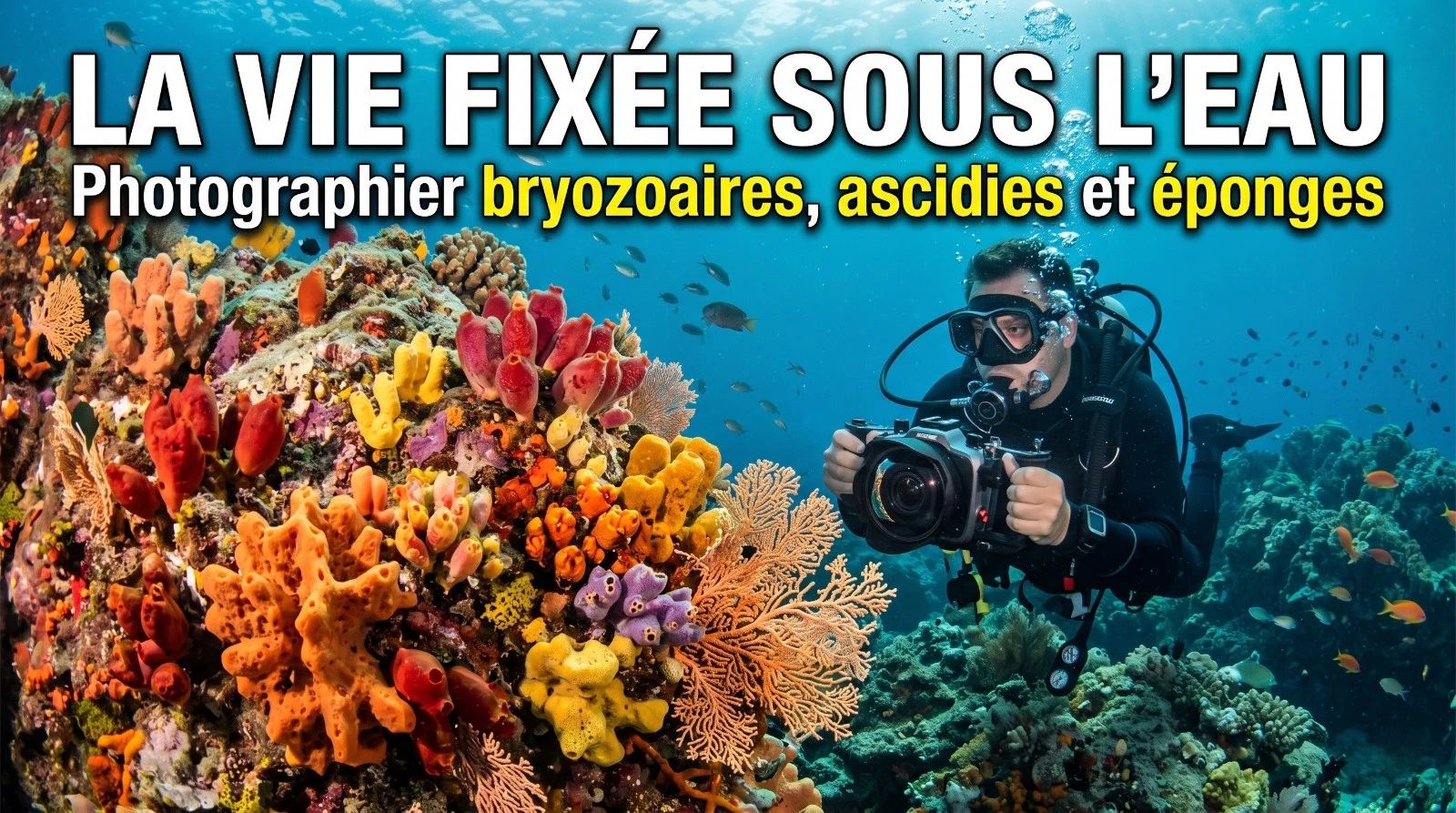
Sessile Life Underwater: Photographing Bryozoans, Tunicates and Sponges
Bryozoans, tunicates and sponges: the most patient macro subjects in the ocean. How to identify, compose and light them with zero impact on the fragile reef.
These are organisms that live attached to the substrate without moving: sponges, bryozoans, tunicates, gorgonians, hydroids. They filter water to feed and never flee. For the photographer they are the most accessible subjects, with no risk of animal stress, perfect for working on composition and light.
How do I tell a sponge, a bryozoan and a tunicate apart?
A sponge has a porous texture with visible openings through which it expels filtered water. A bryozoan forms lacy or crusting colonies made of tiny individuals. A tunicate is a small, often translucent sac with two siphons, one to draw water in, the other to push it out. Close observation reveals these details.
Do I need expensive macro gear for sessile life?
No. A close-up wet lens on a smartphone or GoPro is more than enough. Since these subjects do not move, you have all the time you need to refine focus and framing. It is the ideal subject to start macro without pressure and without costly gear.
What light brings out the textures?
A raking light, coming from the side rather than head on, reveals the relief and textures. In natural light at shallow depth, play with the angle of the sun. With a lamp, light from the side to create shadows that draw the surface. Frontal light flattens the subject and kills the relief.
Is sessile life worth documenting ecologically?
Yes. Sponges, tunicates and bryozoans are bio-indicators of habitat quality and shelter an entire microfauna. Your dated and located photos can feed citizen science programs and help monitor the state of the bottom. Sessile life is a scientific subject as much as an aesthetic one.
Why are my photos of colourful walls dull?
Three causes: light that is too frontal and flattens the relief, a distance too great that lets the water mute the colours, and a frame too wide that dilutes the subject. Get closer, light from the side, and isolate a portion of the wall instead of trying to include everything.
Can I photograph sessile life without damaging the reef?
Yes, provided you master your buoyancy and never rest fins, knees or hands on the organisms. Sessile life is fragile and slow to rebuild. You approach in open water, stabilised, without contact. It is the ideal subject to practise macro with zero impact.
To learn how to get the most out of your gear underwater, discover the AquaExposure training.
When a beginner tells me they never find a subject to photograph, I show them a rocky wall covered in sponges and tunicates, and I ask them to give me five different images of the same square metre.
During a course on the Catalan coast, I ran this exercise with a diver frustrated at always coming back with nothing. He was hunting the rare fish, the spectacular encounter, and he was swimming past a wall of colour without seeing it. I set him in front of a plain wall, full of orange sponges, lacy bryozoans and small translucent tunicates. At first he shrugged. Twenty minutes later he had made his best photos of the week, because he finally had the time to refine his focus, his light and his framing. The subject did not flee.
That is the whole paradox of sessile life. These are the most ignored and the most formative subjects in underwater photography.
The most patient subjects in the ocean
Sessile life groups together all the organisms attached to the substrate that do not move: sponges, bryozoans, tunicates, gorgonians, hydroids. They filter water to feed and spend their lives in the same place. For an animal it is a strategy. For a photographer it is a gift.
No flight, no stress, no behaviour to anticipate. You can settle, take your time, redo the same frame ten times until it is right. It is the exact opposite of a subject like the seahorse, which demands a millimetre-perfect approach, or cleaner shrimp, whose interaction is fleeting. Sessile life, on the other hand, waits for you.
This is why I recommend it as the first macro training ground, even before nudibranchs. You work on pure technique without the pressure of moving life.
Learning to recognise the groups
You photograph better what you understand. No need to be a biologist, but knowing how to tell the main groups apart changes the way you look.
Sponges
Sponges are the oldest filter feeders. Their texture is porous, pierced with openings through which they expel filtered water. In the Mediterranean you find encrusting orange, red or yellow sponges, and upright forms. Their surface offers remarkable texture abstractions in close-up.
Bryozoans
Bryozoans form colonies made of thousands of tiny individuals. Some draw fine lace clinging to walls, others crust over surfaces like embroidery. Seen up close, they reveal a fascinating, repetitive geometry.
Tunicates
Tunicates, or sea squirts, are small, often translucent sacs fitted with two siphons, one to draw water in, the other to push it out. Some live alone, others in colonial forms with bright colours. Their transparency makes them superb subjects in soft backlight.
Since the subject does not move, all the energy can go into composition. This is where sessile life becomes a true school exercise.
Isolate rather than include everything
The classic mistake is framing wide to show it all. The result is a colourful mush with no focal point. Do the opposite: choose a portion, a pattern, a colour, and build the image around it. A single well-framed sponge beats a whole badly read wall. I detail these framing principles in the underwater composition guide.
Play with abstraction
Sessile life lends itself to abstract compositions, where texture and colour matter more than the identifiable subject. A sponge surface in close-up becomes a landscape. A lacy bryozoan becomes a graphic. Use the immobility to explore this register that moving subjects never allow.
Raking light reveals everything
With sessile life, light makes all the difference, and the rule is simple: light from the side, never head on.
Why side light
A frontal light flattens the subject and erases the relief. A raking light, coming from the side, creates shadows that draw every pore, every lace, every fold. It is what gives volume and matter to the image. In natural light at shallow depth, play with the sun's position. With a lamp, shift it to the side.
Stay in natural light when you can
At shallow depth in daylight, sunlight is often enough and gives more natural renders than flash. When the wall sits in the shade of an overhang, a low intensity continuous light, placed to the side, is the best option. The no-flash doctrine applies fully here, as I explain in the article on the exceptions where flash becomes necessary.
The gear is enough, really
No need for an overpriced body. A close-up wet lens on a smartphone or GoPro does all the work, as I show in the article on macro with a smartphone and GoPro. The motionless subject gives you time to refine every setting.
The zero-impact subject
Sessile life has one last virtue, and not the least. It is the most respectful macro subject there is, on one condition: never touch it. These organisms are fragile and slow to rebuild. A fin laid down, a knee laid down, a hand laid down, and a colony years in the making disappears.
The rule is therefore identical to that of every macro subject: perfect buoyancy, approach in open water, zero contact. This body control is the foundation I work on in the housing handling exercises.
Beyond aesthetics, these organisms have real scientific value. Sponges, tunicates and bryozoans are bio-indicators of habitat health and shelter an entire microfauna. Your dated and located images can serve research, a subject I develop in the article on ethical photography and citizen science.
Start with the simplest to progress fast
Nobody becomes good at macro by hunting the seahorse straight away. You get there by spending hours on forgiving subjects, where you can miss, retry, understand. Sessile life is that ideal training ground. Once composition and light are mastered on a sponge, approaching a living subject becomes far more natural.
It is also an excellent complement to spotting macro subjects: by learning to see sessile life, you learn to see everything else. To structure this progression, from the first sponge close-up to behavioural macro, that is exactly the path we build in the AquaExposure course.
Sessile Life Underwater: Photographing Bryozoans, Tunicates and Sponges | AquaExposure