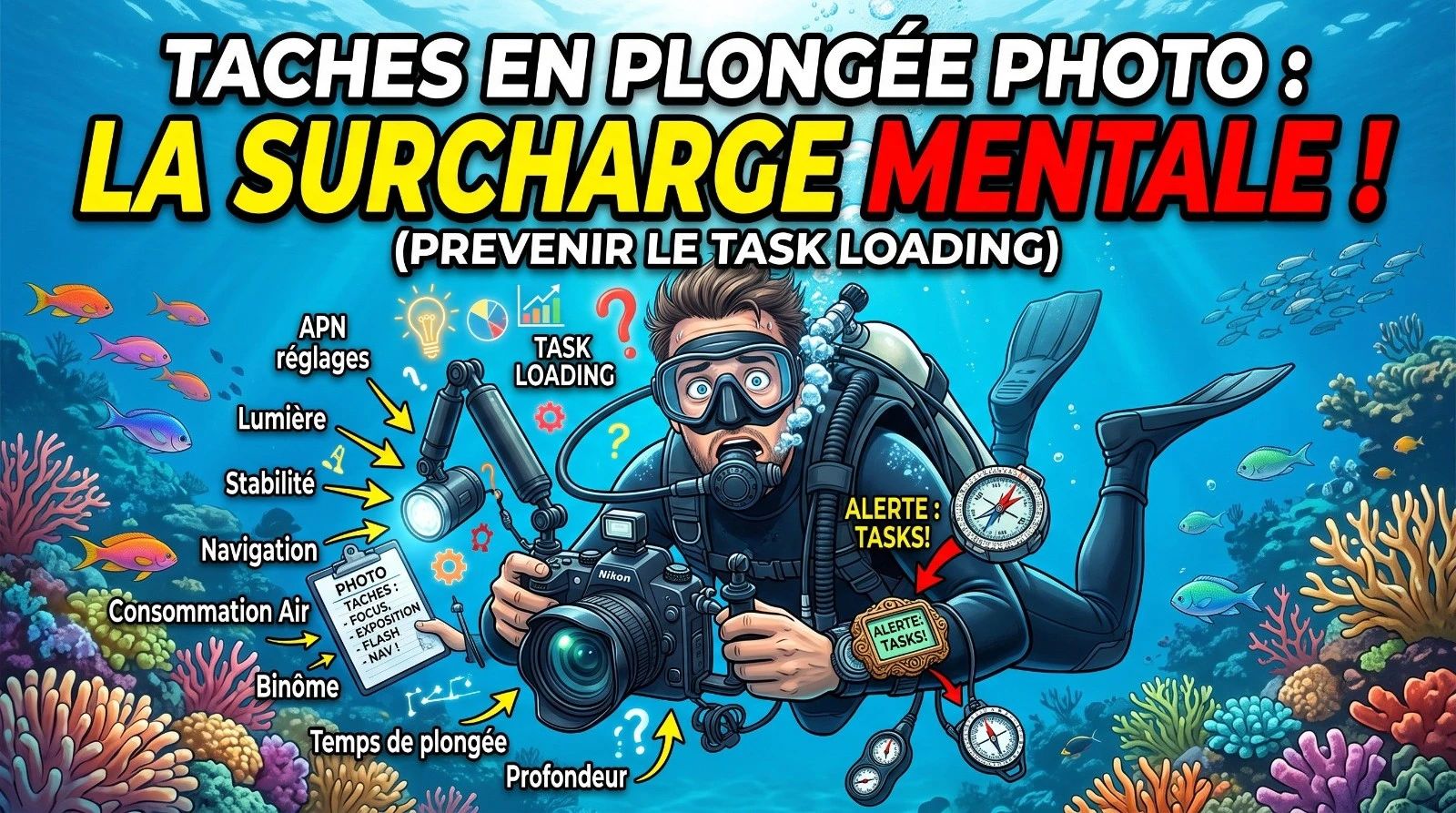
Task Loading in Dive Photography: Understanding and Preventing Cognitive Overload
Underwater photography overloads the brain with simultaneous tasks. Mechanisms, warning signs, and techniques to stay safe while improving your images.
Task loading is the accumulation of simultaneous tasks that exceeds available cognitive capacity. In standard diving, the brain already manages buoyancy, orientation, air monitoring, and buddy communication. Adding a camera stacks additional layers: exposure settings, framing, subject selection, precise positioning. When the total exceeds the threshold, the least-anchored tasks are dropped first, often safety-related ones.
How do I know if I am cognitively overloaded underwater?
Key signs: you look up and realize you do not know where your buddy is. You check your computer and the numbers take a moment to register. Your buoyancy has drifted several meters without you noticing. The most reliable test: if someone asked you a simple question right now, would there be a delay before you could answer? That delay is visible cognitive overload.
Can cognitive overload actually cause a diving accident?
Yes, and this is documented in dive safety literature. The majority of accidents involving photographers are not caused by equipment failure but by divided attention at the wrong moment: uncontrolled ascent while following a subject, exceeding depth limits without noticing, losing contact with the buddy.
Should I avoid underwater photography if I am not yet fully comfortable diving?
That is the rule I apply in AquaExposure training. Before introducing a camera, buoyancy, air management, and navigation must be genuinely automatic: not "I know how to do it," but "I do it without thinking." Those are not the same thing. Advanced certification with real dive experience is a reasonable minimum threshold.
Does automating technique actually reduce cognitive load?
That is the core principle. An automated task consumes almost no conscious cognitive resource. A diver who adjusts buoyancy without thinking frees up capacity for photography. The problem arises when diving outside your usual conditions, which can temporarily de-automate skills you thought were solid.
Does photographic technique affect task loading?
Directly. A photographer who must think through every setting consumes far more cognitive resources than one for whom ISO, shutter speed, and focus are reflexes. Progress in underwater photography is not just technical: it is a process of automation that gradually frees your brain for safety and composition.
How does AquaExposure address task loading in its training?
We work in two phases. First, dives without a camera in new conditions, to assess the real level of automation of the fundamentals. Then, progressive introduction of gear with clear protocols: one new setting per dive, regular check-in points, a systematic pre-dive checklist.
To learn how to get the most out of your gear underwater, discover the AquaExposure training.
Task loading is the accumulation of simultaneous tasks that exceeds available cognitive capacity. In underwater photography, adding a camera to the management of buoyancy, air, and navigation quickly creates this overload. The tasks dropped first are those not yet automated. Too often, that means safety.
The brain underwater: a finite resource
Every conscious action consumes cognitive capacity. At the surface, this resource feels unlimited because the environment is familiar and most actions are automated. Underwater, nothing is automatic at the start.
On a first dive, the brain runs at full capacity: buoyancy corrections, ear equalization, orientation, buddy monitoring, computer checks. With experience, these tasks become automatisms that consume little conscious resource. That is why an experienced diver looks calm where a beginner looks tense.
What task loading reveals is that this calm is fragile. It holds as long as conditions stay within familiar territory and the number of simultaneous tasks stays below the threshold.
Photography as a task multiplier
Underwater photography does not add one task. It adds a dozen.
I first really understood this mechanism during a training session in Cyprus in 2019. An experienced diver, over 200 logged dives, nervous underwater for the first time in years. He had just switched from a compact camera to a DSLR in a housing. He was managing his settings, losing buoyancy, ascending two meters without noticing, then descending again. The computer beeped. The buddy waited. He was looking through the viewfinder.
This was not negligence. It was classic task loading. Switching gear had de-automated settings that had become fluent on his previous camera. That de-automation saturated his cognitive capacity to the point where safety automatisms fell away.
Photography typically adds these simultaneous layers:
Physical level: precise movement without touching the reef, maintaining distance from the subject, body position suited to the framing.
Technical level: exposure, focus, shutter speed, ISO, white balance if shooting RAW, triggering at the right moment.
Communication level: indicating direction to the buddy, signaling a found subject, asking for time.
Each layer consumes resources. Their sum can cross the threshold.
Warning signs to recognize
Cognitive overload does not announce itself clearly. It builds gradually, and often the first person not to notice it is the one experiencing it.
Signs to watch in yourself: You check your computer and need a moment to process the numbers. You look up from the camera and realize you do not know where your buddy is, when you should have known at all times. Your buoyancy has drifted three meters without you noticing. Your computer beeps and your first instinct is to hesitate rather than react immediately.
Signs to watch in your buddy: slow or missing responses to standard signals, gaze fixed in one direction for too long, unusual buoyancy oscillations.
These are data points, not accusations. An attentive buddy recognizes them and acts.
Automation as the primary solution
The only durable answer to task loading is automation.
An automated task consumes almost no conscious cognitive resource. That is the principle behind thousands of hours of airline pilot training: not to teach them how to fly, but to make flying consume no space in their conscious mind. When an unexpected situation arises, resources are available to respond.
In dive photography, this means two distinct things.
On the diving side: buoyancy, air management, navigation, and basic buddy communication must be genuinely automatic before introducing a camera. Not "I know how to do it," but "I do it without thinking." The test is simple: after a dive with a camera, can you say how many bars you consumed in the first half of the dive without checking? If not, the fundamentals are not yet automatic.
On the photography side: your camera's basic settings must become reflexes. ISO for clear water, ISO for murky water, shutter speed to freeze motion, focus for a fast-moving subject. If you have to think each time, you consume resources. If you adjust by instinct, your brain is free for the environment and composition.
Progress in underwater photography is not just technical. It is a process of progressive automation.
The task hierarchy: a priority rule
When overload begins, the brain drops tasks, but in inverse order of their anchoring, not in order of their importance.
To counter this, I apply an explicit hierarchy in all AquaExposure training:
1. Safety: buoyancy, air, depth, buddy contact, dive plan compliance.
2. Ethics: no contact with the reef, no disturbance of subjects, no environmental damage.
This hierarchy must be internalized before entering the water, not recalled when the problem occurs. It works as a default: when you do not know what to do, return to level 1 and address what is needed before resuming the shot.
A photograph never justifies sacrificing level 1. This rule is non-negotiable.
Practical protocols to reduce load
Before the dive: the photographer's briefing
A two-minute briefing with your buddy before every dive with a camera changes the experience significantly. Where are you going, what subjects are you targeting, what signals will you use specifically for photography, what is the "I need you now" signal. This briefing externalizes some decisions and frees cognitive capacity underwater.
Every two to three minutes, lift your head from the camera. Check the computer. Locate your buddy. Verify buoyancy. It takes ten seconds. It resets the priority of information in the brain.
One new setting at a time
If you are testing a new technique or setting, do it without a subject to photograph first. No performance pressure. Just learning the setting until it begins to feel automatic. Introducing a new subject and a new technique simultaneously stacks two learning layers that cancel each other out.
A simple dive plan
A successful photo dive starts with a simple plan: maximum depth, duration, target subject type, dive zone. This plan is not a constraint. It is a decision reducer. Fewer decisions to make underwater means fewer cognitive resources consumed.
The interaction with narcosis and air management
Task loading interacts with other risk factors. Nitrogen narcosis reduces available cognitive capacity. A photographer at 30 meters without training at that depth compounds two degradation factors simultaneously.
Air management also suffers from task loading: an absorbed photographer consumes more air than usual and checks the gauge less often.
These interactions are not reasons to avoid photography at depth. They are reasons to plan each dive carefully, accounting for all parameters together.
What this means in practice
Awareness of task loading changes how you approach underwater photography.
First, it reframes the concept of experience level. Having 200 dives does not mean you are ready for a DSLR in a housing. What matters is the real automation level of your fundamentals for the specific conditions of the planned dive.
Second, it gives a framework for progression: add one layer at a time, wait until it is absorbed, then move to the next.
Third, it changes your relationship to missed shots. A sequence missed because you chose to check your buoyancy is not a failure. It is a well-managed priority.