The Ink #9 - For a century, we only knew her dead. This year, a camera watched her live.
A goblin shark filmed alive for the first time, a ghost great white found in the Mediterranean, Trinidad explores its own abyss. The Ink #9, July 2026.
Why had a goblin shark never been seen alive before 2026?
Since the species Mitsukurina owstoni was described in 1898, every known specimen came from accidental line captures. The animal died within minutes once hauled out of the cold deep water. A University of Hawai'i at Manoa team published the first in situ observations of a live individual on May 19, 2026, in the Journal of Fish Biology, filmed in 2019 near Jarvis Island and in 2024 on the Tonga Trench.
What does the capture of a juvenile great white shark in the Mediterranean reveal?
In April 2023, Spanish fishermen accidentally caught a 2.10 metre juvenile off Spain's eastern coast. A team cross referenced this capture with 160 years of records, tallying 62 documented sightings. The presence of a juvenile suggests a breeding or nursery area within the Mediterranean basin itself, reinforcing the idea that a small ghost population persists there.
What is the Trinidad and Tobago scientific expedition looking for?
From June 29 to July 28, 2026, the expedition Deep Wonders of Trinidad and Tobago and the High Seas, led by biologist Diva Amon aboard the vessel Falkor (too), explores the country's deep waters. With the ROV SuBastian, the DORIS camera and sensor system, and the autonomous vehicle Childlike Empress, the team maps the seafloor, searches for hydrothermal vents, and measures microplastic pollution in a zone where 93% of the nation's marine territory lies below recreational diving depth.
How can a diver with a camera contribute to shark science?
Programmes such as the PADI Shark & Ray Census let any diver turn an encounter into useful scientific data, provided each observation is dated and located precisely. The story of the Mediterranean ghost great white shows that an isolated sighting, kept on record for decades, can one day become decisive evidence.
The Ink is a weekly series on recent marine discoveries. The ink of writing. The anchor of the seabed. One issue, a few findings, and what they change when you dive with a camera.
"No creature on earth has a worse, and perhaps less deserved, reputation than the shark." Eugenie Clark
We are entering July 2026, and three stories about sharks and the deep intersect, without ever touching.
The first comes from the central Pacific, where a camera finally filmed an animal we thought condemned to exist only as a corpse.
The second comes from Spain, where fishermen hauled up a 160 year old ghost.
The third comes from Trinidad, where a country decided to descend and see what lives beneath its own waters.
Three scales, one lesson. What we believe extinct, or impossible to observe, sometimes just waits for us to look differently.
We had only seen her dead. This time, she was swimming.
The goblin shark carries a poor name, and an even worse reputation.
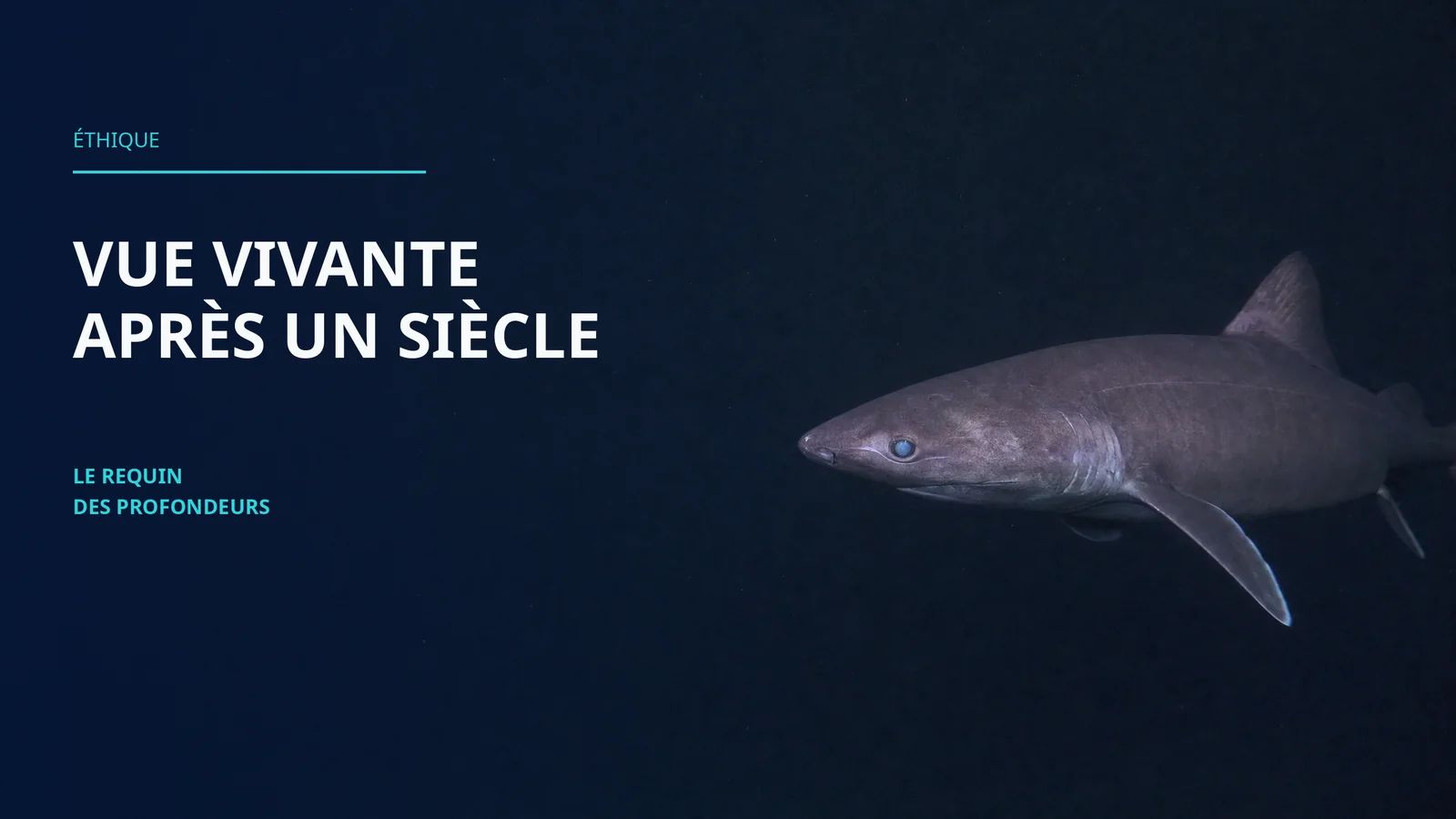
A snout as flat as a trowel, a jaw that snaps forward in a fraction of a second, skin almost pink and translucent. Since the species Mitsukurina owstoni was described in 1898, it has fed every horror image of the deep.
The problem is that no one had ever seen it alive in its own element. Every known specimen had been hauled up by accident on a fishing line, and died within minutes once out of the cold water of the depths.
A team from the University of Hawai'i at Manoa has just changed that. Published on May 19, 2026, in the Journal of Fish Biology, their study documents two encounters with the animal filmed alive, in its habitat, without ever being touched.
The first took place in 2019, near a seamount off Jarvis Island. The second in 2024, on the slope of the Tonga Trench, in the central Pacific.
In the footage, the animal moves with an almost peaceful slowness, far removed from the caricature it has carried for more than a century.
It took 128 years between the species being described and the first photo of a living individual, neither captured nor dying.
That is the real news. Not the shark. The time it took us to look at it properly.
A Mediterranean ghost for 160 years, found with a pup
In the Mediterranean, the great white shark holds a peculiar status. We know it exists. We almost never see it.
In April 2023, fishermen off Spain's eastern coast accidentally caught a young individual. About 2.10 metres, between 80 and 90 kilograms. A size that betrays an animal still far from adulthood.
A team of researchers used this capture to revisit 160 years of records and sightings. The result, published in 2026, tallied 62 documented observations across a century and a half, scattered but continuous.
The detail that matters is the shark's age. A juvenile has a limited range. Its presence suggests a birthing or nursery area somewhere within the Mediterranean basin itself, not merely a passing animal from the Atlantic.
The ghost population may never have disappeared. It simply became discreet, to the point where its continued presence had come into doubt.
What this story tells us goes beyond the great white. An isolated sighting, kept and dated over decades, can one day become evidence again. Nothing is lost as long as someone keeps recording what they see.
If you dive along the Mediterranean coastline, an encounter like this remains extremely rare. It is no longer to be ruled out.
A country dives into its own abyss
Third story, and it is unfolding right now, off Trinidad and Tobago.
93% of the country's marine territory lies below the depth reachable by recreational diving. Most of this national ecosystem remains, for now, largely unknown to its own people.
From June 29 to July 28, 2026, an expedition named Deep Wonders of Trinidad and Tobago and the High Seas is exploring this zone aboard the research vessel Falkor (too), chartered by the Schmidt Ocean Institute.
It is led by marine biologist Diva Amon, of the organisation SpeSeas, and made up mostly of Trinidadian scientists.
The team carries the ROV SuBastian, a camera and sensor system named DORIS, and a new autonomous vehicle named Childlike Empress, used here for the first time on a scientific mission.
The stated goal, map the seafloor, look for possible hydrothermal vents, document mesophotic habitats, and measure pollution from microplastics and debris.
What changes here is not only the technology. It is who holds the camera. A Caribbean nation is exploring its own underwater territory with its own researchers, rather than waiting for a foreign team to do it in its place.
What this changes for us, underwater
Three stories, three timescales. A hundred and twenty eight years for one photo. A hundred and sixty years of records to confirm a population. One month of expedition to map an entire territory.
For an underwater photographer, the common thread is simple. Patience and record keeping matter as much as gear.
The goblin shark reminds us that a species can exist without ever having been properly seen. What gets documented first shapes, for a long time, the image we build of an animal.
The ghost great white shows the value of a dated sighting, even an isolated one. A photo taken while diving, with its date and location, can sit for years before becoming a useful piece of evidence for a researcher.
And the Trinidad expedition reminds us that you do not need to travel far to find the unknown. Sometimes the most interesting abyss is the one you have never looked at, right beneath your own doorstep.
That is exactly the logic behind the PADI Shark & Ray Census, where every diver can turn an encounter into useful data for shark science. It still helps to know how to approach a shark properly before reaching for the camera.
All of AquaExposure's teaching starts from there. A well dated, well framed underwater image is never wasted, even if it waits years before it is put to use.
FAQ
Why had a goblin shark never been seen alive before 2026?
Since the species Mitsukurina owstoni was described in 1898, every known specimen came from accidental line captures. The animal died within minutes once hauled out of the cold deep water. A University of Hawai'i at Manoa team published the first in situ observations of a live individual on May 19, 2026, in the Journal of Fish Biology, filmed in 2019 near Jarvis Island and in 2024 on the Tonga Trench.
What does the capture of a juvenile great white shark in the Mediterranean reveal?
In April 2023, Spanish fishermen accidentally caught a 2.10 metre juvenile off Spain's eastern coast. A team cross referenced this capture with 160 years of records, tallying 62 documented sightings. The presence of a juvenile suggests a breeding or nursery area within the Mediterranean basin itself, reinforcing the idea that a small ghost population persists there.
What is the Trinidad and Tobago scientific expedition looking for?
From June 29 to July 28, 2026, the expedition Deep Wonders of Trinidad and Tobago and the High Seas, led by biologist Diva Amon aboard the vessel Falkor (too), explores the country's deep waters. With the ROV SuBastian, the DORIS camera and sensor system, and the autonomous vehicle Childlike Empress, the team maps the seafloor, searches for hydrothermal vents, and measures microplastic pollution in a zone where 93% of the nation's marine territory lies below recreational diving depth.
How can a diver with a camera contribute to shark science?
Programmes such as the PADI Shark & Ray Census let any diver turn an encounter into useful scientific data, provided each observation is dated and located precisely. The story of the Mediterranean ghost great white shows that an isolated sighting, kept on record for decades, can one day become decisive evidence.