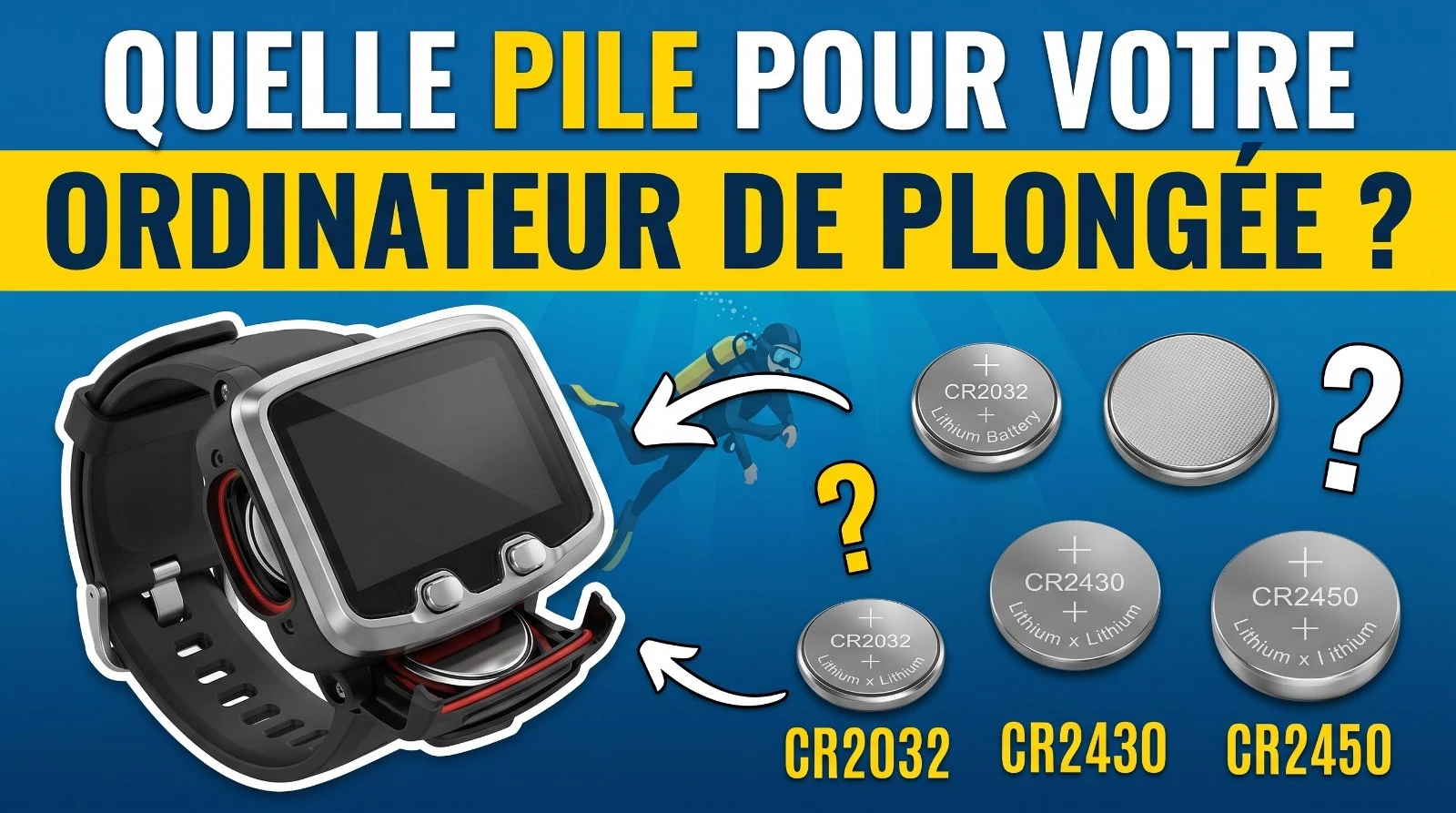
Comprehensive guide on choosing the right batteries for dive computers (CR2450, CR2430, AA). Tips for maintaining O-rings to prevent flooding.
To learn how to get the most out of your gear underwater, discover the AquaExposure Training.
1. Introduction
The sun was just beginning to rise over the Red Sea, casting a cold, metallic light on the deck of our dive boat. It was the third day of a cruise where diving sessions followed one after another.
One of my students, whose dive computer had just stopped working due to a dead battery, showed me a blinking symbol on its gray-scale segmented screen.
Thinking he was doing the right thing, he opened the watertight compartment on a table wet with salt, inserted a new battery, and quickly closed the hatch.
At the first dive, at a depth of about fifteen meters, his watch stopped working forever in a curtain of microscopic bubbles. The O-ring, which remained dry and misaligned, had just failed.
This classic incident demonstrates just how crucial it is to ensure the proper power supply for our security equipment. A single moment of carelessness can turn a high-end computer into an expensive paperweight.
2. The Great Divide: Standard Battery or Rechargeable Battery?
The diving equipment industry is currently divided into two distinct philosophies. On one side are the proponents of the standard battery that can be replaced by the user.
On the other hand, there are those who prefer rechargeable lithium-ion batteries that can be charged via a USB cable. Each of these solutions has its strengths and weaknesses in practice.
The standard battery (usually in the button cell CR2450, CR2430, or AA format) offers complete freedom while traveling. You don't need to look for an electrical outlet or worry about forgetting a proprietary charger.
In case of a breakdown, you simply need to retrieve the necessary items from your emergency kit. However, opening the compartment carries a risk of water ingress if the reassembly is not done correctly.
The rechargeable battery eliminates this risk of leakage, as the casing remains hermetically sealed at the factory. The disadvantage is the dependence on the electrical grid.
If you forget the specific connector on the boat, your photography trip will end prematurely. Furthermore, a lithium-ion battery inevitably ages over time.
When its capacity decreases, the device must be returned to the manufacturer's after-sales service for a complete replacement.
3. A Guide to Batteries by Brand
To help you navigate this technical landscape, here's a list of the formats used by the main models on the market.
Shearwater
The Canadian brand prioritizes versatility for its large cases. Legendary models like the Shearwater Perdix 2 operate with a single AA battery.
You can insert an alkaline battery, a 1.5V lithium battery, or a 3.6V Saft cell (LS14500) for increased battery life.
Models like the Shearwater Teric or the Shearwater Tern series feature a wirelessly rechargeable battery.
Aqualung
The transition is clear at Aqualung. Entry-level computers like the Aqualung i100 and the classic Aqualung i300C use a CR2450 button battery.
Models with color screens, such as the Aqualung i330R or the Aqualung i770R, use a rechargeable lithium battery.
Mares
Mares standardizes almost its entire product range with the CR2450 battery. Models such as the Mares Puck 4, the Mares Quad series, or the Mares Smart share this format.
High-end computers like the Mares Sirius or the large screen Mares Genius are now rechargeable.
Cressi
The Italian brand uses two types of button batteries. Older models, such as the Cressi Leonardo or the Cressi Giotto, require a CR2430 battery.
The recent generation, including the Cressi Donatello or the Cressi Michelangelo, uses a CR2450 battery.
Scubapro
At Scubapro, the Aladin range and the Scubapro A1 and Scubapro A2 watches use a CR2450 battery.
Larger models, such as the Galileo G2 or the recent Galileo G3, feature a rechargeable battery.
Oceanic and SEAC
Oceanic uses the CR2450 battery format for its range of consoles and wrist-mounted devices, such as the Oceanic Veo 4.0.
Similarly, SEAC uses the CR2450 battery to power the Seac Action and the Seac Screen.
4. The Golden Rule of O-rings: Avoid Submersion
Replacing the battery in your dive computer is a simple operation, but it hides a potentially fatal trap for electronics.
The vast majority of computer floods (water damage) occur during the first submersion after a battery change.
It's not the lid itself that is faulty, but the sealing gasket around it.
When you open the compartment, the O-ring undergoes deformation and accumulates invisible impurities.
A single grain of sand or a crushed hair is enough to create a leak under the pressure of the depths.
If your model allows it, always use a replacement kit that includes a new battery and a new O-ring.
!Comparison of a clean, lubricated O-ring and a pinched or dirty O-ring.jpg) (Visual guidelines: Close-up macro shot showing a black O-ring placed on the rim of a yellow plastic battery compartment cover. On the left, the O-ring is smooth and slightly shiny with silicone grease. On the right, a grain of sand is visible on the O-ring.)
If you need to reuse an existing gasket, carefully examine it with a magnifying glass to check for any cracks or deformations.
Clean the inside of the casing with a soft, lint-free cloth to remove any old salt deposits.
Lightly lubricate the seal with a thin layer of pure silicone grease. The seal should simply have a slight sheen, without excess lubricant.
Excess grease acts like a dust magnet and can cause leaks. Replace the seal without pinching or twisting it.
Screw on the lid using the appropriate tool, being careful not to overtighten and damage the plastic threads.
!The different battery formats for dive computers: CR2450, CR2430, and AA battery.jpg) (Visual guidelines: Three batteries placed side by side on a teak boat table: a thick CR2450 button cell battery, a thinner CR2430 battery, and an AA lithium battery.)
5. Anticipate so you can dive with peace of mind.
Whether you choose the simplicity of disposable batteries or the modern convenience of rechargeable batteries, your safety depends on the care taken with your equipment.
Before each trip for a long stay, test your equipment and always bring a set of spare batteries that are compatible.
To delve deeper and master the maintenance of your photographic equipment and underwater instruments, discover our comprehensive training modules on AquaExposure Training.
© 2026 AquaExposure. All rights reserved. Reproduction prohibited without authorization.
Share
Questions about the Journal
Can I use the photographs from this journal?
All images are protected by copyright. For any commercial or editorial use, please contact us via our form.
How can I be notified of new articles?
Follow us on social media or join the Sentinels Circle to receive our immersion stories before anyone else.
Do you offer hands-on workshops?
Yes, we organize masterclasses and field expeditions for members of our school. Check the Training page for details.


