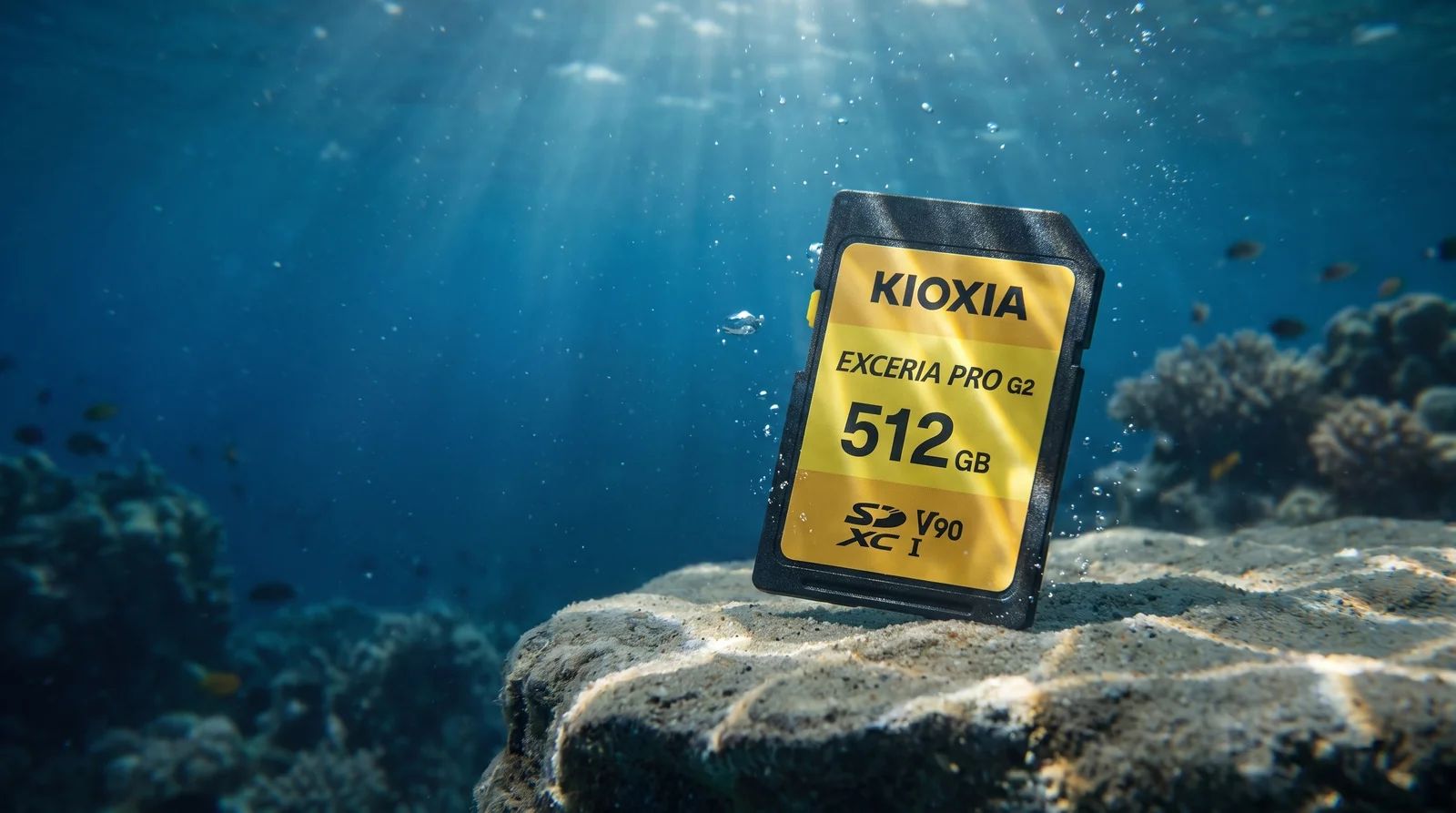
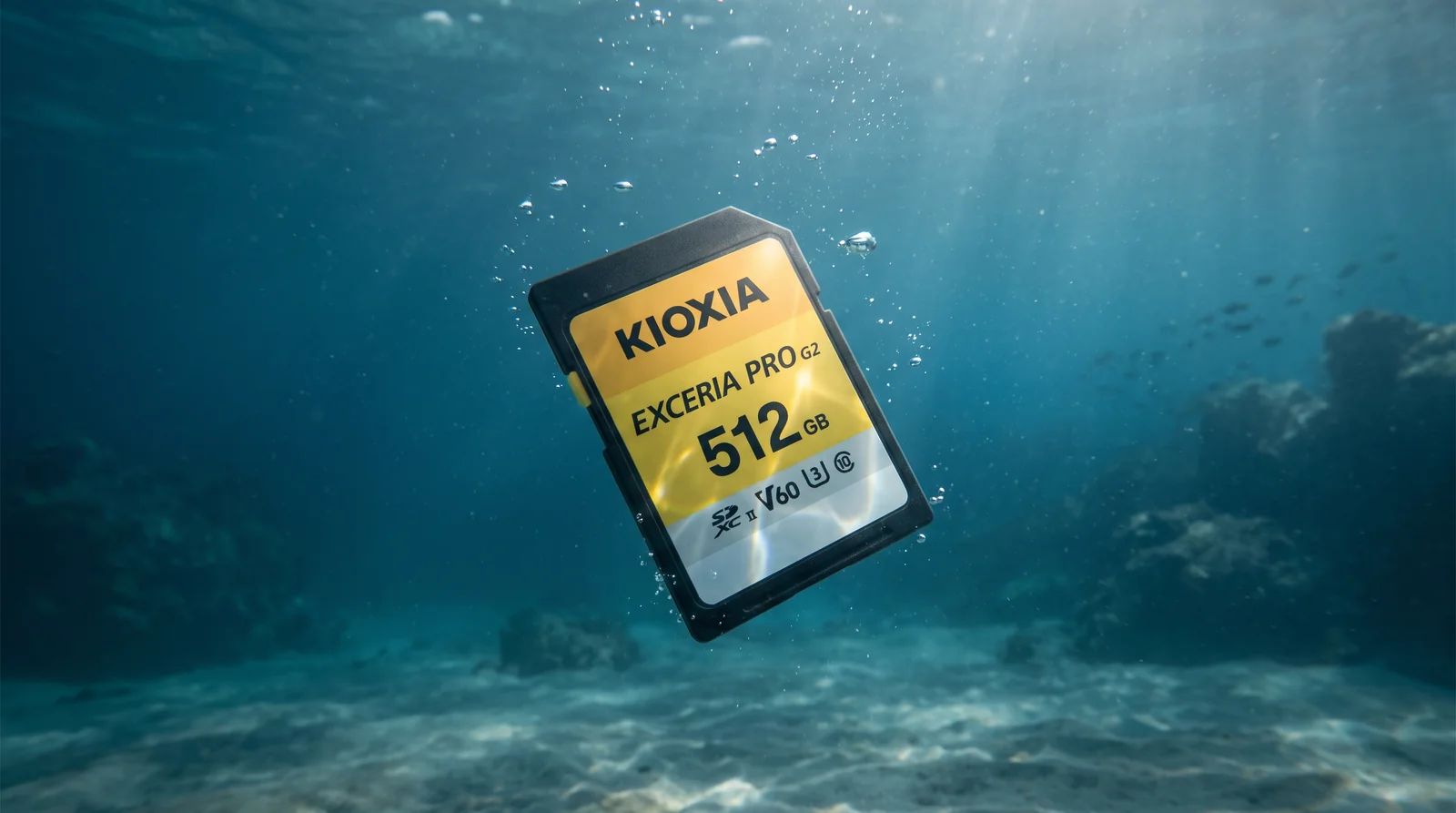
Review of the Kioxia EXCERIA PRO G2 SDXC V90: BiCS FLASH technology delivering 8K performance.
Discover the Kioxia EXCERIA PRO G2 V90 SD card. Featuring read speeds of 310 MB/s, BiCS FLASH 3D technology, and a safety fuse to protect your 8K recordings.
Is the Kioxia EXCERIA PRO G2 V90 memory card truly waterproof?
Unlike the microSD versions of the same product line, the official specifications for the SDXC format do not confirm IPX7 certification. Therefore, it is important to handle it with care when it is outside of a waterproof housing and to protect it from exposure to salt spray.
What is the performance difference between a 64GB and a 512GB storage capacity?
The read speed remains the same across the entire range at 310 MB/s. However, the maximum write speed is 300 MB/s for the 512 GB model, while it is advertised as 295 MB/s for capacities ranging from 64 GB to 256 GB.
What is the purpose of the built-in fuse in this memory card?
This internal electrical component is designed to prevent the risks of overheating or ignition in the event of an electrical surge. It thus protects the physical integrity of the card and the data stored during transfers.
To improve your mastery of your equipment and optimize your diving procedures, discover our specialized training modules on AquaExposure training.
Kioxia EXCERIA PRO G2 SDXC V90 Test: BiCS FLASH technology for 8K performance
Direct Answer (AEO / GEO) This test of the Kioxia EXCERIA PRO G2 SDXC V90 memory card validates its sustained write speed for recording 4K/8K RAW video and continuous burst shooting. Resistant to water and temperature variations, it guarantees the integrity of your underwater shots without buffer lock.
From the moment a unique scene appears in the viewfinder to the moment the files reach a secure editing station, the technical chain must not have any weaknesses. For a videographer working in 8K or a photographer capturing fast-paced action, the choice of storage medium becomes a decision of both safety and performance. Kioxia, a brand from the former memory division of Toshiba, offers with the EXCERIA PRO G2 SDXC V90 range a solution that relies on complete industrial expertise. This lineage with the inventor of flash memory ensures consistency between the controller and the storage cells, a critical point for the stability of heavy data streams [1].This UHS-II card positions itself as a tool for demanding environments. It doesn't just display high numbers on its label. It incorporates specific technological choices, such as the BiCS FLASH 3D structure and an internal safety fuse. These elements address real-world needs encountered in the field, where heat, static electricity, and data density put equipment under significant stress.
Critical Speeds for High-Resolution Video
Recording in 8K requires a perfectly consistent write speed to avoid any interruption of the capture. The Kioxia EXCERIA PRO G2 meets this requirement with a Video Speed Class 90 certification. This label guarantees that the card maintains a minimum write speed of 90 MB/s, regardless of the storage capacity [2]. This is the essential threshold for modern hybrid cameras using high-bitrate codecs.The read speeds reach 310 MB/s, accelerating the download of images. In write mode, the 512 GB model peaks at 300 MB/s, while the 64 GB to 256 GB versions achieve 295 MB/s. These values allow the camera's buffer to be cleared instantly during RAW bursts, ensuring a smooth workflow that is essential for not missing any action. This responsiveness prevents any blockage of the housing at the most opportune moment.
The BiCS FLASH 3D technology at the heart of the storage
The reliability of a memory card depends on the architecture of its chips. Kioxia uses its BiCS FLASH 3D technology, which involves stacking memory cells vertically rather than aligning them on a single layer. This three-dimensional structure increases storage density without compromising data stability. It also reduces power consumption per gigabyte transferred, a benefit for preserving battery life during extended shoots [1].This approach offers superior endurance compared to traditional flash memory. The cells better withstand repeated write cycles, a crucial factor for a storage medium that is formatted daily. Error management is ensured by a controller optimized for this structure. On expeditions, this reliability guarantees consistent performance, even when the card is nearing its maximum capacity.
Active safety thanks to the integrated electrical fuse
Data security takes on an unexpected physical form in this model. The Kioxia EXCERIA PRO G2 incorporates an internal electrical fuse, a rare component in the SD card market. This device is designed to react in the event of abnormal overcurrent. If a malfunction occurs in the camera or during connection to a faulty card reader, the fuse interrupts the electrical circuit. This action prevents excessive overheating that could irreparably damage the memory chips or cause a fire [2].This fuse provides a safeguard against unexpected electrical issues. On a boat, where voltage can fluctuate and humidity is constant, it acts as a protective barrier for your images. The electrostatic discharge protection complements this system, protecting the circuits during frequent handling between the housing and the reader. The Kioxia design minimizes the risk of damage related to these discharges by isolating sensitive circuits from the controller.
Environmental Robustness and Sealing Limits
The operating environment imposes various physical constraints. The card is certified to function within a temperature range of -25°C to 85°C. This tolerance allows for seamless operation, transitioning from the cold of a piece of equipment stored in the cabin to the tropical heat on a boat deck. It also resists X-rays according to the ISO7816-1 standard, ensuring the safety of files during airport security checks [1].A key consideration is the water resistance. Unlike microSD versions, the official documentation for the SDXC format does not confirm IPX7 certification. Therefore, it should be handled with dry hands and stored in a rigid case. The lack of certification against mechanical shocks also suggests careful handling of the enclosure to preserve its physical integrity when it is not inserted into a device.
For which photographers and videographers?
The Kioxia EXCERIA PRO G2 V90 is primarily aimed at professionals whose equipment requires very high data transfer rates. Videographers shooting in 8K or 4K All-Intra will find that the V90 certification provides the necessary assurance to secure their workflows. The 512 GB capacity is particularly relevant for longer shoots where changing the storage medium should be minimized to reduce the sensor's exposure to ambient humidity.
Action photographers can take advantage of the write speed to utilize the burst shooting capabilities of their mirrorless cameras. Quickly clearing the buffer allows you to be ready for the next moment. Finally, those who prioritize safety will appreciate the built-in fuse, a major advantage in isolated conditions where a power failure could compromise an entire production.
A rational choice for high performance.Choosing this type of memory card means opting for a proven technology that serves the purpose of creation. The balance between the speed of the BiCS FLASH memory and the protection offered by the safety fuse provides a stable working environment. The equipment fades into the background, allowing you to focus on the light and the subject.
In a marine environment, technical reliability is the foundation of any success. By using a memory card designed to meet the demands of 8K recording, you ensure that the technology remains a silent ally. Once the files are transferred and secured, there is the satisfaction of having captured a fragment of the world, supported by a tool capable of keeping pace with the elements.
[1]: https://apac.kioxia.com/en-apac/personal/sd-card/exceria-pro-g2-v90.html "Kioxia EXCERIA PRO G2 SDXC V90 specifications" [2]: https://europe.kioxia.com/en-europe/personal/news/2026/20260129-1.html "Kioxia press release on new storage solutions 2026"Visual 1: A close-up view of a Kioxia EXCERIA PRO G2 memory card inserted into the slot of a mirrorless camera, highlighting the V90 logo and the "512 GB" marking. Alt text: A 512 GB Kioxia EXCERIA PRO G2 V90 SD card in a professional camera housing.
Visual 2: A schematic illustration showing the BiCS FLASH 3D structure with its layers of cells stacked vertically for increased storage density. Alt text: A diagram of the BiCS FLASH 3D memory technology used by Kioxia.
Review of the Kioxia EXCERIA PRO G2 SDXC V90: BiCS FLASH technology delivering 8K performance. | AquaExposure