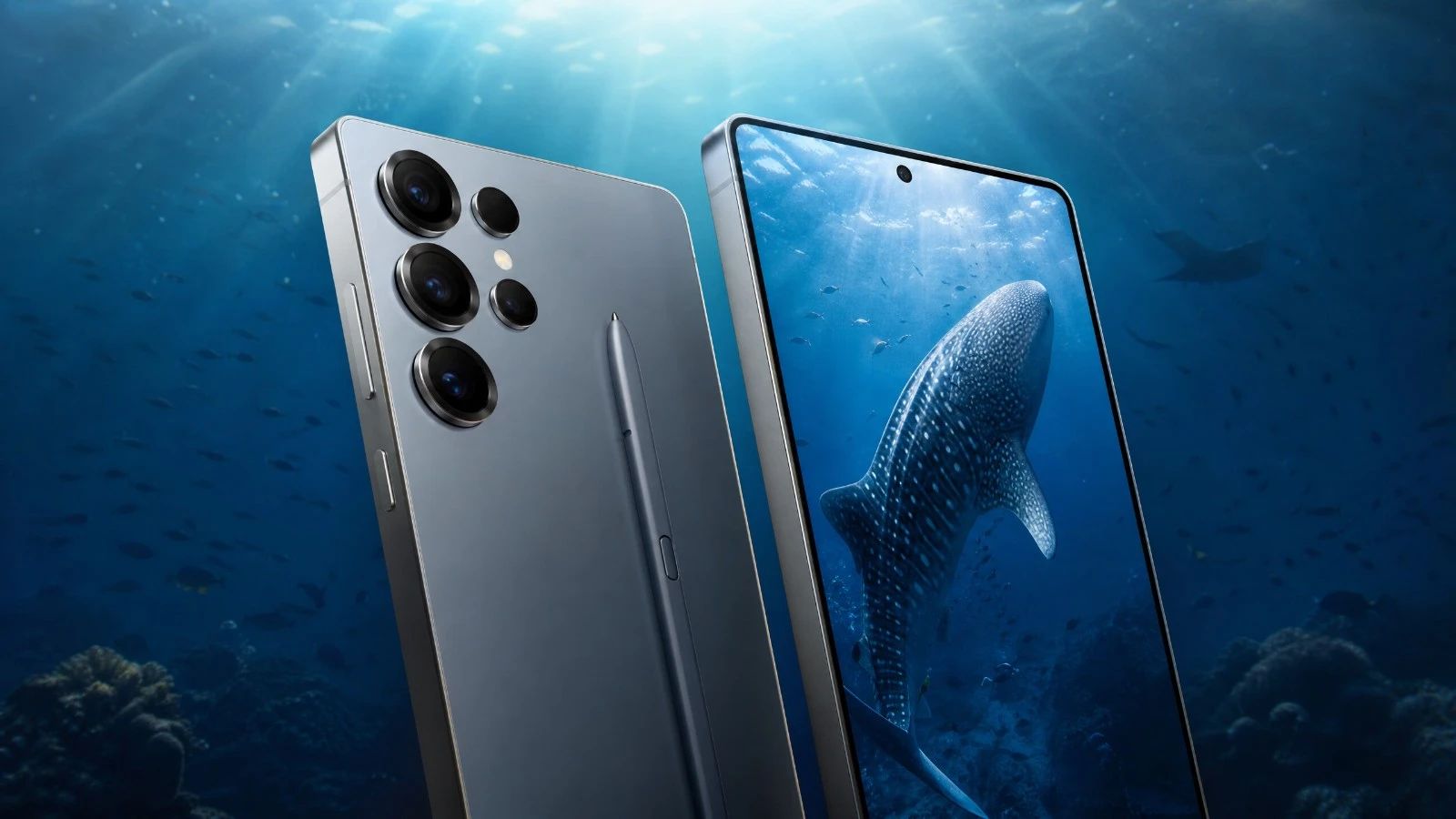
Samsung Galaxy S25 Ultra scuba dive test: IP68 rating limits (5 ft / 1.5 m) vs 196 ft (60 m) in a housing. Expert RAW 16-bit, score 3.8/5 & US housing guide.
Is the Samsung Galaxy S25 Ultra good for underwater photography?
Yes, inside a Divevolk housing. The S25 Ultra scores 3.8/5 in the AquaExposure evaluation framework. Its ultrawide lens focusing at 1.2 inches (3 cm), 16-bit RAW via Expert RAW, and full compatibility with the Divevolk SeaTouch 4 Max make it a serious natural-light underwater system down to 196 ft (60 m).
What housing should I use for the Samsung Galaxy S25 Ultra diving?
The Divevolk SeaTouch 4 Max is the reference housing for the S25 Ultra. It is certified to 196 ft (60 m), provides full gel touchscreen access, and lets you control Expert RAW and Pro modes underwater. The SeaLife SportDiver Ultra (130 ft / 40 m) and Kraken Sports KRH08 V2 (262 ft / 80 m) are premier electronic button alternatives with built-in vacuum leak check.
Can the Samsung Galaxy S25 Ultra shoot RAW underwater?
Yes. Expert RAW (a free app on the Galaxy Store) unlocks 16-bit DNG with full manual controls. For video, the native Pro Video mode offers Samsung Log (H.265) with manual Kelvin white balance.
How long does the S25 Ultra battery last on a day of three dives?
With a 5,000 mAh battery and the Snapdragon 8 Elite (3 nm process), the S25 Ultra handles three one-hour dives in active RAW mode with the screen on, with comfortable margin. Avoid repeated fast charging in cold water to preserve Li-Ion cell longevity.
IP68 Rating vs Scuba Diving Reality: The Samsung Galaxy S25 Ultra carries an IP68 certification for dust and water resistance, tested for immersion up to 5 ft (1.5 m) for 30 minutes in static fresh water. This factory rating is strictly intended for accidental drops in rain or sinks, not scuba diving. At diving depths, saltwater pressure, ocean surge, and dynamic movement will immediately bypass chassis seals. Furthermore, capacitive touchscreens cannot register touches underwater. Scuba diving requires a pressure-certified underwater housing certified to at least 130 ft (40 m) to 196 ft (60 m) such as the Divevolk SeaTouch 4 Max, SeaLife SportDiver Ultra, or Kraken Sports KRH08 V2.
There is a paradox you encounter often in underwater photographer communities.
People invest hundreds in a housing, pick the right o-ring, prep their gear carefully, and arrive underwater with a smartphone they have not really evaluated at the sensor level.
The Samsung Galaxy S25 Ultra raises that question out loud. 200 megapixels on the main sensor, an ultrawide that focuses at 3 centimeters, 16-bit RAW, Samsung Log video. On paper, this is a spec sheet that deserves the same scrutiny as a dedicated compact camera.
This test applies the AquaExposure evaluation framework, built exclusively for natural-light underwater photography. No artificial lighting: the sensor, RAW pipeline, and thermal management are the only responses to what water does to light. The question this guide answers: does the S25 Ultra hold up inside a housing, under 20 meters?
Overall Score: 3.8 / 5
Criterion
Score
What it means
Optics & sensor
3.7/5
Formidable ultrawide at 3 cm, shutter lag worth watching
RAW & color
4.1/5
Expert RAW 16-bit, Samsung Log, MotionCam Pro: a complete pipeline
Storage
3.8/5
Fast USB 3.2 Gen 2, no microSD slot, 1 TB available
Thermal
3.5/5
Titanium frame is an asset in warm water, watch cold water
Battery
3.0/5
5,000 mAh Li-Ion standard: three dives comfortable, classic cycle life
Autofocus
4.0/5
Multi-directional PDAF + AI + Focus Peaking, laser not disableable
Housing
5.0/5
Divevolk SeaTouch 4 Max: full gel touchscreen, certified 196 ft (60 m)
Best suited for: an intermediate underwater photographer who wants a serious RAW pipeline without investing in a dedicated compact, in temperate to tropical water.
Less ideal for: very cold water (increased condensation risk) and situations where trigger speed is critical (fast-moving pelagic subjects).
Optics: What the Sensor Sees Underwater
3.7/5
The S25 Ultra has four camera modules. The one that makes the real difference underwater is the ultrawide: 50 megapixels, f/1.9 aperture, focusing at 3 centimeters. That is the shortest minimum focus distance on a 50 MP ultrawide available on a smartphone today.
The main sensor (200 MP, f/1.7, 1/1.3-inch) covers wide scenes in open water. Its size sits in the 1/1.2"-1/1.4" bracket of the AquaExposure scoring table, which is a reasonable baseline for raking-light scenes at 15-20 meters.
Shutter lag is the weak point. Multiple independent tests in 2025 documented it as problematic in standard mode: a fast subject can exit the frame before the photo is actually captured. Action Shot mode improves this at the cost of higher ISO.
Technical details Ultrawide sensor: 50 MP ISOCELL JN3, f/1.9, 1/2.4-inch, MFD 3 cm. Main sensor: 200 MP ISOCELL HP2, f/1.7, 1/1.3-inch, MFD 10 cm. 3x telephoto: 10 MP IMX754, f/2.4, MFD 18 cm. 5x periscope: 50 MP IMX854, f/3.4, MFD 24 cm. OIS on all modules, plus digital hybrid stabilization. Shutter lag not published in milliseconds by any source at time of writing. Score 3 applied by default on that criterion, noted as "unmeasured."
RAW and Color: Where the S25 Ultra Stands Out
4.1/5
This is where the S25 Ultra clearly separates itself from previous smartphones in a housing. Expert RAW is a free app (Galaxy Store) that unlocks 16-bit DNG, multi-frame noise reduction, and full manual controls over ISO, shutter, focus, and white balance.
In native Pro Video mode, Samsung Log is available. The output is flat, designed for color correction in DaVinci Resolve or Lightroom. White balance instability in Log mode was reported by users at launch and has been partially addressed in subsequent firmware updates.
MotionCam Pro is available on Android GMS and provides an alternative RAW video pipeline for those who want more control over compression.
Technical details RAW format: 16-bit DNG via Expert RAW, 12-bit DNG in native Pro mode. Max video codec: H.265 Samsung Log (Samsung proprietary log profile). White balance: manual Kelvin setting in Pro Video, with firmware-related artifacts reported on some versions. ISP: Samsung proprietary, no certified Zeiss, Leica, or Hasselblad color partnership. Advanced proprietary calibration, recognized in photography reviews, but no published color profile specific to underwater use.
Storage and Transfer: Managing Files Between Dives
3.8/5
The S25 Ultra does not accept external memory cards. That is the standard trade-off for Galaxy Ultra since 2019. The upside: USB-C 3.2 Gen 2 allows transfers to a portable SSD at real-world speeds above 400 MB/s, with no computer required.
In 16-bit RAW (Expert RAW DNG), each file weighs 50 to 80 MB depending on the scene. Over one hour of active shooting with 300 releases, expect 15 to 24 GB. A 512 GB model handles a week-long liveaboard without mandatory nightly transfers. A 256 GB model requires an evening SSD transfer each day (roughly 15 minutes at USB 3.2 Gen 2 speeds).
The 1 TB model eliminates this constraint entirely.
Technical details USB 3.2 Gen 2 (10 Gbps theoretical, 400-800 MB/s real depending on the SSD). OTG compatibility confirmed: a USB-C to USB-C cable connects a portable SSD directly during surface intervals. No microSD slot, no CFexpress. Available capacities: 256 GB, 512 GB, 1 TB. For liveaboards lasting more than five days, 512 GB is the recommended minimum in active RAW mode.
Thermal Management: Condensation and Shock Resistance
3.5/5
The titanium frame of the S25 Ultra is a genuine advantage underwater. Titanium conducts heat significantly less than aluminum, which reduces the thermal differential between the inside of the housing and the optical port glass. In tropical water (25°C and above), condensation risk is well contained.
In cold water (Mediterranean in winter, Atlantic, altitude dives), the differential increases. The internal vapor chamber that dissipates SoC heat to the frame can amplify this: it creates a warm point on the chassis that contrasts with the cold air trapped inside the housing. A desiccant is essential at every dive below 15°C.
Technical details Titanium frame (low thermal conductivity) + internal vapor chamber for Snapdragon 8 Elite heat dissipation. IP68 (1.5 meters, 30 minutes) + Corning Gorilla Armor 2 glass. No documented MIL-STD-810 certification. Thermal score: 4/5 in tropical water, 3.5/5 overall accounting for cold-water condensation risk. Pressure protection from 0 to 60 meters provided by the Divevolk housing.
Battery: Endurance on a Diving Day
3.0/5
The S25 Ultra has a 5,000 mAh Li-Ion battery, with conventional chemistry and no silicon-carbon anode. The Snapdragon 8 Elite (3 nm) partially compensates with energy efficiency: in typical shooting conditions (Expert RAW active, screen on via SeaTouch), two to three one-hour dives in a day presents no autonomy problem.
The limitation is long-term cycle life. Without published manufacturer data, a standard Li-Ion battery is estimated at 300 to 500 cycles before losing 20% capacity. That is functional over 2-3 years of regular use, but noticeably shorter than the 1,000+ cycles advertised by silicon-carbon batteries in several competing flagship models in 2025-2026.
Technical details Capacity: 5,000 mAh. Chemistry: standard Li-Ion (no silicon-carbon unlike some 2025 competitors). Fast charging: 45W wired. Cold-water performance not officially documented. Field recommendation: charge to 80% maximum in regular use to extend cell life over the years.
Before each dive session, make sure your external battery is ready. Use our portable battery comparator to choose the right power bank for your housing and usage.
Underwater Autofocus: PDAF, AI, and Laser
4.0/5
The AF system combines multi-directional PDAF, AI scene recognition, and an infrared laser ToF sensor. Under typical diving conditions, with visibility and a stationary or slow subject, the autofocus is fast and reliable.
Focus Peaking is available in Pro and Expert RAW modes, providing a visual confirmation of sharpness on subjects that allow time to aim carefully. In turbid or particle-heavy water, the laser ToF sensor can lock onto suspended matter instead of the subject. Manual disabling of the laser is not clearly documented in the available firmware as of this writing.
No LiDAR (Apple Pro exclusive): physical distance measurement is not available on Android in 2025, which is a minor penalty in low-visibility water.
Technical details AF technology: multi-directional PDAF + infrared laser ToF + AI scene recognition. Laser ToF: present, manual disabling unconfirmed. Focus Peaking: available in Pro and Expert RAW. Standard mode shutter lag exceeds iPhone 16 Pro on fast-moving subjects (Android Authority, 2025). Action Shot mode improves capture speed at the cost of higher ISO sensitivity.
Housing: Divevolk SeaTouch 4 Max & US Alternatives
5.0/5
The S25 Ultra has full compatibility with the Divevolk SeaTouch 4 Max, currently the benchmark housing for smartphone diving. The gel membrane gives complete touchscreen access underwater: navigating Expert RAW, switching between lenses, adjusting ISO between shots, all from gloved hands at depth.
The housing is certified to 196 ft (60 m), covering the full recreational dive range and a portion of technical diving. Wet lens ports are available for additional wide-angle coverage and macro work.
For divers seeking electronic push-buttons with automated vacuum leak detection, the SeaLife SportDiver Ultra (certified to 130 ft / 40 m) and Kraken Sports KRH08 V2 (certified to 262 ft / 80 m) offer exceptional reliability.
In 16-bit RAW (Expert RAW DNG), each file weighs 50 to 80 MB. Over one active hour with 300 shots, expect 15 to 24 GB. A 512 GB model handles five to six shooting days without a mandatory transfer. A 256 GB model requires a nightly SSD transfer (about 15 minutes at USB 3.2 Gen 2).
Samsung Ocean Mode, accessible via Expert RAW, adds an automatic underwater color correction layer. In clear, well-lit shallow water, it reduces post-processing time. To understand its limits by depth, see our article Samsung Ocean Mode: Is It Really Useful Underwater?
Condensation in Cold Water
The internal vapor chamber transfers processor heat to the titanium frame. In very cold water (below 15°C), this heat flow can create a slight thermal differential with the cold air trapped inside the housing. A desiccant changed before each dive is the rule, regardless of water temperature.
Laser ToF in Turbid Water
In green or particle-heavy water, the infrared ToF sensor can lock onto suspended particles. Manual focus via Focus Peaking becomes the recommended approach for slow fish portraits or static subjects. See our 2026 smartphone underwater photography comparison to see how the S25 Ultra compares to the Pixel 10 Pro and iPhone 16 Pro on this point.
Our Verdict
The S25 Ultra is not the best smartphone for every diver.
It does not have the LiDAR of iPhone Pro, its Li-Ion battery is more conventional than several 2025 competitors, and its shutter lag has a documented reputation in standard mode that can cause missed shots of fast subjects.
But for a diver who wants a serious 16-bit RAW pipeline, a macro focus distance of 3 centimeters on the ultrawide, and access to MotionCam Pro on Android inside a 60-meter-rated housing, this is one of the most complete smartphone systems available right now.
If you are heading on a liveaboard in Egypt or the Maldives with an S25 Ultra in a SeaTouch 4 Max, you will come back with strong images. If you dive regularly in cold Atlantic water under 12°C, check our 2026 smartphone underwater photography comparison before deciding.