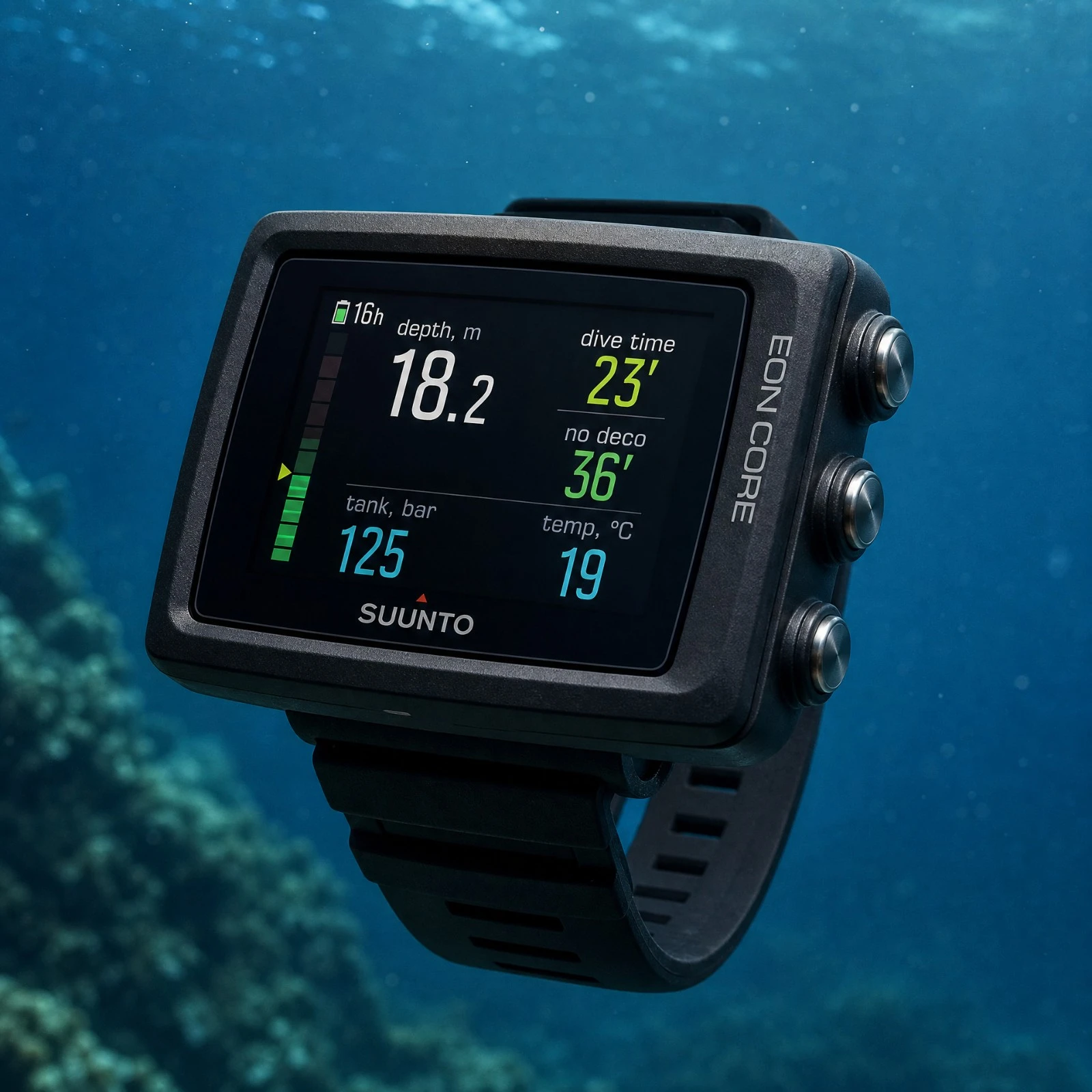
Full review of the Suunto EON Core, a compact color dive computer. Features include Bühlmann 16 GF algorithm, TFT display, multi-gas management, Trimix, and CCR support.
Introduction
In the world of scuba diving, the dive computer is not just a fashion accessory. It's a measuring instrument that calculates our decompression and ensures our safety every minute we spend underwater. Choosing a colored model often presents a dilemma between readability, bulkiness, and price.
I remember a dive in the autumn in the very murky waters of Zeeland. Visibility didn't exceed one meter, and my students were struggling to decipher their old, grayish LCD screens. Next to them, my Suunto EON Core shone like a beacon in the dimness, clearly displaying the decompression limit. This experience convinced me that a good screen is a direct factor in safety by reducing the mental load on the diver underwater.
With the Suunto EON Core, the Finnish brand offers a lighter version of its famous EON Steel. It replaces the heavy steel casing with a composite material that is much lighter and more comfortable to wear on the wrist. But a beautiful screen isn't enough. We will analyze its technical capabilities underwater to see if it truly represents the ideal compromise for your dives.
The Verdict in Summary
Overall score: 4.4/5
| Criterion | Score | What it means |
|---|---|---|
| Algorithm & decompression settings | 5.0/5 | Bühlmann 16 GF or Suunto Fused RGBM 2 models available. Full control over decompression. |
| Air & multi-gas | 5.0/5 | Up to 10 configurable gases, complete Trimix support, and CCR mode that can be easily activated. |
| Screen & ergonomics | 4.8/5 | Very large and customizable color TFT screen. Intuitive navigation with three buttons. |
| Battery life | 3.5/5 | Rechargeable battery offering 10 to 20 hours of dive time. Acceptable, but requires recharging during travel. |
| Connectivity & app | 4.2/5 | Very reliable Bluetooth for the dive log. Updates via USB cable and computer. |
| Compass & instruments | 4.3/5 | High-performance electronic 3D compass. Classic depth gauge mode is available. |
| Robustness & depth rating | 3.5/5 | Certified to a depth of 80 meters. Lightweight composite casing, but less robust than steel. |
| Price & customer service | 4.5/5 | Excellent value for money considering its multi-gas capabilities. Suunto's customer service network is impeccable. |
This computer is designed for: Regular recreational divers, instructors, or light technical divers who are looking for perfect readability without being weighed down by a bulky metal device on their wrist. This computer is not ideal for: Extreme technical divers aiming for very deep dives beyond 80 meters, or those who refuse to recharge their battery every evening at the hotel.
Detailed Analysis
Algorithm & tiers (5.0/5)
This is excellent news for regular divers. With firmware version 4.0, Suunto has officially integrated the Bühlmann 16 GF model into the EON Core. This allows you to abandon the original Fused RGBM 2 and configure your own Gradient Factors. This enables you to perfectly align your decompression profile with that of your fellow divers using other brands. The display of the ceiling and total ascent time is remarkably clear.
For further information The EON Core now implements the Bühlmann ZHL-16C with adjustable Gradient Factors. The user can freely adjust the GF Low and GF High values to personalize their safety margin. The display offers an intuitive graphical representation of the saturation levels of different tissue compartments. There are no known bugs or slowdowns in this calculation suite.
Air & mixed gases (5.0/5)
This computer offers features comparable to the most advanced professional models. It can manage up to 10 different gases during diving. You can plan complex decompression schedules using pure oxygen or helium for Trimix dives. The closed-circuit rebreather mode is also available and can be activated simply via the Suunto mobile app.
For further information The system accepts Nitrox mixtures from 21% to 99% oxygen and Trimix up to 95% helium. The CCR mode allows you to set high and low partial pressure of oxygen targets, with manual management of backup gases. Wireless air management integration is available to monitor the pressure of multiple tanks simultaneously.
Screen & Ergonomics (4.8/5)
The color TFT screen is a key feature of this dive computer. The characters are large and have high contrast, making them easy to read for divers whose near vision gets tired. The ergonomics rely on three push buttons on the right side. They are easy to operate, even with thick neoprene gloves. The display is fully customizable thanks to the CustomDisplay function. You can choose to display only the essentials for a beginner student or add all the details for a technical dive.
For more information The color TFT screen has a diagonal of 2.2 inches. The resolution and brightness allow you to read the information even in direct sunlight or in complete darkness at great depths. Navigation through the menus is done without a touchscreen, which avoids accidental operations underwater.
Battery Life & Power (3.5/5)
This is a common weakness of very bright color displays. The rechargeable Lithium Ion battery offers between 10 and 20 hours of operating time underwater, depending on the water temperature and brightness settings. This is sufficient for a full weekend of training, but it requires you to bring the magnetic cable on a week-long cruise.
For further information The battery recharges via a proprietary magnetic port. The indicator displays an accurate percentage of the remaining charge. In cold water, below 10 degrees Celsius, the battery shows a logical decrease in autonomy but without any abrupt system shutdown.
Connectivity & App (4.2/5)
The transfer of dive data to your smartphone via Bluetooth is fast and stable. The Suunto app is very well designed for analyzing your profiles and sharing your diving photos. However, major firmware updates still require connecting the computer to a PC or Mac using the provided USB cable.
For more information The device uses the Bluetooth Smart protocol for synchronizing dive data to mobile devices. Data export in the standard UDDF format is available for use with third-party software such as Subsurface. Software updates are performed via the SuuntoLink program.
Compass & Instruments (4.3/5)
The integrated 3D electronic compass has a very effective tilt compensation system. It remains accurate even if you tilt your wrist while finning. The computer also continuously displays the water temperature and offers a dedicated depth gauge mode for exercises or dives using dive tables.
For more information The digital compass can be displayed as an overlay on the main screen or in full-screen mode with heading lock. The temperature sensor has a precision of plus or minus one degree. An apnea mode is also available for training in swimming pools or natural environments.
Robustness & Depth (3.5/5)
The reinforced fiberglass composite casing weighs only 154 grams, which is very pleasant for everyday use compared to the 347 grams of the Suunto EON Steel Black. The mineral glass offers good protection against scratches but is less resistant than sapphire glass. The certified maximum operating depth is 80 meters, which limits its use for very deep technical dives.
For further information The casing complies with the EN 13319 standard for diving instruments. Its structural strength is excellent for advanced recreational use. The push buttons have a double O-ring seal to prevent sand or salt from entering.
Price & Customer Service (4.5/5)
Typically priced between €600 and €700, it offers very advanced features at a price lower than that of competing color displays. Suunto's after-sales service in Europe is known for its speed and professionalism.
For further information The price-quality ratio is excellent since the addition of the Bühlmann algorithm, which was implemented through a software update. The network of authorized dealers and repair centers in Belgium and France ensures quick support in case of technical issues.
What you need to know before buying.
Recommended Level This computer is very versatile. A beginner diver undergoing Level 1 training can use it without being overwhelmed by information by choosing a simplified display. It will then support their progress towards Nitrox and deeper dives without requiring them to change equipment. However, the Trimix and rebreather functions require specific technical training before they can be activated.
Air Integration The EON Core can receive pressure information from cylinders directly on the screen using Suunto Tank POD wireless transmitters. You can connect up to 10 probes simultaneously, which is ideal for instructors who monitor their students' air consumption or for technical divers who use multiple decompression cylinders.
Consumption and Redundancy It is important to remember that wireless radio-frequency transmitters consume their batteries more quickly than the computer's electronics themselves. You must regularly check the condition of these batteries to avoid losing the pressure display during dives. Furthermore, wireless technology is not infallible and can experience temporary disruptions. The use of a pressure sensor never eliminates the need to connect a traditional mechanical pressure gauge to your regulator to ensure physical redundancy of information.
Prices and Used Options The current new price of the EON Core is around €650, according to specialized stores. On the used market, you can regularly find models in very good condition for a budget between €400 and €500. This is an excellent option for equipping yourself with a color screen without breaking the bank. Just be sure to check the battery's condition and have the device's water resistance tested at a specialized center if you have any doubts.
Safety Reminder
A dive computer is a decision-making tool that calculates theoretical models. It cannot know your level of fatigue, hydration, or your personal physiological risk factors. Safety underwater depends primarily on your behavior and adherence to ascent procedures.
Using Gradient Factors with the Bühlmann ZHL-16C model requires a strong theoretical understanding. On the EON Core, this algorithm coexists in dual-boot mode with the proprietary Suunto Fused RGBM 2 model. An overly aggressive setting significantly increases the risk of decompression sickness. We recommend using conservative settings, consulting our dive computer comparator to analyze the behavior of other models, and always diving with a backup instrument such as a second dive computer or physical dive tables.
If you are using wireless transmitters, the presence of a mechanical pressure gauge as a backup remains essential to address any loss of signal or battery failure in the sensor.
Our Verdict
The Suunto EON Core has successfully evolved thanks to software updates from the Finnish brand. By integrating the Bühlmann algorithm with Gradient Factors, Suunto has transformed a comfortable recreational dive computer into a high-performance and upgradeable exploration tool.
It is the perfect choice for divers who appreciate the readability of large color screens and the lightness of composite housings. It avoids the significant weight of its stainless steel counterpart while still offering complete gas management and modern connectivity. While its maximum battery life of 20 hours requires some discipline for recharging, and its depth rating of 80 meters limits extreme dives, it remains one of the best value-for-money options on the current market.
For divers who prefer a more compact format for everyday use, we recommend reading our review of the Suunto Ocean. If you are looking for an indestructible case for deep cave diving, consider the Suunto EON Steel Black.
Frequently Asked Questions (FAQ)
Does the Suunto EON Core include the Bühlmann GF? Yes, since software update 4.0, the Suunto Bühlmann 16 GF algorithm with Gradient Factors is available on the EON Core. This allows you to customize your decompression by modifying safety values.
What is the battery life of the EON Core? The integrated rechargeable battery provides between 10 and 20 hours of active use, depending on the water temperature and the brightness level selected for the screen. Charging is easy using a magnetic cable provided.
Does the Suunto EON Core support Trimix and rebreathers (CCR)? Yes, it supports helium and oxygen for Trimix dives and has a specific mode for closed-circuit rebreather diving that you can activate from the mobile app.
Does the EON Core have wireless air integration? Yes, it is compatible with Suunto Tank POD transmitters to display the pressure of your tanks in real time. Please remember that these sensors consume their battery faster and do not replace the presence of a mechanical safety pressure gauge.
Train yourself to go further.
A highly configurable computer requires a knowledgeable diver. Before modifying your Gradient Factors for advanced dive profiles, solidify your theoretical understanding of decompression by joining our online theory courses on our AquaExposure training platform.
© 2026 AquaExposure. All rights reserved. Reproduction prohibited without authorization.
Share
Table of Contents
- 01Introduction
- 02The Verdict in Summary
- 03Detailed Analysis
- 04Algorithm & tiers (5.0/5)
- 05For further information The EON Core now implements the Bühlmann ZHL-16C with adjustable Gradient Factors. The user can freely adjust the GF Low and GF High values to personalize their safety margin. The display offers an intuitive graphical representation of the saturation levels of different tissue compartments. There are no known bugs or slowdowns in this calculation suite.
- 06Air & mixed gases (5.0/5)
- 07For further information The system accepts Nitrox mixtures from 21% to 99% oxygen and Trimix up to 95% helium. The CCR mode allows you to set high and low partial pressure of oxygen targets, with manual management of backup gases. Wireless air management integration is available to monitor the pressure of multiple tanks simultaneously.
- 08Screen & Ergonomics (4.8/5)
- 09For more information The color TFT screen has a diagonal of 2.2 inches. The resolution and brightness allow you to read the information even in direct sunlight or in complete darkness at great depths. Navigation through the menus is done without a touchscreen, which avoids accidental operations underwater.
- 10Battery Life & Power (3.5/5)
- 11For further information The battery recharges via a proprietary magnetic port. The indicator displays an accurate percentage of the remaining charge. In cold water, below 10 degrees Celsius, the battery shows a logical decrease in autonomy but without any abrupt system shutdown.
- 12Connectivity & App (4.2/5)
- 13For more information The device uses the Bluetooth Smart protocol for synchronizing dive data to mobile devices. Data export in the standard UDDF format is available for use with third-party software such as Subsurface. Software updates are performed via the SuuntoLink program.
- 14Compass & Instruments (4.3/5)
- 15For more information The digital compass can be displayed as an overlay on the main screen or in full-screen mode with heading lock. The temperature sensor has a precision of plus or minus one degree. An apnea mode is also available for training in swimming pools or natural environments.
- 16Robustness & Depth (3.5/5)
- 17For further information The casing complies with the EN 13319 standard for diving instruments. Its structural strength is excellent for advanced recreational use. The push buttons have a double O-ring seal to prevent sand or salt from entering.
- 18Price & Customer Service (4.5/5)
- 19For further information The price-quality ratio is excellent since the addition of the Bühlmann algorithm, which was implemented through a software update. The network of authorized dealers and repair centers in Belgium and France ensures quick support in case of technical issues.
- 20What you need to know before buying.
- 21Recommended Level This computer is very versatile. A beginner diver undergoing Level 1 training can use it without being overwhelmed by information by choosing a simplified display. It will then support their progress towards Nitrox and deeper dives without requiring them to change equipment. However, the Trimix and rebreather functions require specific technical training before they can be activated.
- 22Air Integration The EON Core can receive pressure information from cylinders directly on the screen using Suunto Tank POD wireless transmitters. You can connect up to 10 probes simultaneously, which is ideal for instructors who monitor their students' air consumption or for technical divers who use multiple decompression cylinders.
- 23Consumption and Redundancy It is important to remember that wireless radio-frequency transmitters consume their batteries more quickly than the computer's electronics themselves. You must regularly check the condition of these batteries to avoid losing the pressure display during dives. Furthermore, wireless technology is not infallible and can experience temporary disruptions. The use of a pressure sensor never eliminates the need to connect a traditional mechanical pressure gauge to your regulator to ensure physical redundancy of information.
- 24Prices and Used Options The current new price of the EON Core is around €650, according to specialized stores. On the used market, you can regularly find models in very good condition for a budget between €400 and €500. This is an excellent option for equipping yourself with a color screen without breaking the bank. Just be sure to check the battery's condition and have the device's water resistance tested at a specialized center if you have any doubts.
- 25Safety Reminder
- 26Our Verdict
- 27Frequently Asked Questions (FAQ)
- 28Train yourself to go further.
Questions about the Journal
Can I use the photographs from this journal?
All images are protected by copyright. For any commercial or editorial use, please contact us via our form.
How can I be notified of new articles?
Follow us on social media or join the Sentinels Circle to receive our immersion stories before anyone else.
Do you offer hands-on workshops?
Yes, we organize masterclasses and field expeditions for members of our school. Check the Training page for details.


