Underwater photography in Croatia: explore shipwrecks, caves, and the crystal-clear waters of Dalmatia.
Underwater photography in Croatia: Explore WWII shipwrecks, stunning caves with light beams, and fascinating cephalopods. A comprehensive guide to capturing.
Is Croatia part of the Schengen Area for European divers?
Yes, since 2023. Citizens of the European Union do not need a visa. Croatia also adopted the euro in January 2023, which simplifies transactions on site.
What is the underwater visibility like in Croatia?
The visibility in Dalmatia is among the best in the Mediterranean, typically ranging from 20 to 30 meters under normal conditions, and sometimes even greater in sheltered bays. The Adriatic Sea is relatively shallow, with less than 50 meters depth along most of the Dalmatian coast, and is very little affected by currents.
Are the shipwrecks from World War II accessible to all diving levels?
Some wrecks are accessible to divers with the Open Water Diver certification, including the Baron Gautsch near Rovinj (with a maximum depth of -28 meters accessible for photography), and other, more accessible vessels around the island of Vis. Others, such as the Tara at -67 meters, require an advanced technical diving certification.
Are there octopuses and other cephalopods in Croatia?
Yes, there are plenty. Croatia is one of the best places in the Mediterranean for observing and photographing octopuses, cuttlefish (Sepia officinalis), and squid. The common cuttlefish is particularly abundant in seagrass beds and on sandy areas from May to July.
What is the difference between diving in Istria and diving in Dalmatia?
Istria (north) is known for its shipwrecks and rocky seabed, with many well-documented dive sites around Rovinj and Pula. Dalmatia (central and southern regions, around Split, Hvar, and Vis) offers more caves, secluded coves, and a different type of underwater vegetation. Both regions are photographically interesting.
What photographic equipment do you recommend for photographing Croatian shipwrecks?
A wide-angle lens (16-24mm equivalent to a full-frame sensor) is essential to capture the entire structure of wrecks. The exceptional visibility of the Adriatic Sea allows for taking wide shots that would be impossible in the Atlantic. A compact camera like the Sony ZV-1 or Olympus TG-7 in an underwater housing with a wide-angle port is sufficient for most underwater photography.
Can I go scuba diving in Croatia outside of the peak season?
Yes. Diving is possible year-round. In winter (when the water temperature is 12-14°C), a semi-dry or drysuit is necessary, but the wrecks are accessible, the visibility is at its maximum, and the dive centers that remain open often host smaller groups. This is a great option for photographers who want to avoid the summer crowds.
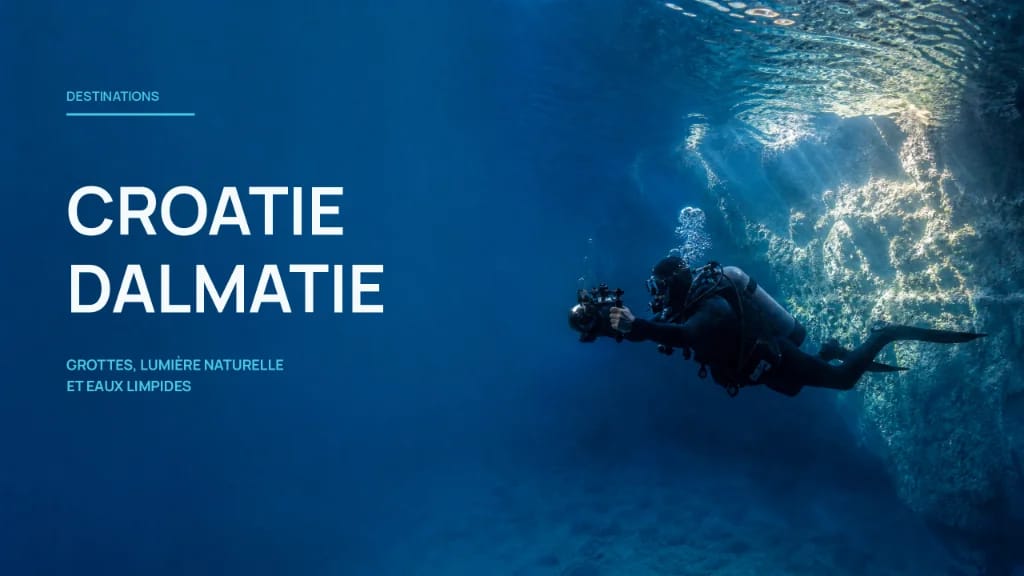
The Dalmatian Adriatic in Croatia captivates with its crystal-clear waters, marine caves, and historical wrecks like the B-17 that sank off the coast of Vis. Photograph between June and September using a bright wide-angle lens to capture the interplay of light within the limestone caves of Kornati and Mljet.
The first time I dove in the Adriatic, I thought my dive computer was broken. The visibility displayed 28 meters. In the French Mediterranean, I would have doubted it. In Croatia, it's the norm.
The Adriatic Sea has a rare characteristic: it is relatively shallow (less than 50 meters along most of the Dalmatian coast), almost enclosed, and the water that enters from the Ionian Sea takes weeks to circulate. As a result, the transparency allows colors to be visible at depths where, elsewhere, everything becomes monochrome. For an underwater photographer working with natural light, this is a fundamental advantage that fundamentally changes what is possible.
This guide covers underwater photography in Croatia, with a focus on Dalmatia: wrecks from World War II, light beam caves, cephalopods, and settings adapted to Adriatic conditions.
What makes the Adriatic unique for photography.Transparency is the primary advantage, but it's not the only one. The Adriatic Sea also experiences relatively little surface current, which means divers are more stable in the water, subjects tend to stay still, and blurry images caused by involuntary movement are less common.
A second advantage is the background color. The water in the Adriatic tends towards a brighter blue-turquoise hue compared to the French Mediterranean, especially around the white limestone islands of Dalmatia (Vis, Hvar, Brač). This naturally bright background changes the color palette available to the photographer.
A third advantage is the shipwrecks. The Adriatic has been the site of numerous naval battles during both World Wars. These wrecks, resting between -20 and -70 meters, have become artificial reefs that have been colonized by marine life for 80 years. They concentrate an extraordinary amount of underwater life on photogenic structures that nature alone would not have created.
Shipwrecks of Dalmatia: Structures and Light
The Baron Gautsch (near Rovinj, Istria)
The Baron Gautsch is the most famous wreck in Croatia. This Austrian passenger ship, sunk in 1914 by a mine, rests at a depth of -40 meters (the upper part of the hull is at -28 meters). The structure is intact, with portholes, staircases, and bulkheads still standing after more than a century.To photograph it in natural light, position yourself at the bow of the ship between 9 am and 10 am in the summer, so that the light comes from the east and is behind you. The hull then stands out against a bright background, and the structure of the wreck is visible without a flash. The depth requires an increase in ISO (800 to 1600), but the 20-meter visibility allows for wide-angle shots that compensate.
The Wrecks of the Island of Vis
The island of Vis, off the coast of Split, is home to several accessible wrecks, including a World War II airplane (-40 meters) and several transport ships. These sites are less crowded than the Baron Gautsch and often offer a more peaceful photographic experience.
The wrecks of Vis are guided by experienced local guides. The dive centers in Vis Town and Komiža know all the sites and the ideal times for each wreck. This information, which is difficult to obtain otherwise, is the main reason to dive with a local guide, even if you are experienced.
Caves and Semi-Caves: Beams of Natural Light
The Dalmatian coast is dotted with semi-submerged caves, some of which create lighting conditions that studio photographers could not artificially reproduce.
The Blue Cave of BisevoTechnically, this is a marine cave accessible by boat rather than by diving. Light enters through an underwater opening at a depth of -4 meters, illuminating the interior of the cave with an electric blue hue between 11 am and 12 pm. The experience is spectacular. To photograph it, position yourself so that the light source is within the frame (contrary to the usual reflex) and expose for the illuminated areas. The dark interior of the cave absorbs light, forcing an exposure that makes the blue even more intense.
Semi-caves along the coast
Along the Dalmatian coast, rocky overhangs create semi-caves where light enters through the open entrance. These situations are ideal for backlighting images: place the subject (a grouper, a moray eel, a conger) in the shadow of the overhang and let the external light outline the animal.
This type of backlighting image is one of the most difficult to achieve in natural light, but also one of the most visually powerful. It requires manually adjusting the white balance and accepting a slight overexposure in the areas of direct light to preserve detail in the shaded areas.
Croatian fauna: cephalopods and varied seabeds
Cuttlefish: the flagship species of the AdriaticThe common cuttlefish (Sepia officinalis) is the iconic animal for underwater photography in Dalmatia. Between May and July, cuttlefish gather in seagrass beds and on sandy areas to reproduce. Females lay their black eggs on gorgonian corals, algae, and artificial structures. During the spawning season, males compete for females in spectacular visual displays, with the chromatophores in their skin changing color in real time.
Photographing a cuttlefish during its mating display is one of the most memorable experiences in Mediterranean diving. The animal is large (20 to 30 cm), moves slowly, and the color changes are slow enough to be captured at normal shutter speeds.
Rock Octopuses
Common octopuses (Octopus vulgaris) are present year-round on the rocky seabeds of Croatia. Unlike Corsica or Port-Cros, where they sometimes hunt during the day, Croatian octopuses generally remain in their dens during periods of high light and emerge at dawn and dusk. A late-day dive (5 PM to 7 PM) significantly increases the chances of finding them active.
White Gorgonians of HvarThe Hvar archipelago is known among local divers for the density of its colonies of white gorgonian coral (Eunicella singularis) found between 15 and 30 meters. These gorgonians, less commonly photographed than red gorgonians, have a strange and mineral appearance that complements the bluish light of the Adriatic Sea.
Camera Settings Adapted to Croatian Conditions
The exceptional visibility of the Adriatic Sea changes how you manage focus. In the French Mediterranean, with a visibility of only 10 meters, you typically work within 2 meters of the subject. In Croatia, with a visibility of 25 meters, you can afford to move back 3 or 4 meters, which changes the perspective and compression of the image.
For wrecks: - Wide-angle lens is essential (16mm or less in full-frame equivalent) - ISO 400 to 1200 depending on the depth - Shutter speed 1/100 to 1/160 (wrecks don't move, so high shutter speeds aren't necessary) - White balance set to "cloudy" or "shade" to reproduce the warm tones of the rust.
For caves and semi-caves: - Higher shutter speed (1/250 to 1/400) to freeze the diver's movements in the scene. - Higher ISO (800 to 3200) to properly expose the darker areas. - White balance in automatic mode to allow the camera to decide between direct light and shadow.For cuttlefish and cephalopods: - Use a longer focal length lens if available (equivalent to 50-90mm) to avoid getting too close and stressing the animal. - Use a shutter speed of at least 1/200th of a second to freeze the water jets and tentacle movements. - Use burst mode if your camera allows it: courtship behaviors are unpredictable, and burst mode can capture what the naked eye might miss.
Croatia in a Mediterranean Photo Tour
Croatia naturally complements a tour that begins in Corsica or Port-Cros. These three destinations offer three different types of underwater photography: marine life in protected reserves (Corsica and Port-Cros), and wrecks and caves with structured natural light (Croatia).
Combined over two to three weeks of travel, they provide a comprehensive view of what the western Mediterranean and the Adriatic can offer to an underwater photographer who works without a flash. The total budget for this Mediterranean tour, including flights and accommodation, remains lower than many exotic destinations, yet often offers superior photographic conditions.To systematically improve your skills in techniques specific to each of these destinations, the AquaExposure underwater photography course offers modules dedicated to Mediterranean destinations, with practical exercises tailored to each type of dive site.
Practical Logistics in Croatia
Access from France and Belgium: Direct flights to Split and Dubrovnik from Paris, Lyon, and Brussels. Many low-cost airlines operate during the summer. Outside of peak season, consider flying via Zagreb or driving if you are coming from Belgium or France (the drive from Paris to Split takes about 12 hours via highways).
Ideal photography season: June (when cuttlefish are spawning, with clear water) and September (when the water is still warm at 23-24°C, with fewer crowds, and the light is softer and more beautiful later in the season).
Dive centers: Croatia has a very well-developed diving infrastructure. The main hubs are Dubrovnik, Split, Hvar, Vis, Rovinj, and Zadar. The quality of the briefings and knowledge of the dive sites varies significantly between centers. It's best to choose centers that have dive guides specializing in underwater photography or that provide illustrated site guides.
Diving budget: A guided dive typically costs between 40 and 60 euros during peak season. Multi-dive packages (5 or 10 dives) reduce the unit price. Factor in the cost of renting a dive tank if you are not traveling with your own.Benjamin Coste has been photographing underwater for over 4,000 dives in the Mediterranean Sea and in all three oceans. His belief is that the best underwater images are created through natural light and patience, not through equipment.
Underwater photography in Croatia: explore shipwrecks, caves, and the crystal-clear waters of Dalmatia. | AquaExposure