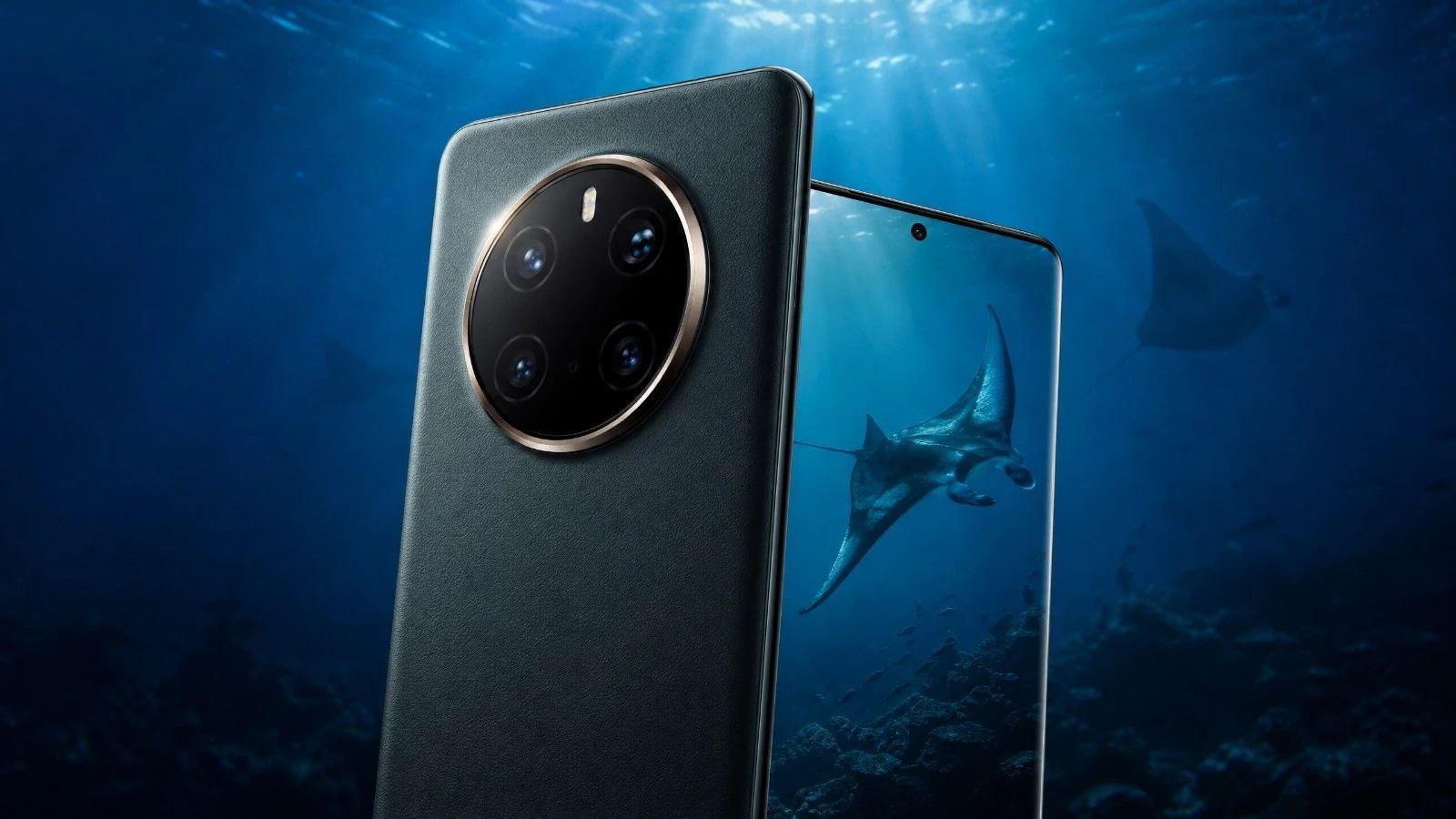
Is the Huawei Mate 90 Pro good for underwater photography?
With an AquaExposure score of 3.7/5, the Mate 90 Pro is a capable device. Its 100MP RYYB sensor and variable f/1.4 aperture are genuine assets in low light. But HarmonyOS blocks access to Blackmagic Camera and MotionCam Pro. A solid choice for divers who master native RAW and accept the Huawei ecosystem.
What housing for the Huawei Mate 90 Pro for diving?
No dedicated rigid housing exists yet (June 2026 - device expected in October). The DiveVolk SeaTouch 4 Max universal housing is the available solution, certified to 60 metres with full touchscreen access. A custom inner adapter for the exact dimensions of the Mate 90 Pro will be needed once the device launches officially.
Does the Huawei Mate 90 Pro shoot RAW underwater?
Yes, RAW is available natively in the Huawei camera app (Pro mode), estimated at 10-bit depth. However, no professional third-party app (Blackmagic Camera, MotionCam Pro) is accessible on HarmonyOS. The RAW workflow runs exclusively through the native application.
How long does the Huawei Mate 90 Pro battery last for a day of 3 dives?
The 7000mAh Si-C battery covers a full day of 3 dives without recharging. Silicon-carbon cells maintain their capacity in cold water better than standard lithium-ion. The 100W wired charging between two full days of diving is sufficient for intensive use.
To learn how to get the most out of your gear underwater, discover the AquaExposure training. Some devices reveal a clear trajectory before they even reach the shelves.
The Huawei Mate 90 Pro is one of them. Expected in October 2026, it is not yet available to buy. What has filtered through since May draws a coherent profile: a 100MP RYYB sensor with variable f/1.4-f/2.0 aperture, a 7000mAh silicon-carbon battery, and the XMAGE Red Maple imaging system in its third generation.
What shifts the analysis is the operating system. Huawei's HarmonyOS does not include the Google Play Store. Blackmagic Camera is iOS-only. MotionCam Pro requires the Play Store. Huawei's App Gallery does not offer a reference professional RAW app at this time.
This article is based on official specifications and information available as of June 2026. It will be updated once real-water testing follows the commercial launch.
Summary verdict
Overall AquaExposure score: 3.7/5
Criterion
Score
What it means
Optics & sensor
3.6/5
100MP RYYB, variable f/1.4, solid in low light
RAW & colour
3.5/5
Native RAW available, but no Pro third-party app on HarmonyOS
Storage
4.0/5
512GB internal, USB 3.1, OTG field transfer possible
Thermal & condensation
3.3/5
Conductive aluminium frame, condensation risk in cold water
Battery
5.0/5
7000mAh Si-C, best endurance in the category in 2026
Autofocus
3.5/5
PDAF + AI capable, limited by absence of third-party apps
Housing
3.0/5
Universal SeaTouch 4 Max available, dedicated housing pending
This device suits: the diving photographer who knows their RAW workflow and accepts the Huawei ecosystem.
This device is not ideal for: anyone who needs Blackmagic Camera, MotionCam Pro, or a dedicated rigid housing immediately.
Optics: 100MP RYYB and variable aperture
The first thing to understand about the Mate 90 Pro sensor is that the 100MP rating is not about printing large-format images. It is about seeing better with less light.
The RYYB sensor (yellow replacing green in the Bayer matrix) captures 40% more light than a standard RGGB sensor. At 12 metres depth, where red wavelengths begin to disappear, that difference shows directly in the RAW files.
The variable f/1.4-f/2.0 aperture is rare on a smartphone. It allows depth-of-field to be adjusted to the situation: f/1.4 for subjects in dark water, f/2.0 for high-contrast scenes at shallower depths.
XMAGE Red Maple is Huawei's third-generation proprietary imaging system. Flare and backlight handling on previous generations (Mate 50, Mate 60) received favourable reviews from independent testers. Similar performance is expected on the 90 Pro.
Technical details Estimated sensor size: 1/1.28 inch. Resolution: 100MP. Aperture: f/1.4-f/2.0 variable (10 mechanical stops). OIS confirmed. Minimum focus distance estimated: 15-20cm on main sensor (not officially documented at this stage). Burst rate estimated: 10fps. Shutter latency: not measured (pre-launch). B1 score: 3.6/5.
RAW and colour: the strength and the weak point
Huawei has offered native RAW since the Mate 40 Pro. On the Mate 90 Pro, the camera app's Pro mode exposes full manual controls, Kelvin white balance, and RAW capture.
That foundation is solid. XMAGE is not a filter applied on top of JPEG. Manual Kelvin white balance in video is available natively. The estimated video codec is H.265 10-bit, with a possible Log profile via the XMAGE system.
Where it falls short is the app ecosystem.
Blackmagic Camera (iOS only) does not run on HarmonyOS. MotionCam Pro (Google Play) does not either. Huawei's App Gallery offers no known equivalent at this time. RAW capture goes through the native app and nothing else.
For the diver who processes RAW files in post (Lightroom, DxO, Capture One), that is workable. For anyone seeking a real-time histogram, H.265 Log monitoring, or third-party focus peaking, the absence of Google Play is a genuine constraint.
Technical details Native RAW: yes (camera Pro mode). Estimated bit depth: 10-bit. Kelvin WB in video: available natively. Estimated video codec: H.265 10-bit (Log profile possible via XMAGE). Colour science: XMAGE Red Maple, 3rd generation. Third-party Pro app: none available (HarmonyOS, no Google Play). Penalty applied on this criterion. B2 score: 3.5/5.
Storage: 512GB and OTG transfer
A day of three dives shooting 100MP RAW generates between 15 and 25GB of data depending on shooting pace. The available 512GB covers several days without offloading files.
OTG transfer works on HarmonyOS. An external SSD can be plugged in between dives on the boat deck to free up space. USB 3.1 Gen 1 delivers an estimated 300-400MB/s throughput, sufficient for a field workflow.
There is no microSD slot. With 512GB internal storage and an OTG SSD, capacity will not be a practical barrier.
One point to check before buying: compatibility of Huawei RAW format with your post-production software. Lightroom has supported Huawei RAW for several generations. Capture One and DxO PhotoLab also do, with the usual delay after new launches.
Technical details Internal storage: 256GB / 512GB / 1TB depending on variant (no external slot). Connector: USB-C 3.1 Gen 1. Estimated real-world transfer: 300-400MB/s. OTG field transfer: compatible with HarmonyOS. B3 score: 4.0/5.
Thermal performance: aluminium and cold water, a real watch point
The Mate 90 Pro's 7000-series aluminium frame is robust. Third-generation Kunlun glass ranks among the most resistant available on a smartphone in 2026. IP68 certification covers incidental immersion.
But aluminium is an efficient thermal conductor. Inside a closed housing, the air trapped between the phone and the port glass experiences a thermal shock each time you enter the water. In cold water (below 15°C), condensation on the inside of the housing port becomes a real risk.
In tropical water (25°C and above), this risk remains low. In the Mediterranean in autumn or in the Atlantic, it requires preparation: let the housing acclimatise to ambient temperature before sealing, never move directly from hot air to cold water.
7000mAh of silicon-carbon battery. That is the maximum score in the AquaExposure framework.
Silicon-carbon chemistry changes two concrete things for the diver. First, energy density is higher than standard lithium-ion: more power in the same volume. Second, Si-C cells hold their capacity in cold water better than standard Li-Ion cells do.
A day of three dives with photos and 4K video does not require recharging between sessions. Cycle life is estimated at over 1000 cycles before reaching 80% capacity, compared to 300-500 for a standard Li-Ion.
100W wired and 80W wireless charging recovers the full 7000mAh in under an hour. Useful between back-to-back days of intensive diving.
Technical details Capacity: 7000mAh. Chemistry: silicon-carbon (Si-C), confirmed by leaks and consistent with the Enjoy 90 Pro Max range already on sale. Charging: 100W wired, 80W wireless. Estimated cycle life: over 1000 before 20% capacity loss. B5 score: 5.0/5.
Before each dive session, make sure your external battery is ready. Use our portable battery comparator to choose the right power bank for your housing and usage.
Autofocus underwater: PDAF + AI, with one constraint
The Mate 90 Pro's AF system uses multi-directional PDAF coupled with AI processing (subject detection, trajectory prediction). That is Huawei's premium AF architecture since the Mate 60.
Focus Peaking is natively available in the camera app's Pro mode. For macro subjects like a nudibranch or the detail of a sea fan, it helps confirm sharpness on a very shallow depth of field. The article on macro photography with a smartphone underwater details this workflow.
What is missing is the advanced control available through third-party apps. MotionCam Pro offers zone-based AF and assisted manual focus that the Huawei app does not provide. Without Google Play, that layer of precision is unavailable.
A one-point penalty is applied on this criterion, in line with the HarmonyOS scoring rule.
Technical details AF technologies: multi-directional PDAF, AI anti-particle tracking. LiDAR: no (Apple Pro exclusive to date). Focus Peaking: available natively in Pro mode. Advanced manual focus app: not available (HarmonyOS). HarmonyOS penalty: -1pt applied. B6 score: 3.5/5.
Housing: universal option while dedicated options are developed
No dedicated rigid housing for the Huawei Mate 90 Pro exists today. The device has not launched yet. Housing manufacturers publish accessories from the final device dimensions, typically within weeks of the official release.
The available solution is the DiveVolk SeaTouch 4 Max, a universal housing certified to 60 metres. The gel technology preserves full touchscreen access underwater, which allows use of Pro mode and manual settings in the Huawei app during a dive.
A custom inner adapter to the exact dimensions of the Mate 90 Pro will be needed. DiveVolk typically produces these adapters quickly after a new flagship launches.
Sea Frogs has produced dedicated rigid housings for the Mate 30 and Mate 20 Pro in the past. A Mate 90 Pro model is likely after the official release, but nothing is confirmed at this stage.
Technical details Dedicated rigid housing: none available to date. Universal housing: DiveVolk SeaTouch 4 Max (60m, gel touchscreen access). Manufacturers to watch: Sea Frogs (Mate series history), DiveVolk (adapter pending launch). B7 score: 3.0/5.
HarmonyOS is the central variable. It is not a poor operating system. But the absence of the Play Store closes off tools that matter for the advanced underwater photographer. Blackmagic Camera and MotionCam Pro are field references that simply do not exist on Huawei.
The RAW field workflow is viable. 512GB plus USB 3.1 OTG plus an external SSD between dives works. But Huawei RAW format compatibility with your editing software needs checking before purchase.
Cold-water condensation requires planning. Aluminium frame plus water below 15°C equals condensation risk on the housing port glass. The fix is straightforward: acclimatise the housing before diving. In the Mediterranean above 20°C, it is not an issue.
The dedicated housing does not exist yet. To dive from the October launch, the solution is the universal SeaTouch 4 Max with an adapter. A dedicated rigid housing should follow in the months after launch.
The Mate 90 Pro has genuine arguments for diving photography in natural light. A 100MP RYYB sensor with variable f/1.4 aperture is a serious proposition for difficult conditions. The 7000mAh Si-C battery delivers the most comfortable endurance in the category.
What holds it back is HarmonyOS. Not because the system itself is weak. Because it cuts access to the Pro apps that make the difference for advanced diving photography. And because no dedicated rigid housing exists yet.
For a diver who knows their RAW workflow, photographs in the Mediterranean or in tropical water, and is comfortable with an ecosystem outside standard Android: the Mate 90 Pro deserves attention at its October launch.
For others, the Google Pixel 10 Pro (full app ecosystem, ultrawide macro, Video Boost) or the Samsung Galaxy S26 (Ocean Mode, dedicated housings available now) remain more accessible alternatives.
Final score: 3.7/5. A capable device with a genuine strength (Si-C battery, RYYB sensor) and a genuine limit (HarmonyOS).
Is the Huawei Mate 90 Pro good for underwater photography?
With an AquaExposure score of 3.7/5, the Mate 90 Pro is a capable device. Its 100MP RYYB sensor and variable f/1.4 aperture are genuine assets in low light. But HarmonyOS blocks access to Blackmagic Camera and MotionCam Pro. A solid choice for divers who master native RAW and accept the Huawei ecosystem.
What housing for the Huawei Mate 90 Pro for diving?
No dedicated rigid housing exists yet (June 2026, device expected in October). The DiveVolk SeaTouch 4 Max universal housing is the available solution, certified to 60 metres with full touchscreen access. A custom inner adapter for the exact dimensions of the Mate 90 Pro will be needed once the device launches.
Does the Huawei Mate 90 Pro shoot RAW underwater?
Yes, RAW is available natively in the Huawei camera app (Pro mode), estimated at 10-bit depth. However, no professional third-party app (Blackmagic Camera, MotionCam Pro) is accessible on HarmonyOS. The RAW workflow runs exclusively through the native application.
How long does the Huawei Mate 90 Pro battery last for a day of 3 dives?
The 7000mAh Si-C battery covers a full day of 3 dives without recharging. Silicon-carbon cells maintain their capacity in cold water better than standard lithium-ion. The 100W wired charging between two full days of intensive diving is sufficient.
Should I use an anti-fog treatment with this device?
Yes, absolutely. With its conductive chassis (often aluminium) and vapor chamber heat dissipation, the risk of condensation in cold water (below 15°C/59°F) is significant. Using an anti-fog treatment (silica gel sachet or anti-fog inserts) inside the housing is mandatory before every dive. > Further reading: Smartphone overheating and fogging in underwater housings: the physics explained -- dew point, thermal management and silica gel protocol.
How can I quickly transfer my photos and videos from this device?
This device offers excellent connectivity. Wired, the USB 3.2 port allows you to offload gigabytes of RAW files or 4K videos in seconds to an external SSD or computer. For wireless transfer, using Huawei Share is ideal for fast and stable transfers.