11/11
100%
Chapter 11 — essentiel
Underwater Photography Specifics: Absorption, Refraction, Diffusion
Understand the 3 physical phenomena that change everything underwater: selective light absorption, refractive index, and scattering. A complete guide for diving photographers.
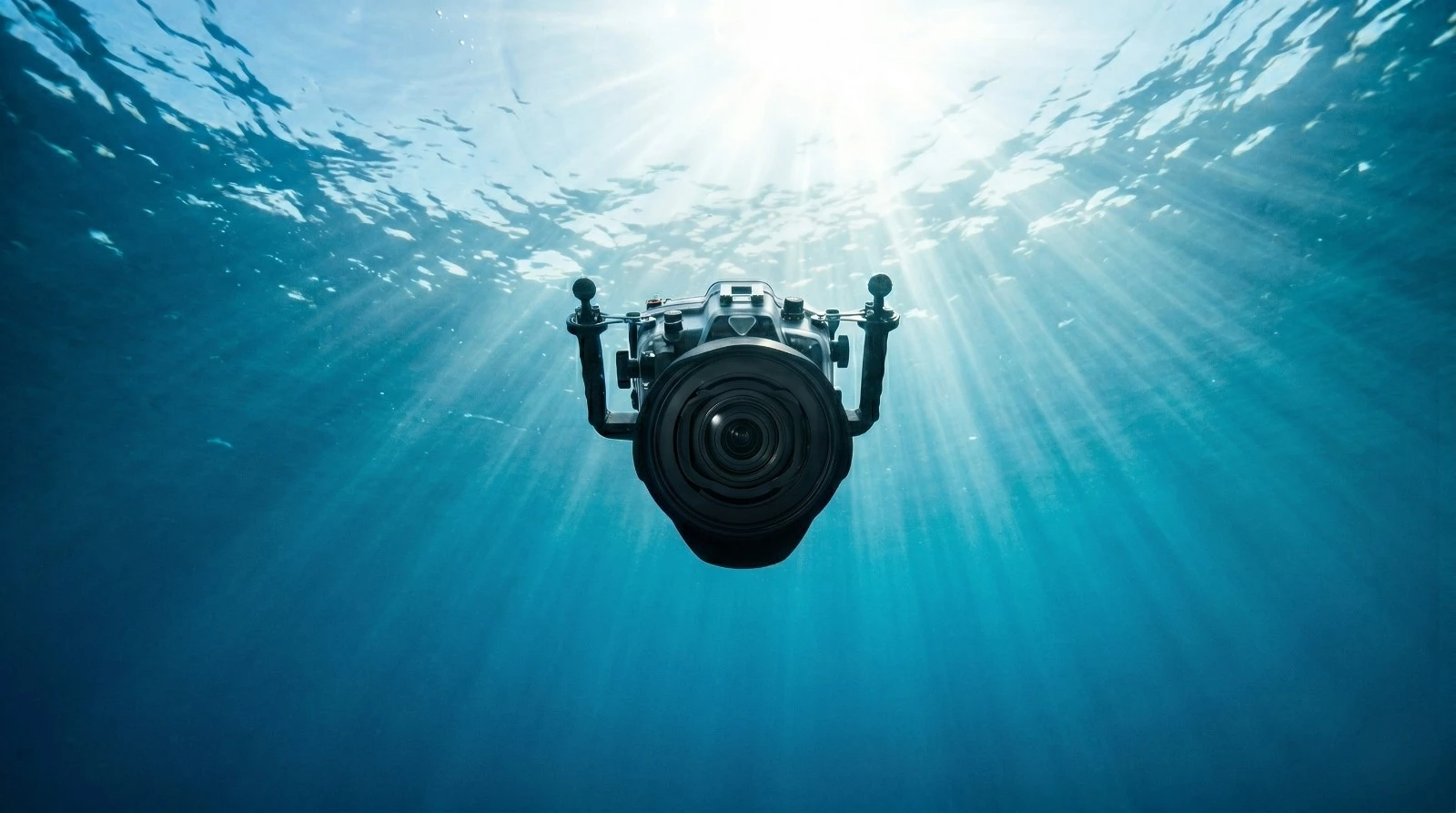
Selective Light Absorption
Water absorbs different wavelengths at different rates. Red light disappears between 3 and 8 meters, followed by yellow. Only blue light penetrates deeply. This is why the underwater world appears uniformly blue-green.
| Color | Wavelength | Disappearance | Photographic Impact |
|---|---|---|---|
| Red | 620-750 nm | 3-8 m | Get closer, correct in post (RAW) |
| Orange | 590-620 nm | 8-15 m | Very attenuated |
| Yellow | 565-590 nm | 15-25 m | Absorbed at depth |
| Green | 500-565 nm | 30-50 m | Dominates coastal waters |
| Blue | 450-500 nm | 60-100+ m | Penetrates the deepest |
The answer to absorption is not technological: it's distance. The closer the lens is to the subject, the less warm wavelengths are absorbed. RAW captures all available data, post-processing extracts the colors.
Refractive Index: Illusion of Size and Distance
Water (refractive index 1.33) deflects light at the water/air interface. Objects appear 25% larger and 33% closer. Autofocus is misleading. A 90-degree lens in air covers only 67 degrees behind a flat port. Optical domes correct this effect.
Light Diffusion: Loss of Contrast
Suspended particles (plankton, sediments) diffuse light, creating a blue-green haze proportional to the distance between the subject and the lens.> Golden Rule: Get closer. Every centimetre gained reduces the amount of water that degrades the image. The wide-angle lens allows you to combine closeness and a wide framing. RAW photos: post-processing recovers contrast and details that the naked eye doesn't perceive on the camera screen.
🧪 Outils interactifs
Frequently asked questions
A quelle profondeur disparaissent les couleurs rouges ?
Entre 3 et 8 metres. Oranges : 10-15 m. Jaunes : 20-25 m. Au-dela de 30 m, seuls les bleus subsistent (loi de Beer-Lambert).
Pourquoi les objets paraissent-ils plus gros sous l'eau ?
L'indice de refraction de l'eau (1,33) fait paraitre les objets 25% plus grands et 33% plus proches. L'autofocus est trompe par cet effet.
Comment reduire la perte de contraste ?
Se rapprocher du sujet est la regle numero un : chaque centimetre gagne reduit la colonne d'eau entre l'objectif et le sujet. Le grand-angle permet cette proximite tout en cadrant large. En RAW, le post-traitement recupere le contraste et les couleurs.
Pourquoi le grand-angle est-il prefere sous l'eau ?
Il permet de se placer tres pres tout en cadrant large. Moins d'eau entre objectif et sujet = moins d'absorption, moins de diffusion, meilleur contraste.