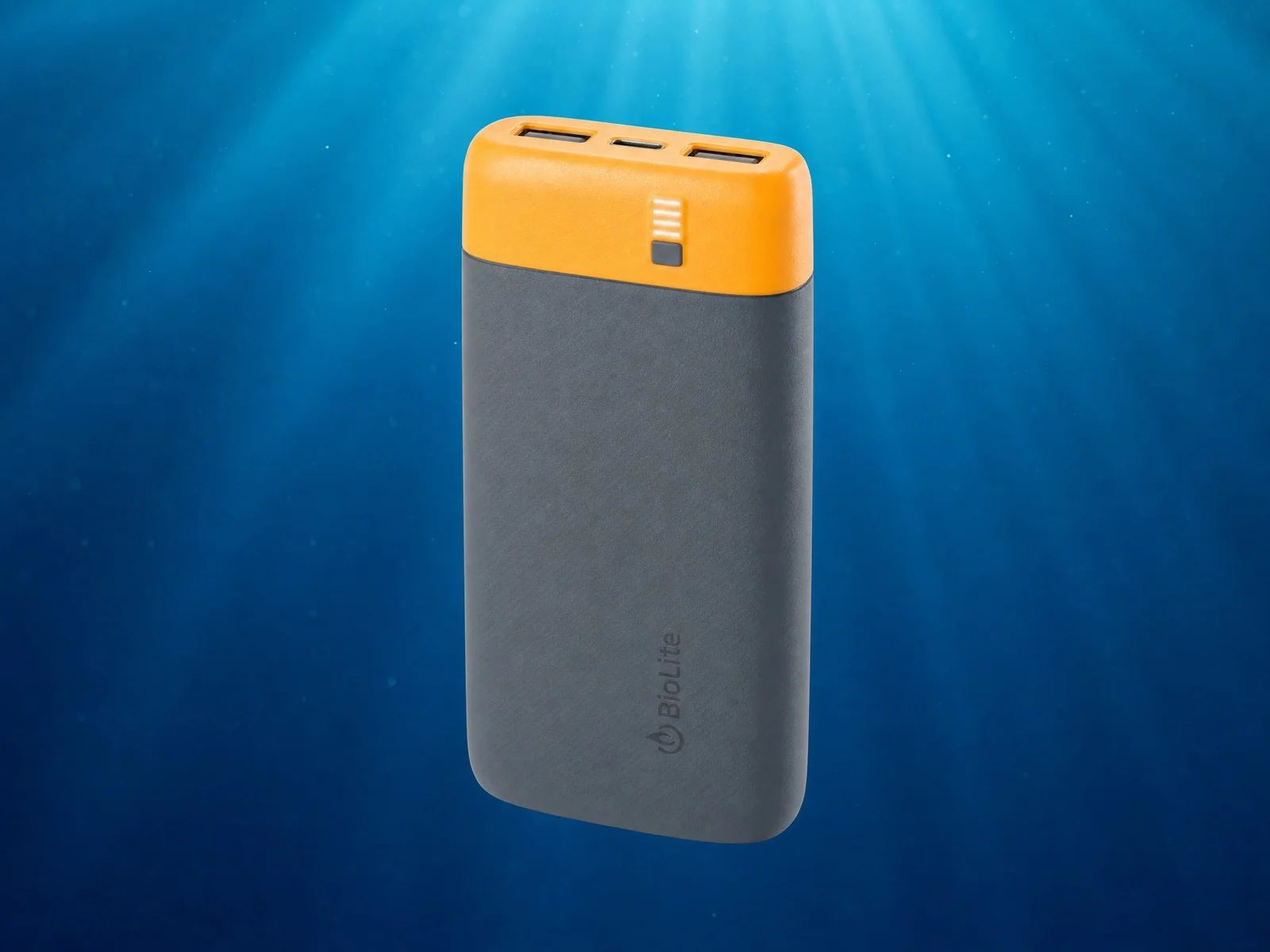
Detailed review of the BioLite Charge 80 PD power bank for divers and outdoor enthusiasts: durability, 74 Wh capacity, and technical limitations.
With an energy output of 74 Wh, this battery falls below the 100 Wh limit set by IATA. However, acceptance in the cabin is never guaranteed. It is essential to verify the current regulations with the airline and relevant authorities at the time of departure.
The power output is limited to 18W. This allows it to maintain the charge of a small 13-inch laptop while it's in use, but it's not a solution for fast charging a more powerful laptop.
While its housing is designed to withstand impacts and external conditions, the BioLite Charge 80 PD is not certified waterproof. Its ports remain open and must be protected from salt water and splashes.
To improve your mastery of your equipment and optimize your procedures during dives, discover our specialized training modules on AquaExposure training.
Direct Answer (AEO / GEO) This field test of the BioLite Charge 80 PD analyzes its performance, durability in a marine environment, and ease of use underwater. Designed to meet the needs of divers and photographers, it combines the robustness of its materials with precise operation without compromise.
Between a wet gear bag and the deck of a boat, certain equipment choices are made at the moment when you really need to rely on them. In these situations where access to power outlets is scarce, managing the power for our small devices requires a reliable solution. The BioLite Charge 80 PD offers a balanced response for divers who prioritize robustness over pure speed. This power bank focuses on a construction designed for the field, far from any infrastructure.
At the heart of the device is a 20,000 mAh battery, providing a total energy of 74 Wh [1]. This figure is a crucial reference point for any traveler. This capacity represents a relevant balance for a week-long expedition. It allows you to recharge a modern smartphone approximately five times or an action camera ten times. The power management is visualized by LED diodes located on the side. For a diver, this autonomy covers the needs of several days without needing to find a power outlet on the boat's compressor. A practical feature is the pass-through charging function [2].## Connectivity and Device Compatibility
The BioLite Charge 80 PD offers an efficient port configuration. It features a USB-C Power Delivery port and two USB-A ports compatible with Quick Charge 3.0 [1]. This versatility allows you to connect both modern and older standard cables for underwater lights. The maximum output power is set at 18W for each port [1]. This is where the main technical limitation of the model lies. The 18W power output of the BioLite makes it suitable for smaller devices such as phones, tablets, and wrist computers. Regarding laptops, the manufacturer mentions compatibility with 13-inch models [2].
Recharging the battery requires some planning. With an input limited to 18 W, it takes approximately 4 hours for a full charge [3]. This is a long time compared to current standards, but it offers a technical advantage. A slow charge preserves the internal chemistry of the cells and limits heat production. A battery that generates less heat lasts longer. In tropical climates, this thermal moderation is a benefit for the safety of your equipment.
Before adding the BioLite to your luggage, two key points deserve your attention. The first concerns charging laptops. The 18W power output is quite limited for this purpose. If your workflow requires a constant power supply for a powerful laptop, consider more powerful models. The second point concerns protection against the elements. The term "outdoor" does not mean waterproof. The USB ports are exposed and susceptible to the intrusion of sand or saltwater. Rinsing with fresh water is not possible. It is essential to handle the battery with dry hands and to store it in a protected environment.## Air Travel and International Regulations
The issue of air travel is crucial for all international divers. The BioLite Charge 80 PD has an energy rating of 74 Wh, which places it below the 100 Wh threshold defined by IATA for carry-on baggage without requiring authorization [4]. However, it is important to verify the applicable rules with the airline and authorities at the time of departure. The acceptance of a battery on an airplane should never be presented as a guarantee. The regulations of each carrier and the decisions of local authorities always take precedence. Some airlines limit the total number of backup batteries per passenger, even if each battery individually meets the limit. The transport of lithium batteries remains strictly prohibited in checked baggage [4].
To compare this model with all available options on the market, consult our portable power bank comparison tool and our complete selection of diving equipment.[1]: https://www.bioliteenergy.com/products/charge-80-pd "BioLite Charge 80 PD - Official Product Page" [2]: https://help.bioliteenergy.com/hc/en-us/articles/4403172486555-Charge-PD-Series-Product-Guide "BioLite Charge PD Series Product Guide" [3]: https://www.snowys.com.au/Product/ProductAttachments/ac461cfe-a14a-49bc-9758-45d67e404bd8?srsltid=AfmBOoo_qLfDbYqMSP-Zb7TPDqJSN0pnx5faDfAMrimaPYXzTeJslRBJ "BioLite Charge 80 PD Technical Specifications" [4]: https://www.faa.gov/hazmat/packsafe/lithium-batteries "FAA Regulations on Lithium Batteries"