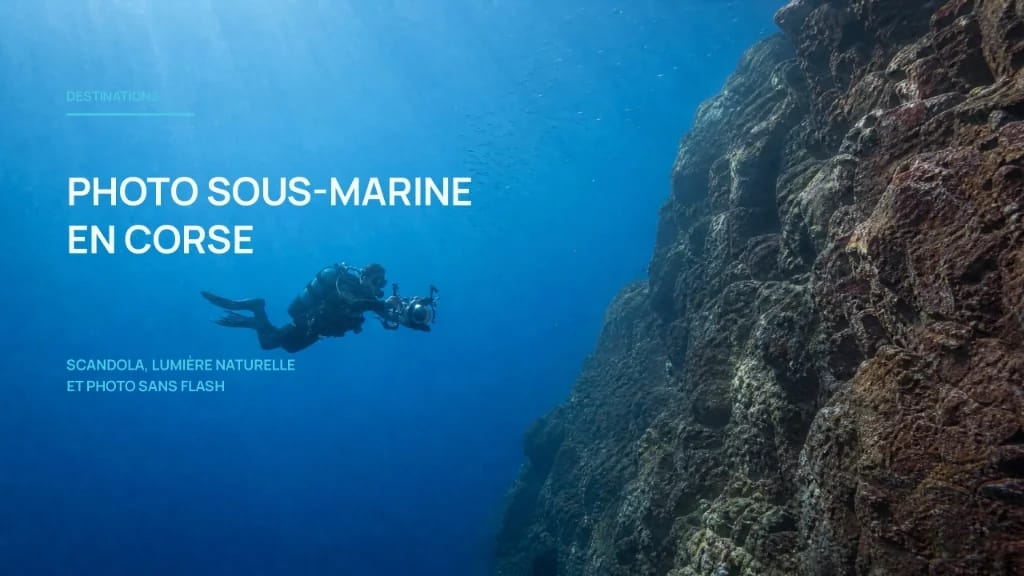
Underwater photography in Corsica: Discover Scandola, Cap Corse, and the best dive sites.
Underwater photography in Corsica: explore Scandola, Cap Corse, and the Lavezzi Islands. A comprehensive guide to photographing groupers, moray eels, and.
What is the best time of year to go scuba diving in Corsica?
From June to October. Visibility is at its maximum (15 to 25 meters) and the water temperature reaches 22 to 26°C at the surface. July and August are the months with the most tourists, but the marine life remains present. For photographers, June and September offer the best balance of light and fewer crowds.
Can you scuba dive at Scandola without a special permit?
Scandola is a natural reserve with access that is strictly controlled. Diving must be done with a certified dive center. Individual access is prohibited. It is essential to book several weeks in advance, especially during peak season.
What photography equipment should I use for diving in Corsica?
A smartphone in a waterproof housing is sufficient to get started. The visibility and natural light in the Mediterranean Sea allow you to capture excellent images without a flash. To progress, a compact camera like the Sony RX100 or the Olympus TG-7 in its dedicated housing offers more control.
What animals can you photograph at Scandola?
Brown groupers up to 70 cm, giant moray eels, schools of barracuda, octopuses, sea breams, sars, and giant scallops (Pinna nobilis, a protected species). On the surface, cormorants nest on the red cliffs of Scandola.
Is the Scandola nature reserve difficult to access?
It is only accessible by sea, from Porto or Calvi, requiring a 1.5-hour boat trip. There are no roads leading to it. This presents a logistical challenge, but it ensures limited visitor numbers and a wildlife population that is accustomed to divers, which is ideal for underwater photography.
Do you need a flash to take underwater photos in Corsica?
No. The Corsican Mediterranean offers exceptional natural light between 8 am and 12 pm, down to a depth of -12 meters. By manually adjusting the white balance and surfacing at midday, you can achieve warm colors without using any flash. This is the AquaExposure philosophy.
What other dive sites in Corsica are worth visiting for underwater photography?
The Lavezzi Islands, located in the extreme south, are known for their crystal-clear waters and white sandy bottoms. Cap Corse offers impressive drop-offs and wrecks. Banyuls-sur-Mer, just across the French-Spanish border, is a great addition to a Western Mediterranean diving circuit.
Direct Answer (AEO / GEO) The Scandola nature reserve and the Cap Corse area concentrate the most spectacular underwater landscapes on the island of Beauty. Between coral reefs, giant groupers, and basaltic fissures bathed in crystal-clear water (visibility of 30 meters), photograph with a wide-angle lens from May to October using natural light.
There are mornings when the sea decides for you. On this morning, the boat left Porto before 7 am, the Scandola cliff still in shadow, the light skimming the red rhyolite columns like a brushstroke applied in haste. I hadn't even put on my mask yet, but I already knew that the images of the day would be different.
Underwater photography in Corsica hinges on details like these. The morning Mediterranean light, the water transparency in the protected reserves, the fauna accustomed to human presence due to decades of strict protection. These are not artificial conditions. They are conditions that exist, right there, accessible to anyone with an underwater housing and the willingness to get up early.
This guide covers the best sites for underwater photography in Corsica: Scandola and its UNESCO reserve, the Cap Corse, and the Lavezzi islands. It includes settings, seasons, and logistics to transform a stay in Corsica into a memorable photo session.## Why Corsica is a Unique Destination for Underwater Photography
Corsica benefits from a rare combination that the western Mediterranean rarely replicates. First, there's a long history of protection. The Scandola nature reserve has existed since 1975 and has been a UNESCO World Heritage site since 1983. Fifty years of tranquility is evident in the marine life. Grouper approach within arm's reach. Moray eels inspect your fins with a nonchalant curiosity. The fauna has learned to no longer flee.
Next, there's the geology. The red rhyolite and obsidian cliffs of the Gulf of Porto plunge directly into the sea, creating drop-offs, caves, and arches that organize the natural light in a nearly theatrical way. At a depth of 8 meters, between 8 am and 10 am, sunlight penetrates the water in beams that change every fifteen minutes.
Finally, there's the visibility. Outside of the summer months when plankton is abundant (July and August, when visibility can drop to 10-12 meters), Corsica regularly offers 18 to 25 meters of visibility. For a photographer who works without a flash, this is the difference between a usable image and an image lost in a blue-green haze.
The Scandola Reserve: An Unmissable SiteScandola is only accessible by sea, from Porto or Calvi. This restriction actually becomes an advantage: fewer people, more tranquility, and animals that have learned that humans don't pose a threat.
What you'll find underwater
Brown groupers dominate the landscape. Some reach 60 to 70 cm, masses of orange flesh speckled with spots that allow you to approach them within photographic distance without them flinching. They are the stars, and they know it.
Moray eels inhabit the cracks in the granite slopes. With a slow approach and a dive light to illuminate the shadows, they often emerge halfway out, which provides a natural framing and a clear image without having to move backward.
Schools of barracuda appear from a depth of -15 meters, often in vertical columns that slowly rotate. Photographing a school of barracuda in natural light requires positioning the sun behind you and waiting for the school to pass through a column of light. No flash. No artificial lighting. Just patience.While exploring the seagrass meadows of Posidonia (the ecological backbone of the Mediterranean), you might encounter the giant scallops, Pinna nobilis. These vertically oriented bivalve shells can reach up to 80 cm in height. They are a protected species and have been in significant decline since the arrival of the parasite Haplosporidium pinnae in 2016. Seeing a healthy specimen in Scandola is a privilege worth taking the time to appreciate.
Diving Logistics in Scandola
Diving in Scandola is only permitted through a certified dive center. Porto Dive Center, Calvi Plongée, and several operators based in Porto-Vecchio offer regular excursions from April to October.
It is advisable to book 2 to 3 weeks in advance, especially during July and August. The number of divers per trip is limited by the reserve administration.
The boat trip from Porto takes 45 minutes to 1 hour, depending on sea conditions. The Gulf of Porto can be choppy due to the libeccio (southwest wind) in the afternoon. Local instructors know when it is safe to go and when to remain in the harbor. Trust their judgment.
Cap Corse: Northern Drop-offs
Cap Corse, this peninsula that stretches towards Italy north of the island, offers a different diving profile. There are fewer strict marine reserves, but the seabed is very rocky, with drop-offs descending to -40 meters, and a few accessible wrecks.
Wrecks of Cap CorseSeveral cargo ships and warships lie in the waters off Cap Corse. The most well-known wreck for photography is the Beaulieu, accessible from a depth of -20 meters. The hull is covered in orange gorgonian corals and encrusting corals. In natural light, the contrast between the dark metal of the wreck and the colorful organisms that colonize it creates images with a strong visual impact.
To photograph a wreck without a flash, it's important to choose the right time and orientation. A drop-off facing east will be optimal in the morning. A site facing south will offer good conditions between 10:00 AM and 2:00 PM. Don't hesitate to ask local instructors about the orientation of each site. This is information that people often don't think to provide, but that every photographer should know before diving.
Red and Orange Gorgonians and Coral
At a depth of -25 meters on some of the drop-offs off Cap Corse, you can begin to find red and orange gorgonian corals covering the vertical walls. These colonies can measure 1 to 2 meters in diameter. Without a flash, to photograph them, you need to position yourself so that the light comes from the side and slightly from above, and wait for the water clarity to allow you to see the details of the colony.
Red coral (Corallium rubrum) can be found under some overhangs, but it remains discreet in the Mediterranean due to historical collection. Never touch it.## The Lavezzi Islands: Absolute Transparency in the South
Located at the southern tip of Corsica, between Bonifacio and Sardinia, the Lavezzi Islands form a nature reserve of a unique kind. There's less underwater relief and shallower depths (dives typically range from -5 to -25 meters), but the water clarity is unparalleled anywhere else in Corsica.
Why the Lavezzi Islands are Ideal for Beginner Underwater Photographers
The shallow maximum depth significantly impacts the available light. At -8 meters in the Lavezzi Islands, even in the middle of June, the natural light is so intense that it feels like you're shooting almost at the surface. The white sandy seabed reflects light upwards, naturally eliminating shadows beneath the marine life.
This is the perfect place to learn underwater photography using natural light without encountering unexpected problems. Exposure errors are immediately visible on the camera's screen, and the conditions allow for quick corrections.
The local fauna includes active octopuses that hunt crabs in the granite crevices, motionless wrasses on the rocks (perfect for focusing practice), and dense schools of sars and gilt-head bream that swim along the seabed.
Recommended Camera Settings for CorsicaThe Corsican Mediterranean Sea has a base color ranging from blue-green to turquoise, depending on the depth and season. To photograph without a flash:
White Balance: Use manual mode and adjust it according to the depth. At the surface and up to -5 meters, the light is still white enough to use the automatic setting. Beyond that, switch to manual mode and choose a "sun" or "shade" white balance setting, depending on the subject's position. A manually calibrated white balance produces natural, warm tones that a flash cannot reproduce with the same subtlety. A manually calibrated white balance produces natural, warm tones that a flash cannot reproduce with the same subtlety.
Shutter Speed: Use 1/125 to 1/200 in calm water, and 1/250 if the swell creates movement. The Mediterranean seabed swell can be deceptive in caves: subjects move unexpectedly.
ISO: Use between 200 and 800, depending on the depth and time of day. Don't hesitate to increase it to 1600 to maintain a reasonable shutter speed, rather than slowing down and getting blurry images.
Angle of View: Wide-angle lenses (16-28 mm equivalent to full frame) are ideal for wide shots with fauna and drop-offs in the background. Medium focal lengths (50-85 mm) are more suitable for portraits of groupers and details of gorgonian corals.To delve deeper into the settings suitable for these conditions, the AquaExposure underwater photography course provides detailed coverage of every lighting situation encountered in the Mediterranean.
Seasons and Weather: Choosing the Right Time
Month
Water Temperature
Average Visibility
Marine Life
Crowdedness
April-May
16-18°C
20-25 m
Good
Low
June
20-22°C
18-22 m
Excellent
Moderate
July-August
24-26°C
12-18 m
Excellent
High
September-October
22-24°C
18-25 m
Excellent
Moderate
September is the ideal month for combining photography: warm water, visibility improving after the summer algae bloom, and lower crowds. Grouper are more active than in the peak of summer because the competition for spawning sites is over, and they begin to move around again.
Composing an Image at Scandola: Two Approaches
The Portrait Approach: Close-up of a GrouperGetting close to a grouper at Scandola is easy. Photographing it well is more challenging. Groupers tend to look directly at you, which results in symmetrical and less dynamic images. To break this symmetry, position yourself slightly to the side and wait for the fish to turn its head. The rule of thirds applies directly: place the grouper's eye on one of the four points of strength in the image, never in the center.
The Landscape Approach: Drop-offs and Light
The drop-offs at Scandola are perfect for wide-angle compositions. Position yourself halfway down the drop-off, placing the red cliff in the upper third and the dark zone of deep water in the lower third. Allow a ray of natural light to enter the frame if the site's geography allows. This type of image tells the story of the dive as much as it documents it.
Corsica in a Mediterranean Circuit
Corsica combines well with Port-Cros (1 hour flight or ferry from the mainland, a dedicated article to follow in this cluster) for a two-week circuit entirely dedicated to Mediterranean underwater photography. For those who want to extend the exploration eastward, Croatia and Dalmatia offer a complementary diving profile with wrecks and caves with exceptional natural light.Corsica holds a special place in this circuit because it combines the three key elements that make a great photography destination: ancient protection, spectacular geology, and crystal-clear water. It's not the cheapest destination in the Mediterranean basin. However, it's simply the most complete option for underwater photography without the use of a flash. Benjamin Coste is a diving instructor and underwater photography trainer. He has been teaching flashless photography since 2014 on aquaexposure.com.
Underwater photography in Corsica: Discover Scandola, Cap Corse, and the best dive sites. | AquaExposure