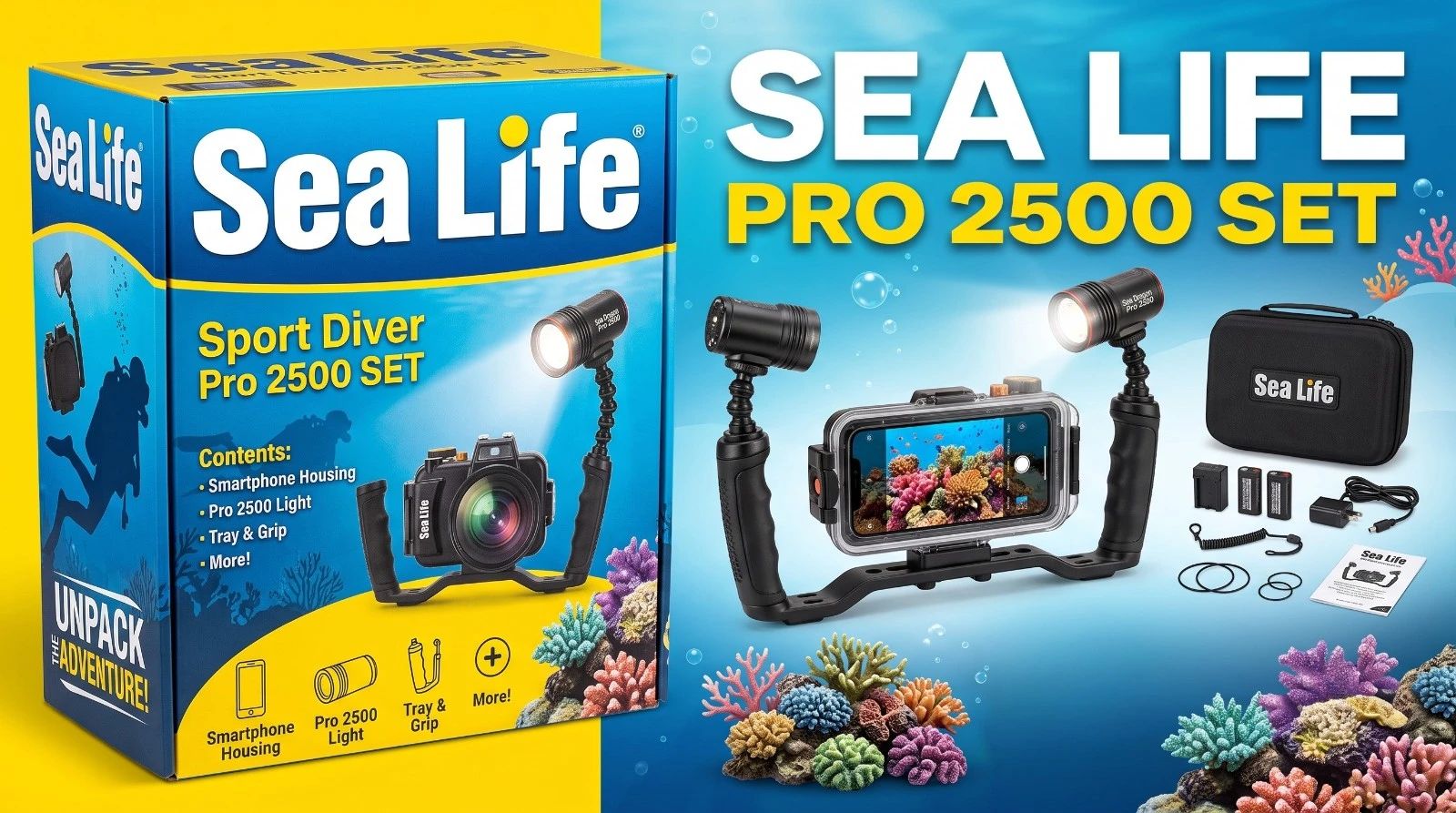
The SportDiver Pro 2500 Set pairs the SportDiver housing with the Sea Dragon 2500 photo-video light. What underwater light actually changes below 5 meters, and whether this bundle is right for your setup.
Anyone who has dived with a camera quickly notices the same thing: the colors visible through the mask don't match the colors recorded in the photo. Reds disappear first, then oranges, then yellows, progressively replaced by dominant blue as depth increases. It's not a camera problem - it's physics.
A continuous light at depth isn't a luxury. It's the correction that makes underwater photography worth the effort.
The SportDiver Pro 2500 Set bundles two components into a single system: the SportDiver smartphone housing (reviewed separately) and the Sea Dragon 2500 photo-video light.
The Sea Dragon 2500 produces 2500 lumens. Its beam is wide - designed to illuminate a scene rather than point at a distant target like a spot dive light. That distinction matters. A wide beam gives you even coverage over a close subject: a coral head, a fish at 40-50 cm, a macro subject. A spot beam gives you range but creates hot spots and shadow edges in photographs.
Depth rating is 40 meters - matching the SportDiver housing's rating and covering the full recreational range.
The bundle price varies by market. Check with your SCUBAPRO dealer for current Euro pricing.
Water acts as a color filter. Every meter of water absorbs wavelengths selectively - red goes first, around 3-5 meters in typical clear ocean conditions. Orange follows. Then yellow. At 20 meters in good visibility, a red nudibranch photographed without artificial light looks brown-grey in the image.
The Sea Dragon 2500 operates at around 5500K color temperature. Pointed at a subject at 50-80 cm, it restores the colors the water has removed. The nudibranch looks red again. The coral polyps show their yellow. The spectrum the water stole comes back.
This is why the light transforms images rather than just brightening them.
The Sea Dragon 2500 is a continuous light - it stays on for the duration of the dive. This is different from an underwater strobe, which fires an extremely brief pulse when the shutter opens.
Strobes freeze motion and avoid backscatter from particles better than continuous lights. But they're more complex to configure, more expensive, and harder to learn with because you can't preview the effect before pressing the shutter.
Continuous lights let you see exactly what the photo will look like while you compose. For video, they're the only option. For learning photography underwater, they're the more forgiving starting point.
A light is not the starting point. It's the answer to a specific need - and that need depends on how you dive and what you already know how to do with available light.
Between 0 and 15 meters in clear water, a photographer who has mastered natural light - sun angle, dive timing, depth of field, ISO and shutter speed - can produce excellent results without any artificial light. Fish behave more naturally without an additional light source. Authentic behaviors are easier to capture. And images have a color coherence that the mix of natural light and a continuous torch doesn't always achieve.
AquaExposure training starts there: understanding natural light, learning to work with it before introducing artificial sources. It's not a budget question - it's a question of foundations. Training costs less than a photo light system and the skills transfer to every dive.
Below 15-20 meters, natural light no longer restores colors regardless of technique. That's where a photo light moves from a comfort item to a genuine necessity.
The Sea Dragon 2500 is a continuous photo-video light producing 2500 lumens with a wide beam designed for illuminating subjects during photography and video. It is not a spot dive light - the wide beam is intended to cover a scene evenly rather than point at a distant target.
No. A strobe fires an extremely short, very powerful burst of light that freezes subject movement. A continuous light like the Sea Dragon 2500 allows real-time preview of the lighting, works well for video, and is simpler to use - but doesn't freeze motion the way a strobe does. For learning and video work, continuous lights are the right starting point.
The transition happens roughly between 5 and 10 meters. Above that, ambient light in clear water is often sufficient for daylight dives. Below 10 meters, blue light increasingly dominates and colors progressively disappear from images. The Sea Dragon 2500 restores warm tones that the water filters out.
Yes. The SportDiver Ultra Duo 5000 Set takes the next step - two Sea Dragon 2500 lights for 5000 combined lumens with symmetric two-source lighting. If you start with the Pro 2500 and want to expand, adding a second light and a tray is a natural progression.