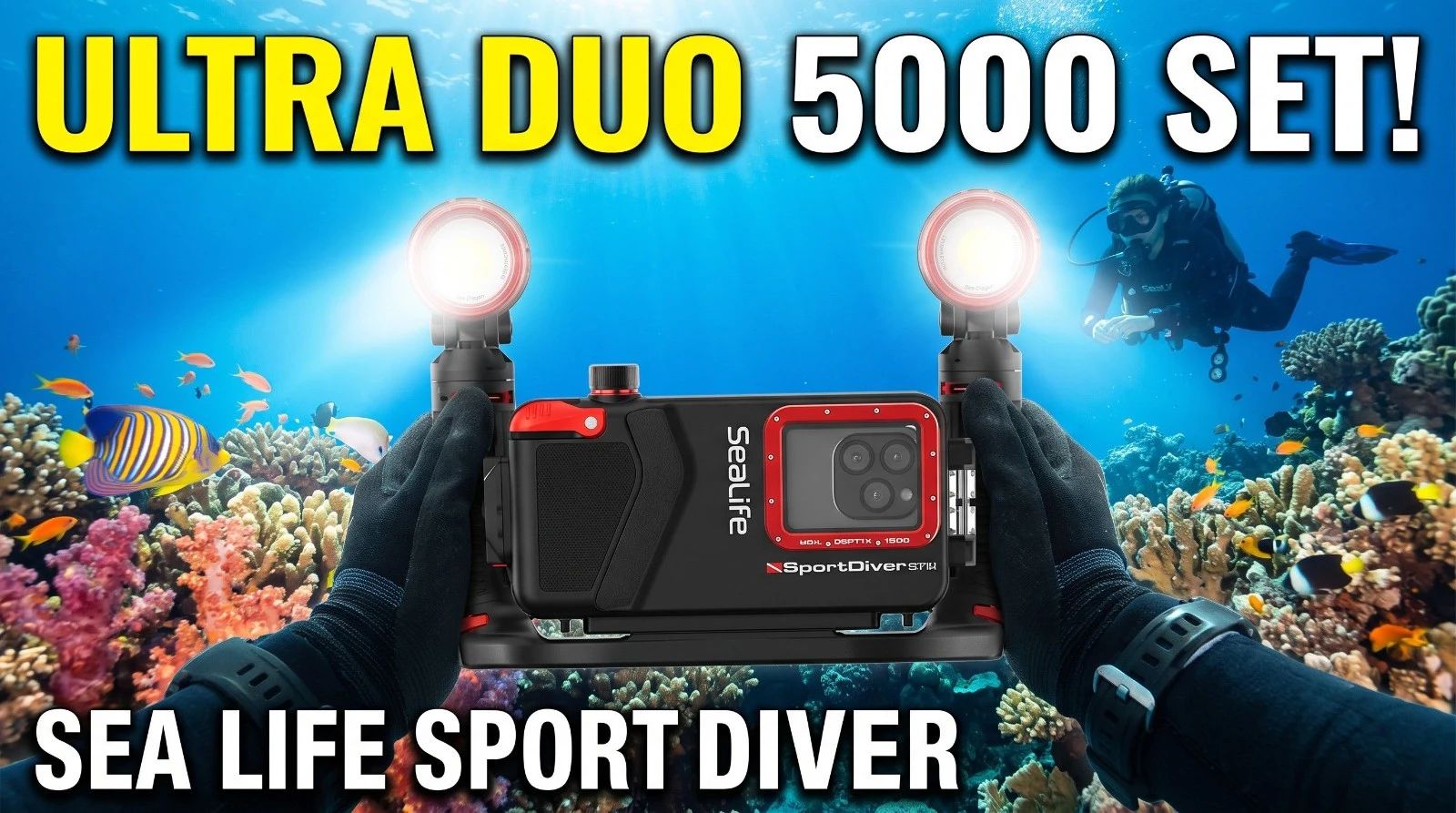
The SportDiver Ultra Duo 5000 Set combines the SportDiver Ultra housing with two Sea Dragon 2500 lights for symmetric 5000-lumen illumination at 1229 euros. Who needs two lights and when does it justify the investment?
A single light underwater creates a shadow. It's unavoidable: one source means one direction, and whatever is opposite that direction is darker. For a fish portrait or a wide reef shot, the shadow lands somewhere in the frame.
Two lights placed symmetrically on either side of the camera solve this. The shadow from the right light is filled by the left, and vice versa. The subject is evenly illuminated. This is the fundamental reason professional underwater photographers use two-light setups.
The SportDiver Ultra Duo 5000 Set is built around the SportDiver Ultra - the larger-format housing for bigger smartphones - paired with two Sea Dragon 2500 photo-video lights mounted on a tray with articulated arms.
Each Sea Dragon 2500 produces 2500 lumens with a wide beam. Two of them, one on each side of the housing, produce 5000 combined lumens with symmetric coverage. At depth, 5000 lumens from two sources is substantial light for subjects at 50-80 cm.
Price: 1,229 euros.
The change between one light and two isn't simply "more lumens." It's a change in how light falls across a subject.
With one light mounted to the right of the housing, the left side of a fish is lit and the right side is in shadow. Depending on the angle, the shadow can be heavy or subtle - but it's always there. You compensate by adjusting your position or the arm angle, which takes time and practice.
With two symmetric lights, the subject receives light from both sides simultaneously. A face-on fish portrait is evenly lit from left and right. A coral head has coverage across its full width. The lighting becomes more consistent shot to shot, which means fewer discards and less post-processing to rescue underexposed areas.
The Ultra Duo 5000 Set is for divers who go beyond occasional shooting. Underwater content creators who publish regularly, dive instructors documenting students, travel divers who want systematic results from every trip.
It's not the entry point for someone exploring underwater photography for the first time. The Pro 2500 Set with one light is the right starting point for learning. The Duo is the natural upgrade when you've shot enough to know that one light creates shadows you want to eliminate.
At AquaExposure, we use two-light setups in training specifically to teach the principle of symmetric lighting - understanding why shadow placement matters before deciding how to manage it. The Ultra Duo 5000 Set puts that principle in a ready-to-use bundle.
Before spending 1,229 euros on a two-light setup, one question is worth asking: have you mastered natural light?
Not theoretically - in practice. Sun angle, optimal dive timing, reading surface conditions to anticipate what you'll find at 15 meters. AquaExposure training starts there, before introducing artificial lighting. Some underwater photographers do the bulk of their work between 5 and 15 meters using only natural light - because they know where to position themselves and how to expose correctly.
This isn't a critique of the setup. It's a reminder that lights transform images at depth, but technique transforms images in every condition. Training costs less than a photo light system, and the skills compound with every dive.
If you dive regularly between 15 and 30 meters and film consistently, the 5000 lumens of this Set will earn their cost. If you're starting out, or if you primarily dive in shallow water, mastered natural light is the stronger foundation.
The Pro 2500 has one Sea Dragon 2500 light on one side of the housing. The Ultra Duo 5000 has two Sea Dragon 2500 lights - one on each side - for 5000 combined lumens. The Ultra Duo uses the SportDiver Ultra model (larger phones), while the Pro 2500 uses the standard SportDiver. The two-light setup eliminates shadows from single-source lighting.
The SportDiver Ultra is the larger-format housing designed for bigger smartphones including the iPhone 15 Plus, iPhone Pro Max models, and Samsung Galaxy S24 Ultra. The standard SportDiver covers most iPhones from generation 8 through 15 Pro. Both use the same electronic module with sealed electronics and dual alarm system.
The physical setup is more involved - assembling the tray, positioning two arms, balancing the rig. The lighting result is more predictable once configured: symmetric two-source lighting eliminates the harsh shadow cast by a single light. The challenge shifts from "fixing shadows" to "positioning consistently."
It's the right system for underwater content creators who dive regularly and want a step beyond casual shooting. If you publish images on social media, teach diving, or need consistently exploitable results without professional housing complexity, this bundle delivers at a price point well below mirrorless-and-housing territory.