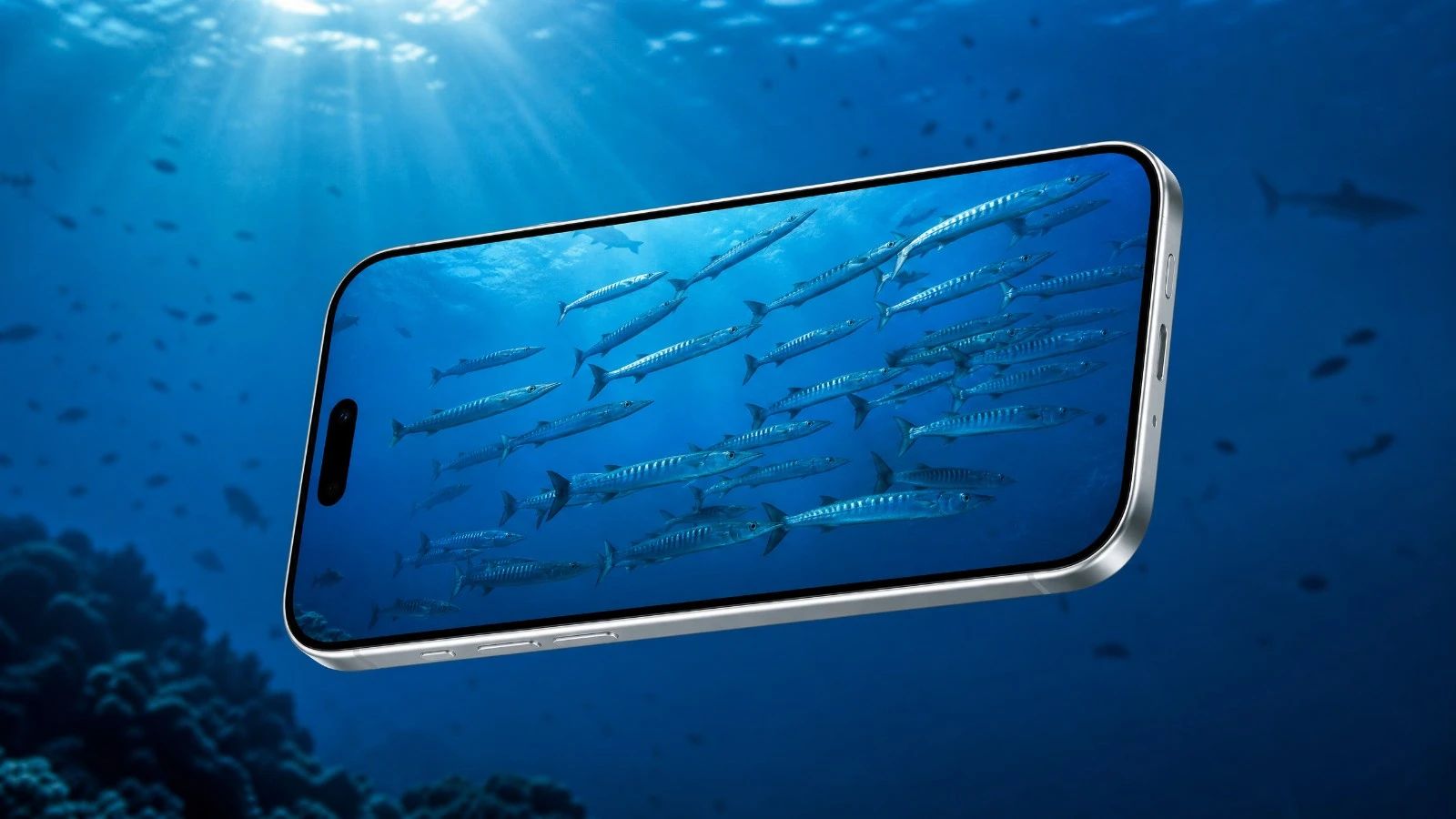
iPhone 17 scuba dive test: IP68 rating limits (20 ft / 6 m) vs 196 ft (60 m) in a housing. AquaExposure score 3.4/5, RAW workflow & Kraken, SeaLife, Divevolk guide.
Yes, but only by accident. The iPhone 17 is IP68 rated for 20 ft (6 m) during 30 minutes, which is a laboratory rating for a dropped phone, not a diving rating. It is measured in fresh water, on a brand new device, with no movement and no thermal shock. Salt water, currents and a phone that has already taken a few knocks all fall outside that test. Our position is simple: take it in the water, but inside a certified pressure housing.
Can you take underwater photos with the iPhone 17?
Yes, and the results are genuinely good. The iPhone 17 shoots 12-bit ProRAW through Blackmagic Camera, with lockable Kelvin white balance and focus peaking, which is what actually matters in natural light. The catch is that a bare phone gives you no usable touchscreen below the surface and no depth margin. In a Divevolk SeaTouch 4 Max Plus housing you keep full app control down to roughly 15 metres and the housing itself is certified to 60 metres.
Can the iPhone 17 record video underwater?
Yes, up to 4K. The base iPhone 17 does not have native ProRes RAW, which is reserved for the Pro models, so you record in standard codecs and correct the colour afterwards. Bear in mind that video is where the phone heats up fastest, and heat inside a sealed housing is what produces condensation on the port. An anti-fog insert before every dive is not optional.
How deep can the iPhone 17 actually go?
Twenty feet (6 m) for 30 minutes on its own, per Apple's IP68 rating, and even that assumes ideal conditions. With a Divevolk SeaTouch 4 Max Plus, the certified depth is 196 ft (60 m), which covers the entire recreational diving range. The limiting factor at that point is no longer the phone, it is the ambient light.
Is a €250 housing really worth it over a €10 waterproof pouch?
A pouch keeps water out, at best, and that is the only thing it does. It distorts the image, it floods above a few metres, and it gives you no reliable control of the screen. A housing at around €250 is a different category of object: certified depth, a conductive membrane that lets you drive Blackmagic Camera underwater, and optical glass that does not degrade the file you paid €899 to capture. Given the price of the phone inside it, the housing is the cheapest insurance in the bag.
Is the base iPhone 17 worth it for dive photography when the Pro exists?
It depends on what you are aiming for. The standard iPhone 17 offers 12-bit ProRAW photos and Blackmagic Camera, which covers the core needs of natural light underwater photography. It lacks the LiDAR, native ProRes RAW video, and telephoto lens of the Pro. For photos only, the gap is manageable. For serious RAW video, the Pro is required.
Can you really use Blackmagic Camera on the standard iPhone 17?
Yes, without restriction. Blackmagic Camera is available on all iOS iPhones, including the base model. You get access to ProRAW DNG, lockable Kelvin white balance, and focus peaking. What you won't have is ProRes RAW video and Apple Log 2, which require the A19 Pro chip.
Is the Divevolk SeaTouch 4 Max Plus compatible with the standard iPhone 17?
Yes, compatibility is confirmed for the entire iPhone 17 lineup, including the base model. The 60-meter certified housing uses a conductive touchscreen membrane giving access to Blackmagic Camera and all third-party apps down to roughly 15 meters, where hydrostatic pressure stiffens the membrane.
Is the USB 2.0 speed on the standard iPhone 17 really a problem for underwater photography?
For photos only, it is minor: 48MP ProRAW files are 25 to 40 MB each, and 35-40 MB/s real-world transfer is acceptable. For large volumes of 4K video, it is a bottleneck. In that case, AirDrop or Wi-Fi 6 becomes the natural workaround to offload rushes quickly.
Should I use an anti-fog treatment with this device?
Yes, absolutely. With its conductive aluminium chassis and vapor chamber heat dissipation, the risk of condensation in cold water (below 15°C/59°F) is high. Using an anti-fog treatment (fresh silica gel sachet or anti-fog inserts) inside the housing is mandatory before every dive. > Further reading: [Smartphone overheating and fogging in underwater housings: the physics explained](/blog/underwater-smartphone-condensation-overheating-physics) -- dew point, thermal management and silica gel protocol.
How can I quickly transfer my photos and videos from this device?
The wired port on this device is limited to the USB 2.0 standard, making physical transfers quite slow. To quickly offload your RAW files or video clips, it is highly recommended to use the fast wireless protocol of the ecosystem (AirDrop), or extract the memory card if the housing and device allow.
To learn how to get the most out of your gear underwater, discover the AquaExposure training.
Yes, the iPhone 17 can go underwater. Apple rates it IP68, which means 20 ft (6 m) for 30 minutes, and we would still advise you not to do it.
That rating describes a phone that falls in a pool and gets fished out. It does not describe a dive. It is measured in still fresh water, on a device fresh out of the box, with no current, no thermal shock and no salt. Take the same phone to 26 ft (8 m) in the Mediterranean after two seasons of use and you are no longer inside the test conditions, you are simply hoping.
There is also a practical problem nobody mentions in the spec sheet: a bare screen does not respond underwater. Even at a metre deep you lose the touchscreen, so you lose focus, exposure and the shutter. The phone survives, and you come home with nothing.
The answer we give people is always the same one. Put it in a housing. A Divevolk SeaTouch 4 Max Plus sits at around €250, which is not the €10 transparent pouch you see at the airport, and it is not meant to be. It is certified to 196 ft (60 m), it keeps a working touchscreen down to roughly 50 ft (15 m) through a conductive membrane, and it lets you drive Blackmagic Camera in ProRAW at depth. On a phone that costs €899, spending €250 to actually use it is the least irrational line in the whole budget.
What people ask
Straight answer
Can it go underwater?
Yes, 20 ft / 6 m for 30 min (IP68), accidental immersion only
Can it take photos underwater?
Yes, 12-bit ProRAW via Blackmagic Camera, but you need a housing to control it
Can it record video underwater?
Yes, up to 4K. No native ProRes RAW on the base model
Is it certified for diving?
No. No smartphone is. The housing is what carries the certification
How deep with a housing?
196 ft / 60 m certified, touchscreen usable to roughly 50 ft / 15 m
Housing budget
Around €250 for the Divevolk SeaTouch 4 Max Plus
Check compatibility for your exact model with our underwater smartphone housing comparator, which covers 120+ phones across SeaLife, Divevolk, Kraken and Weefine.
The rest of this article is the measured part: what the iPhone 17 is actually worth in the water, block by block.
Introduction
There is a question I receive regularly since the launch of the iPhone 17 lineup: does the base model hold any value for underwater photography, or is it mandatory to go Pro?
The honest answer is: it depends on exactly what you are looking for. And that is precisely the subject of this article.
The base iPhone 17 starts at €899 new. The Pro begins at €1099. The €200 difference might seem marginal, but it covers technical differences that matter underwater: the Pro's larger main sensor (1/1.28" vs 1/1.55"), LiDAR for autofocus in turbid water, and native ProRes RAW video.
For those who have already read the Pro Max review, you will see that scores diverge on three specific blocks. The rest is closer than you might think.
Verdict in Brief
AquaExposure Global Score: 3.4/5
Block
Criterion
Weight
Score
B1
Optics & sensor
20%
3.2/5
B2
RAW & color
25%
4.5/5
B3
Storage & transfer
15%
2.5/5
B4
Thermals
15%
3.0/5
B5
Battery
10%
3.5/5
B6
Autofocus
10%
3.2/5
B7
Housing
5%
3.0/5
Total
Built for: underwater photographers who want a serious RAW workflow without the Pro budget, iOS users moving to DNG via Blackmagic Camera, travelers looking for a good image-to-price ratio.
Not ideal for: underwater videographers who want native ProRes RAW, divers in very turbid water where LiDAR makes the difference, photographers who will frequently transfer large volumes of video via cable.
B1 - Optics and Sensor: 3.2/5
The base iPhone 17 features a 1/1.55-inch main wide-angle sensor, 48 megapixels, f/1.6 aperture with sensor-shift optical image stabilization.
It is solid. But it is not the 1/1.28-inch sensor of the Pro.
Main sensor: 1/1.55" (vs 1/1.28" on the Pro). Ultra-wide: roughly 1/3.0", 48 MP, f/2.2, fixed focus (no native macro mode). No physical telephoto: the 2x zoom is a digital crop on the main wide-angle. Minimum focus distance on the wide-angle: about 15 cm. Sun flare towards the surface: present, softened by anti-reflective coatings but visible in strong backlighting.
What is most missed for underwater photography is macro capability on the ultra-wide lens and the absence of a telephoto. The 2x digital crop zoom produces acceptable results at close range, but it is not the same as a true 2x optical zoom.
Shutter latency measured at around 22 ms remains in the high-end standard. Burst mode goes up to 10 frames per second (software limits in the native app).
B2 - RAW and Color: 4.5/5
This is where the standard iPhone 17 surprises positively, and it is the block that weighs heaviest in the global score (25%).
Three sub-criteria:
B2a - Photo ProRAW (4.5/5): Apple ProRAW is natively available in the Camera app on the base model. 12-bit DNG, 48 megapixels. It lacks ProRes RAW video (reserved for the Pro), but for underwater photo, it is exactly what you need.
B2b - Blackmagic Camera (5.0/5): The Blackmagic Camera app is available across all iOS iPhones without range distinction. It provides manual Kelvin white balance locking, focus peaking, and DNG. What you won't have on the base model is ProRes RAW video and Apple Log 2, which require the A19 Pro chip.
B2c - Apple Color Science (4.0/5): The Apple Photonic Engine (A19 chip) delivers clean, consistent color. No certified third-party partnerships (no Zeiss, no Leica), but Apple's proprietary ISP remains a reference in natural tone rendering.
Photo ProRAW: 12-bit DNG, 48 MP, natively available on the base model. Video ProRes RAW: absent (Pro only). Blackmagic Camera: Kelvin lockable white balance, focus peaking, DNG. Apple Log 2: absent on the standard model. Available video profile: 10-bit H.265 HEVC, Dolby Vision HDR up to 4K/60 fps.
The key takeaway: Blackmagic Camera works fully on the standard iPhone 17 for photos. It is the gateway to clean DNG with controlled white balance, available without extra cost.
B3 - Storage and Transfer: 2.5/5
This is the Achilles' heel of the standard model, and we must be direct about it.
The USB-C port on the standard iPhone 17 is limited to USB 2.0. Theoretical speed: 480 Mbps. Real-world measured transfer: 35 to 40 MB/s. This is roughly 10 times slower than the USB 3.2 Gen 2 of the Pro models.
USB 2.0 only (vs USB 3.2 Gen 2 on Pro models). Real wired transfer: 35-40 MB/s. Internal storage: 256 GB to 512 GB. No microSD slot. Direct recording to external SSD in ProRes is not supported on the standard model.
For photos only, the constraint is manageable: a 48 MP ProRAW file weighs between 25 and 40 MB. Transferring 200 photos takes a few minutes rather than a few seconds.
For large volumes of 4K video, this is a real bottleneck. The natural workaround: AirDrop or Wi-Fi 6 to offload files to a Mac, which often outperforms the USB 2.0 cable in real-world conditions.
Internal storage starts at 256 GB (roughly 235 GB usable). A 512 GB version is available. No microSD slot, as with the entire iPhone range.
B4 - Thermals: 3.0/5
The standard iPhone 17 uses the standard A19 chip (non-Pro). The vapor chamber is exclusive to the Pro models of this generation.
In practice: during extended 4K video runs in tropical environments (water at 28-30°C), a moderate risk of overheating exists. The device may throttle or stop recording.
Aluminium and glass chassis (vs titanium on Pro models). Passive dissipation only. No vapor chamber. IP68 certification: 6 meters for 30 minutes. No MIL-STD shock certification.
[!CAUTION] Anti-buée obligatoire. The aluminium chassis of the standard iPhone 17 is the most conductive in the lineup. Without a vapor chamber to redistribute heat, the trapped air in the housing cools even faster in cold water. Condensation is guaranteed below 15°C (59°F) without a silica gel packet. In cold water, this iPhone presents the highest condensation risk in the entire 2025 lineup.
Tropical Overheat: without ProRes encoding, the standard A19 chip generates significantly less heat than a Pro configuration. Software thermal shutoff occurs around 25 minutes of continuous shooting in water at 28°C. For photos only, the risk is virtually zero.
For natural light underwater photography in standard sessions of 45 to 60 minutes, the risk is low. For continuous 4K video shooting in warm water, monitor the temperature between dives.
The IP68 rating is identical to the Pro models on this point: 6 meters for 30 minutes. This does not protect you for diving (a housing is mandatory), but it is useful protection against splashes at the surface.
B5 - Battery: 3.5/5
The standard iPhone 17 battery capacity runs around 3692 to 4005 mAh depending on regional versions. Apple advertises up to 50% charge in 20 minutes.
Battery lifespan is documented at 1,000 cycles before falling below 80% capacity (EU requirement). This is a tangible improvement over previous generations.
Capacity: roughly 3692-4005 mAh. Documented cycles: 1000 cycles to 80% minimum capacity. Cold water performance (under 10°C): expected 15% to 20% drop in effective runtime (standard Li-Ion chemistry, not specific to Apple).
The cold point: Li-Ion chemistry performs poorly below 10°C. In winter diving in the Mediterranean or North Atlantic, plan for a drop in effective runtime and do not count on 100% of advertised battery life.
For a standard dive session (2 dives, 45 minutes each, with a few minutes of app navigation in between), battery life is sufficient without recharging in between.
Before each dive session, make sure your external battery is ready. Use our portable battery comparator to choose the right power bank for your housing and usage.
B6 - Autofocus: 3.2/5
The autofocus of the standard iPhone 17 relies on phase-detection pixels (Focus Pixels) on the main sensor. The Photonic Engine integrates real-time AI subject tracking (faces, eyes, animals).
What is missing compared to the Pro: LiDAR.
Phase-detection Focus Pixels on main sensor. AI tracking: faces, eyes, animals. No LiDAR (Pro/Pro Max exclusive). Focus peaking available via Blackmagic Camera and Halide. No focus peaking in the native iOS app. Turbid water performance: hunting possible in high suspended particle conditions.
LiDAR physically measures the distance to subjects, even in turbid water or high suspended particles. Without it, the autofocus can hesitate or hunt in front of a dense wall of particles.
The workaround: lock focus manually via Blackmagic Camera, in hyperfocal or fixed distance mode depending on the subject. This is an extra step, but highly practical for experienced photographers.
B7 - Housing: 3.0/5
The Divevolk SeaTouch 4 Max Plus is confirmed compatible with the entire iPhone 17 range, including the base model (6.3-inch chassis).
Divevolk SeaTouch 4 Max Plus: certified to 60 meters, conductive touchscreen membrane, full access to third-party apps (including Blackmagic Camera) down to roughly 15 meters depth. Beyond this: hydrostatic pressure stiffens the membrane and reduces touchscreen sensitivity. Other options: Kraken Sports Smart Housing or Weefine Smart Housing (certified to 80 meters, Bluetooth control via proprietary app).
Divevolk offers an advantage that Bluetooth housings lack: direct access to the touchscreen and therefore all apps, including Blackmagic Camera. To exploit the RAW workflow described in this article, Divevolk remains the logical choice.
The score of 3.0 reflects the lack of physical access to dedicated buttons (unlike optical housings with mechanical controls) and the depth limit of the membrane.
Divevolk SeaTouch 4 Max Plus: Certified to 196 ft (60 m). Conductive gel membrane reproduces capacitive touch gestures underwater, providing full control of the Blackmagic Camera app. From about 50 ft (15 m) depth, hydrostatic pressure stiffens the membrane, so set your initial manual Kelvin white balance and ISO at the surface.
SeaLife SportDiver Ultra: Certified to 130 ft (40 m). Heavy-duty polycarbonate housing featuring electronic Bluetooth buttons and dual leak alarms (vacuum test and moisture alarm).
Kraken Sports KRH08 V2: Certified to 262 ft (80 m / 85 m). High-grade anodized aluminum body with motorized vacuum pump and depth sensor.
The difference with the Pro: you won't have Apple Log 2 for video, and ProRes RAW video is unavailable. For photos, the 12-bit ProRAW DNG provides similar correction latitude to what you would get on an entry-level dedicated compact camera.
Current Prices (July 2026)
New: - Apple Store France: from €899 (128 GB) - 256 GB around €1009 - Source: Apple.com, checked July 2026 - Fnac: aligned Apple Store pricing, with interest-free financing options
Used: - Back Market France: from €680-750 for a 256 GB in 'Very Good' condition (estimated based on typical 25-30% discount on Back Market for models under a year old) - Leboncoin: expect €750-850 peer-to-peer for a lightly used 256 GB
Price note: New 128 GB price is confirmed via the Apple Store. Used prices are estimates based on observed discounts on comparable models in July 2026. Verify real-time prices on backmarket.fr and apple.com before buying. The used market remains tight: the iPhone 17 was launched in September 2025, which is less than 10 months old at the time of this article.
Versus iPhone 17 Pro: Is the Upgrade Worth the Price?
For natural light underwater photography, here are the three differences that really matter:
The Pro's larger sensor (1/1.28" vs 1/1.55") translates to better light collection, visible in low light or at depth.
LiDAR changes the experience in turbid water. On a reef loaded with particles, the standard autofocus may hesitate, while the Pro locks on.
ProRes RAW video and Apple Log 2 are exclusive to the Pro models. If you do serious video alongside photo, the €200 difference is quickly justified.
For photos only, in clean water and good visibility: the standard iPhone 17 covers 80% of needs at two-thirds of the Pro's price. For a beginner or intermediate photographer moving to a smartphone, it is a serious entry point.
Our Verdict
3.4 out of 5. This is the score we give the standard iPhone 17 for natural light underwater photography.
This score reflects the USB 2.0 speed, the lack of LiDAR, and a slightly smaller sensor than the Pro. These three points are felt - the first for video file transfers, the other two directly in the water.
At €899 new (128 GB) or around €700 used, it is the best iOS entry point for serious underwater photography. Not the absolute best option in the iPhone 17 range - the iPhone 17 Pro Max review confirms that - but an honest option for a photographer choosing practicality and budget over maximum performance.
The best settings and gear cannot replace mastering natural light underwater. If you are starting out or looking to advance your underwater imaging skills, the AquaExposure training covers the full workflow: subject approach, reading ambient light, manual Kelvin white balance, and post-production color grading.