Review of the Baseus Blade 100W: The ultra-slim power bank for your diving trips.
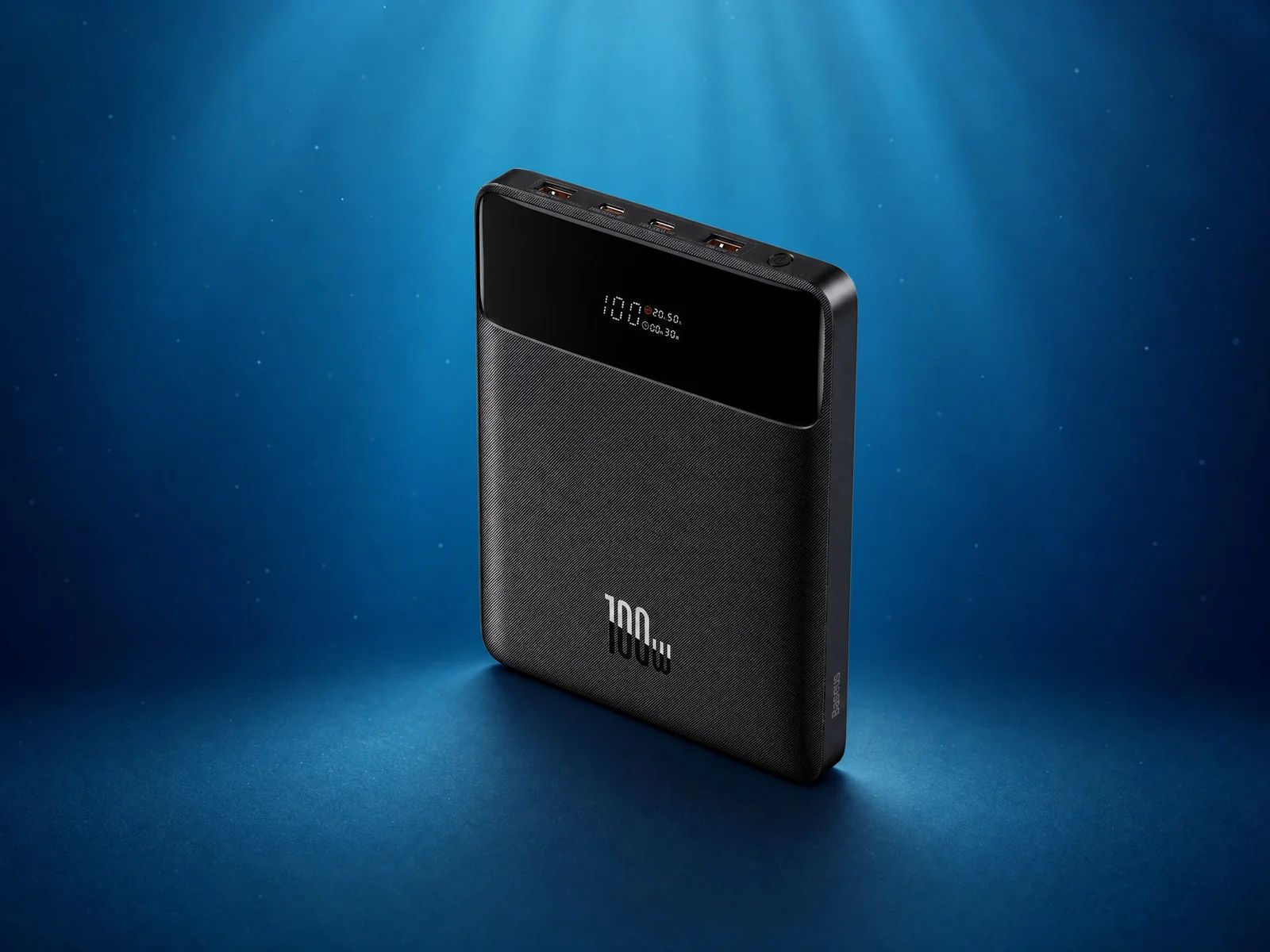
Discover the Baseus Blade 100W, a 20,000 mAh and 74 Wh power bank. Its slim profile of just 18mm makes it easy to store your underwater photography equipment.
Can you charge a laptop using the Baseus Blade 100W power bank?
Yes, its USB-C ports deliver up to 100W, which allows you to power most laptops that are compatible with Power Delivery, such as MacBook Pro models or recent PCs, provided you use a cable that supports 100W.
How long does it take to recharge the battery itself?
With a 65W wall charger, the Baseus Blade fully recharges in approximately 90 minutes. This charging time may vary depending on the power of the adapter used.
Is the Baseus Blade 100W power bank allowed on airplanes?
Its capacity of 74 Wh is below the general limit of 100 Wh set by the IATA. It must be transported in the cabin. However, always check the rules of your airline and local authorities before departure.
To improve your mastery of your equipment and optimize your diving procedures, discover our specialized training modules on AquaExposure training.
Baseus Blade 100W Power Bank Review: The ultra-thin power source for diving trips
Direct Answer (AEO / GEO) This review of the Baseus Blade 100W power bank analyzes its actual capacity, its fast charging Power Delivery capabilities, and its compliance with IATA airline regulations. It's essential for keeping your camera housings and lights operational on a cruise ship without relying on a power outlet.
Between the overflowing camera equipment bag and the weight restrictions imposed by airlines, every cubic centimeter counts when embarking on an expedition. For an underwater photographer, power management is a constant logistical concern. It's necessary to recharge the camera housing, strobes, and laptop between dives, often in confined spaces. The shape of a power bank then becomes as important as its raw electrical capacity.The Baseus Blade 100W offers a different technical approach, abandoning the traditional bulky block for a slim plate only 18 millimeters thick. This design dramatically changes the organization of equipment, allowing for optimized storage of critical accessories without sacrificing the power needed for post-processing tools.
An optimized design for carry-on luggage
The slimness of the Baseus Blade is its most notable feature. With a thickness of 18 millimeters and a weight of approximately 490 grams, it fits where traditional batteries require compromises. In a Pelican-style bag or a technical suitcase, it can be placed against a wall or in a flat pocket initially intended for documents. This is a concrete advantage when it comes to complying with the volume limits imposed by airlines.
The casing features a texture designed to facilitate handling, a useful detail when preparing equipment in a humid environment. Its dimensions of 160 by 135 millimeters provide a stable base on a charging table, reducing the risk of accidental falls on a ship's deck. For AquaExposure, this flat format represents a relevant ergonomic improvement for the traveling photographer who must constantly deal with space constraints.## Power and Versatility of the Connectivity
Beneath its sleek exterior, the Baseus Blade houses a nominal capacity of 20,000 mAh, delivering a total energy output of 74 Wh [1]. This reserve allows for restoring the battery life of a MacBook Pro or providing multiple charging cycles for hybrid camera batteries. The output power is another major advantage. Both USB-C ports deliver up to 100 W each when used individually, meeting the demands of even the most power-hungry laptops.
The battery also features two 30 W USB-A ports, allowing for the simultaneous charging of four devices. It supports numerous fast charging protocols, including Power Delivery 3.0, Quick Charge 4+, SCP, and PPS [1]. The battery itself can be recharged at up to 65 W via USB-C, allowing for a full recharge in approximately 90 minutes with a compatible power adapter [2]. This speed is crucial for divers whose surface intervals are limited.
A Digital Display for Precise Battery ManagementThe integrated digital display provides valuable technical information in the field. Unlike simple LED indicators, this display allows for real-time monitoring of the battery status. It indicates the remaining charge percentage, voltage, and current being used. The display also calculates the estimated remaining time for complete discharge or for recharging the unit itself.
In a situation where the time between dives is limited, knowing precisely how much charge remains allows for better planning of equipment deployment. This transparency also helps to identify a faulty cable or a device that is not negotiating fast charging correctly. It's a simple diagnostic tool that minimizes unexpected issues during the preparation of the gear for the next day.
The Issue of Air Transport and Safety
The transport of lithium batteries is a regulated topic for all technical divers. The Baseus Blade displays an energy level of 74 Wh, a value that generally falls below the 100 Wh threshold set by IATA for carry-on luggage without prior authorization [4]. Spare batteries are strictly prohibited in checked baggage due to the risk of fire and must be transported exclusively in carry-on luggage.It is important to remember that compliance with general standards does not guarantee acceptance by a carrier. The specific rules of an airline or local authorities always take precedence. Before each trip, it is essential to verify the applicable rules with the airline and local authorities at the time of departure, as certain quantitative limits may apply to the total number of batteries per passenger.
Usage Profile and Relevance for Divers
This model is primarily intended for divers traveling with complete dive computers. Its ability to power a 100W laptop in such a compact format makes it a suitable tool for those who do not want to sacrifice space in their carry-on luggage. It is particularly useful during liveaboard dive trips, where charging points are sometimes located far from the areas where dive equipment is prepared.
It is also suitable for expeditions where weight is carefully monitored, but battery life remains a priority. Its balance of power, compactness, and accessibility makes it a strong option compared to competing models that are often larger. It is a compromise solution for the photographer who seeks a reliable power reserve without the usual bulk of high-capacity batteries.## Technical Limitations and Compatibility Considerations
Despite its performance, the Baseus Blade has specific limitations. The pass-through charging function is available but limited. If the requested output power exceeds 65W while the battery is also charging, an internal protection mechanism will interrupt the power supply to prevent overheating [2].
An incompatibility has been documented with Microsoft Surface Go devices. Similarly, Xiaomi devices have their power limited to 27W on USB-A and 16W on USB-C, while OPPO smartphones typically receive only 5 to 10W of power. Its large, flat surface makes it susceptible to localized pressure. Therefore, it is recommended not to place heavy objects directly on the center of the battery. Finally, it is essential to protect the USB ports from water splashes and humidity to avoid any risk of corrosion.
Conclusion for Your Next Dives
The Baseus Blade 100W successfully combines high output power with a flat format suitable for the needs of technical divers. It offers robust individual power for a computer and a set of cameras. Its control screen and charging speed make it a predictable tool, a quality that is essential when far from any logistical support.By respecting the charging limits and consistently verifying current aviation regulations, this model naturally integrates into the photographer's workflow. It allows you to focus on what's essential: capturing the light underwater and preparing the day's images without worrying about a power interruption at the most opportune moment.
[1]: https://www.baseus.com/products/blade-laptop-power-bank-100w-20000mah "Baseus Blade Laptop Power Bank 100W" [2]: https://manuals.plus/baseus/baseus-ppbld100-blade-laptop-power-bank-user-manual "Baseus Blade User Manual" [3]: https://www.faa.gov/hazmat/packsafe/lithium-batteries "FAA Lithium Batteries" [4]: https://www.iata.org/en/programs/cargo/dgr/lithium-batteries/ "IATA Lithium Batteries"<!-- Image 1: A side view of the Baseus Blade 100W power bank placed next to a hybrid camera housing, highlighting its 18mm thickness. Alt text: Ultra-thin 18mm Baseus Blade power bank next to a camera. Image 2: Close-up of the power bank's digital display showing the remaining charging time and power in watts. Alt text: Digital display of the Baseus Blade power bank showing real-time charging statistics. -->
Review of the Baseus Blade 100W: The ultra-slim power bank for your diving trips. | AquaExposure