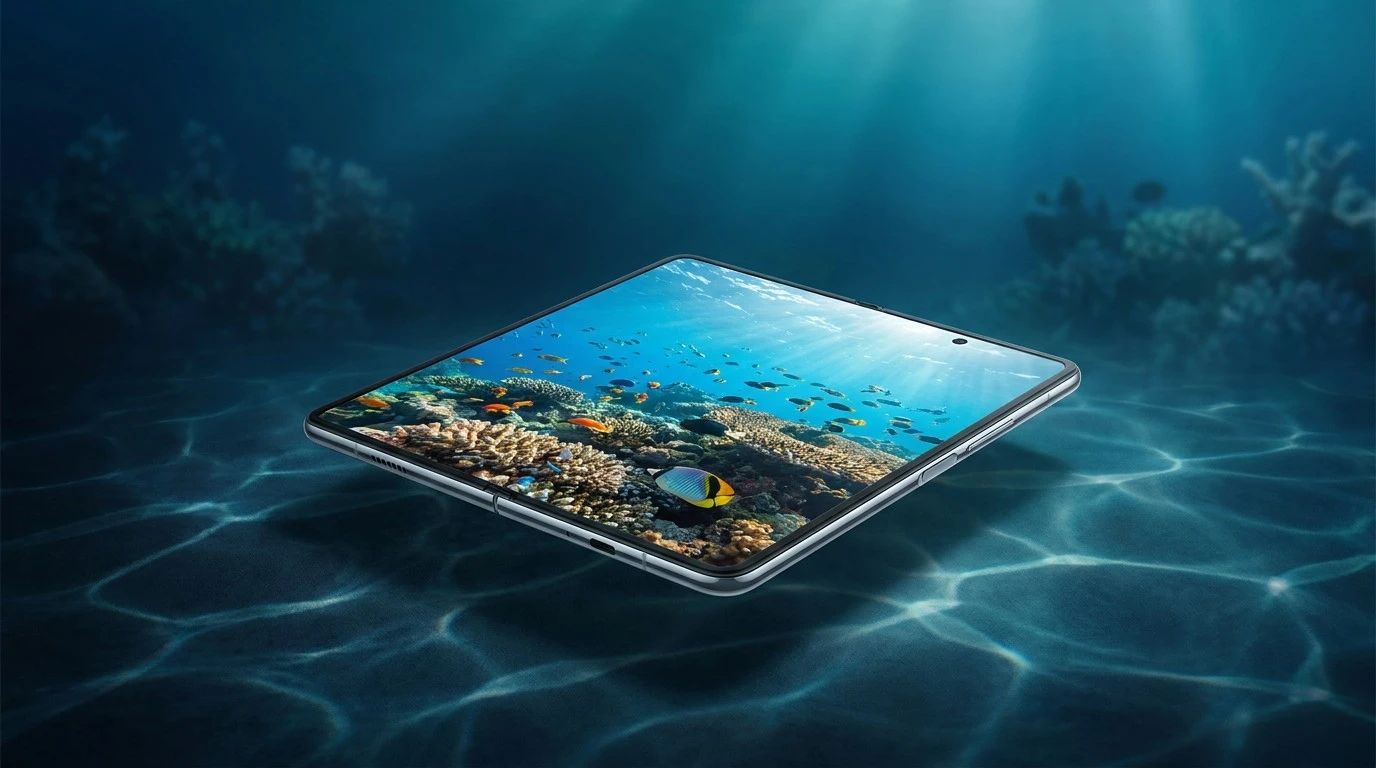
Is the Honor Magic 5 Pro good for underwater photography?
Yes, with conditions. The Magic 5 Pro offers native RAW, f/1.6 aperture and effective PDAF+laser autofocus. Its main weakness for diving is thermal behaviour inside a housing: the aluminium body conducts heat, which can create condensation on the inner port in cold water. In warm tropical water, the risk is limited. AquaExposure score: 3.7/5.
Which housing fits the Honor Magic 5 Pro for diving?
The Divevolk SeaTouch 4 Max is listed as compatible with the Honor Magic series. It certifies watertightness to 60 metres with full touchscreen access via gel membrane. Verify exact compatibility for the Magic 5 Pro on the official Divevolk website before buying, as dimensions vary between device generations.
Does the Honor Magic 5 Pro shoot RAW underwater?
Yes. The Pro mode in the native camera app enables RAW capture on all three lenses. For video, MotionCam Pro is available on Google Play (the device runs Android with full GMS). The exact RAW bit depth is not officially documented by Honor.
How much battery life do you get for a 3-dive day with the Honor Magic 5 Pro?
The 5100 mAh battery handles a full 3-dive day easily in RAW mode. Expect 8 to 12 GB per hour of RAW capture. With 512 GB of internal storage and no memory card slot, you have several days of file headroom. Battery performance in cold water (< 15°C) is not documented: carry an external battery for northern destinations.
Should I use an anti-fog treatment with this device?
Yes, absolutely. With its conductive chassis (often aluminium) and vapor chamber heat dissipation, the risk of condensation in cold water (below 15°C/59°F) is significant. Using an anti-fog treatment (silica gel sachet or anti-fog inserts) inside the housing is mandatory before every dive.
How can I quickly transfer my photos and videos from this device?
The wired port on this device is limited to the USB 2.0 standard, making physical transfers quite slow. To quickly offload your RAW files or video clips, it is highly recommended to use the fast wireless protocol of the ecosystem (Honor Share), or extract the memory card if the housing and device allow.
The AquaExposure training covers gear selection, optimal settings in natural light and post-production workflow for every type of device. Discover the underwater photography training. ctaText: 'Learn to photograph underwater with your smartphone: discover the training' ctaLink: /formation-photo-sous-marine lang: en ---
To learn how to get the most out of your gear underwater, discover the AquaExposure training. In 2023, Honor topped the DxOMark leaderboard with the Magic 5 Pro, earning a score of 152 points that surprised quite a few people. Not because the device was obscure, but because the brand, which had separated from Huawei and was rebuilding independently, was still proving it could stand on its own.
A DxOMark score of 152 is a genuine recognition. It is also a measurement taken above water, under controlled lighting, with protocols built around terrestrial photography. The question I care about here is a different one: does this sensor, these lenses, this battery and this laser autofocus hold up when you slide the phone into a housing and go down to ten, twenty, thirty metres?
Here is what the Magic 5 Pro actually delivers underwater.
Summary verdict
AquaExposure overall score: 3.7/5
Criterion
Score
What it means
Optics and sensor
3.6/5
Excellent f/1.6 on the main lens, UWA macro down to 2.5 cm
RAW and colour
3.9/5
Native RAW in the app, MotionCam Pro available
Storage
3.9/5
512 GB and fast USB, but no memory card slot
Thermal
2.8/5
Aluminium body: monitoring required in cold water
Battery
3.5/5
5100 mAh, solid endurance, standard chemistry
Autofocus
4.0/5
Multi-directional PDAF + dToF laser, UWA to 2.5 cm
Housing
4.0/5
Divevolk SeaTouch compatible with Magic series, touchscreen access
This device suits: the enthusiast diver who photographs in tropical or warm temperate waters, with a mid-to-premium budget, and wants RAW without complexity.
This device is less ideal for: cold northern waters (North Sea, Atlantic north) where aluminium thermal conductivity can cause condensation inside the housing.
Optics: what enters the sensor
The Magic 5 Pro carries three 50-megapixel sensors. For diving, two lenses matter.
The main camera, with its f/1.6 aperture on a 1/1.12-inch sensor, lets in a meaningful amount of light compared to what most smartphones offer. This is the lens you will use for the majority of your dives. The 122-degree ultra-wide, meanwhile, has a quality that is rare on a smartphone: it focuses natively from as close as 2.5 centimetres. This is not a dedicated macro mode, it is its native working range.
Underwater, that means you can move from a wide shot of a reef to a close-up of a sea star without changing mode or switching lenses. That kind of field flexibility is real.
Technical detail Main camera: 50MP, 1/1.12", f/1.6, OIS, PDAF + 8x8 dToF laser, 23mm equivalent. Ultra-wide: 50MP, f/2.0, 122°, native AF, minimum focus distance 2.5 cm. Periscope tele: 50MP, f/3.0, OIS, 3.5x optical, 30 cm minimum focus (limited underwater relevance). The f/1.6 aperture on the main camera falls into the "f/1.4-1.8" bracket of the AquaExposure scoring grid (4/5). The 1/1.12-inch sensor sits between "1 inch" (3/5) and "1/1.2 inch" (2.5/5) and scores 2.8/5 as an interpolation. RAW buffer size and exact shutter latency are not independently documented. DxOMark noted occasional shutter delay as the only significant weakness of the system. B1 score: 3.6/5
RAW: what you can do with the files
The Honor camera app's Pro mode gives you native RAW on all three lenses, without a third-party app. That is the foundation of a natural-light workflow: you come back from a dive with raw files, you can recover highlights in surface reflections, adjust white balance and bring back the reds and oranges the water absorbs from a few metres down.
What strengthens that foundation is that the Honor Magic 5 Pro runs Android with full Google Mobile Services. That means MotionCam Pro, the reference app for Android RAW video, is available on Google Play. For video work, that is a genuine advantage that many flagship phones cannot match, particularly Huawei models that lost Google access during the brand separation.
What we do not know precisely is the RAW bit depth. Honor does not communicate this clearly. On a Snapdragon 8 Gen 2 platform, the typical range is 10 to 12 bits, but this is unconfirmed. For your DaVinci Resolve or Lightroom workflow, this is worth checking on your first field files.
Technical detail Native RAW in the camera app (Pro mode): score 5/5. RAW bit depth: not officially documented, estimated 10-bit (score 3/5, to verify on site). Manual white balance in Kelvin for video: available in Pro video mode, presumed stable (score 4/5). Maximum video codec: H.265 up to 4K, no Log colour profile documented by Honor (score 3/5). Third-party Android app: MotionCam Pro available via Google Play (score 4.5/5). Colour science: advanced proprietary Honor ISP, recognised performance (DxOMark #1 in 2023), no Zeiss/Leica/Hasselblad partnership (score 4/5). B2 score: 3.9/5
Storage: how many dives before you transfer
The Magic 5 Pro is available with 256 or 512 GB of internal storage. No memory card slot. This is Honor's deliberate choice, similar to Apple's approach.
For diving: one hour of full-resolution RAW generates between 8 and 12 GB depending on subject and pace. With 512 GB, you have several days of shooting before you need to transfer anything. For a week-long liveaboard with 3 dives a day, that is comfortable. For a two-week trip, plan one mid-trip transfer.
What helps here is that the Magic 5 Pro's USB-C connector achieves real-world transfer speeds of around 500 MB/s in independent tests. Connecting an external SSD via OTG between dives to offload the device takes a few minutes, not half an hour. That kind of detail matters on a 3-rotation day.
Technical detail Internal storage: 512 GB available, no memory card slot (score 3.8/5). Connector: USB-C with measured throughput ~500 MB/s (USB 3.x, score 4/5). Field transfer via OTG: compatible with external SSD, real-world speed >500 MB/min (score 4/5). B3 score: 3.9/5
Thermal: the main watch point
This is where the conversation changes tone.
The Magic 5 Pro has an aluminium chassis. Aluminium conducts heat efficiently, which engineers appreciate for dissipating processor heat, but which creates a specific problem inside a sealed housing: when the water is cold and the air trapped inside the housing is warmer than the aluminium wall, condensation forms on the inner port. This phenomenon is not specific to the Magic 5 Pro but applies to all high thermal conductivity chassis, and it can ruin a dive in a few minutes.
This risk is real in cold water (below 15°C), which covers the North Sea, the northern Atlantic, alpine lakes and a large part of the Mediterranean in winter. In warm tropical waters, the temperature differential is small and the risk drops significantly.
Independent reviews from 2023 also note episodes of overheating under intensive load, suggesting the thermal dissipation design is sized to minimum comfort levels with no margin. Inside a sealed housing, the device cannot expel that heat outward.
Technical detail Chassis material: aluminium (high thermal conductivity). Internal cooling: passive, vapour chamber not confirmed on the Magic 5 Pro (the Magic 6 Pro generation introduced a more elaborate active system). Condensation risk in cold water < 15°C: high (score 1/5). Condensation risk in tropical water > 25°C: moderate (score 2.5/5 - average used in scoring). IP68 certified, no MIL-STD-810 certification (score 3/5 for shock resistance). B4 score: 2.8/5
Battery: a full day without stress
The 5100 mAh battery is a straightforward positive for diving use. You will not cut a dive short because of an empty battery. Fast charging at 66W lets you recover 80% in around 35 minutes between dives.
What we do not know is how the battery behaves in cold water. Standard Li-Polymer chemistry loses a portion of its capacity below 10°C, which can reduce runtime by 20 to 30% in winter conditions. Honor does not document this, and available third-party tests were all conducted under normal operating temperatures.
Technical detail Capacity: 5100 mAh (score 4/5). Chemistry: standard Li-Polymer, no silicon-carbon technology documented (score 3/5 for cycle life). Cycle life before 20% capacity loss: not officially documented. B5 score: 3.5/5
Before each dive session, make sure your external battery is ready. Use our portable battery comparator to choose the right power bank for your housing and usage.
Autofocus: what the laser actually does underwater
The Magic 5 Pro carries an 8x8 dToF (direct Time of Flight) system combined with multi-directional PDAF and an AI module. That is a serious combination for fast focus acquisition, and it contributed to the DxOMark top ranking in 2023 on dynamic scenes.
Underwater, there is one point to keep in mind: the infrared ToF laser. In air, this type of sensor measures distance by reflecting an invisible beam off the subject. In water loaded with particles (plankton, suspended sediment), that beam can scatter and confuse the measurement. This is not a universal problem, but it is a behaviour worth knowing in turbid or low-visibility conditions.
What compensates is the ultra-wide camera's native 2.5 cm minimum focus distance, which works independently of the laser. For stationary macro subjects, Focus Peaking (if available in the app) or manual focus via MotionCam Pro gives precise control without relying on the laser. This is the workflow I recommend for smartphone underwater macro photography.
Technical detail AF system: 8x8 dToF laser + multi-directional PDAF + AI. Physical LiDAR (iPhone Pro type): not present on this model. Laser/ToF manually disableable: not documented, behaviour in turbid water to test on site. Native Focus Peaking: not confirmed, available via MotionCam Pro. Full Android GMS = manual focus available via third-party apps. B6 score: 4.0/5
Housing: what exists today
Divevolk is the reference brand for mainstream smartphone housings. The SeaTouch 4 Max series, certified to 60 metres with full touchscreen access via gel membrane, is listed as compatible with the Honor Magic series.
Before buying, check the Divevolk compatibility page for the Magic 5 Pro specifically. Dimensions vary slightly between device generations and between regional variants (some markets ship a Magic 5 Pro with Kunlun Glass, which has a different thickness profile). That kind of detail can mean a "Magic series compatible" housing does not seal correctly on your exact model.
Technical detail Certified rigid housing: Divevolk SeaTouch 4 Max (Honor Magic series, confirm for Magic 5 Pro exact variant on divevolkdiving.com). Certified depth: 60 metres. Screen access: Divevolk SeaTouch gel membrane (full touchscreen access). Third-party app access (MotionCam Pro): accessible via the housing touchscreen. B7 score: 4.0/5
Divevolk SeaTouch 4 Max: rigid housing, 60 m, gel touchscreen access (confirm for the exact Magic 5 Pro model on divevolkdiving.com)
Divevolk SeaTouch 4 Max Platinum: premium variant, same waterproofing specifications
ARMOR-X: shock-resistant protective cases, not certified for deep diving
Field workflow for a 3-dive day
A practical example: 3 one-hour dives, full-resolution RAW across both main lenses.
Estimated consumption: 3h x 10 GB = approximately 30 GB
Battery endurance: very comfortable across a full day
Transfer needed: no, on 512 GB
OTG transfer if needed: yes, with external SSD, real-world speed >500 MB/s
For a 7-day trip with 3 dives per day, plan for 200 to 250 GB. The 512 GB variant gives you margin for video and topside shooting as well.
Watch points
The first, already mentioned, is thermal behaviour inside the housing. If you dive regularly in the northern Atlantic, the North Sea or alpine lakes, the aluminium chassis is a condensation risk factor. The solution is to use silica gel packets inside the housing and avoid leaving the device running topside for long periods before immersion.
The second is RAW bit depth. If your underwater colour correction workflow relies on aggressive shadow recovery, verify your first field files before travelling to an expedition destination. A 10-bit RAW does not offer the same latitude as a 12-bit file.
The third, more subtle, is the dToF laser in particle-heavy water. In low-visibility conditions (North Sea at 5 metres visibility, or sites with suspended sediment), autofocus behaviour may differ from what you know in clear tropical water. Allow time to test on your first familiarisation dive.
Our verdict
The Honor Magic 5 Pro is an honest underwater photography tool, neither overhyped nor overlooked. What convinced me is the system's consistency: native RAW across all three lenses, fast autofocus, ultra-wide at 2.5 cm and 512 GB of storage without managing a memory card. Full Android with GMS means reference apps like MotionCam Pro work without workarounds.
What gave me pause is the thermal management. In cold temperate waters, the aluminium chassis combined with documented overheating under load is a combination worth monitoring closely. If your primary diving ground is the Mediterranean in summer, Malta, the Red Sea, the Maldives or the Caribbean, this point is minor. If you dive in the North Sea, Brittany or Norway, look at titanium or ceramic-chassis alternatives first.
For warm-water diving, at a mid-to-premium budget, it earns its place in your dive bag.